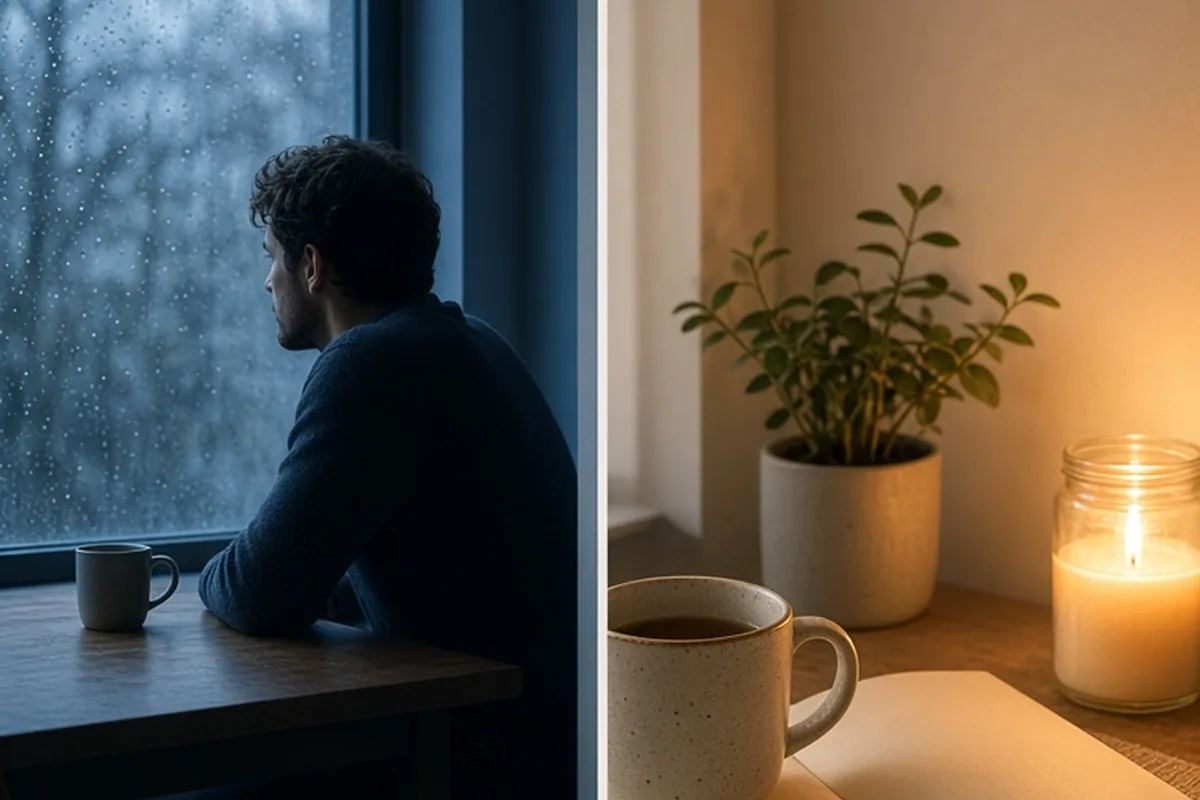
Being emotionally unavailable means having difficulty accessing, expressing, or responding to feelings — your own or someone else's. It can look like avoiding deep conversations, keeping relationships surface-level, pulling away when things get close, or struggling to offer comfort. It is usually a protective pattern rather than a lack of caring, and it ranges from mild and situational to a long-standing way of relating.
Maybe you have felt it from across the table — someone warm and fun who somehow never lets you any closer. Or maybe a partner said the words to you, and you are trying to figure out whether they fit. Either way, the concept is worth getting right.
What Emotional Unavailability Actually Means
Emotional unavailability is not a diagnosis or a character flaw. It describes a pattern in which someone has limited access to their own feelings, limited willingness to share them, or limited capacity to respond to someone else's. A person can be funny, generous, reliable, and still be emotionally unavailable, because the issue is not whether they are a good person — it is whether they can let another person past the surface. That distinction matters, because many people spend months arguing that their partner cares about them, when the real question is whether their partner can show it in the way a relationship needs.
It also exists on a spectrum. For some people it is situational: a recent breakup, a season of grief, or burnout at work can temporarily close someone off. For others it is a long-standing default — the person who is warm and easy with friends but goes quiet the moment a partner asks where things are going. Occasional guardedness is normal and even healthy early in dating. The pattern becomes a problem when the door never opens wider, no matter how much time or trust has built up.
Common Signs in a Partner and in Yourself
In a partner, unavailability usually shows up as consistency in the wrong places. They are charming on dates and vague afterward. They deflect emotional questions with humor or a quick subject change. They may be physically affectionate yet visibly uncomfortable when you cry or ask for reassurance. Plans stay loose, labels get dodged, and conversations about the future get answered with 'let's just see where this goes' — months into the relationship.
In yourself, the signs are quieter. You might notice you answer 'I'm fine' on autopilot, feel irritated or trapped when someone wants comfort, or lose interest right when a relationship starts to feel real. Some common markers include:
One caution: these are clues, not verdicts. A hard week, a health issue, or simple shyness can look identical from the outside. What separates unavailability from a rough patch is repetition — the same wall, in the same places, over months rather than days.
- Changing the subject or joking when a conversation turns emotional
- Feeling relief, not sadness, when plans with a partner get canceled
- Keeping relationships in a casual lane long past the point of real intimacy
- Struggling to name what you feel beyond 'good,' 'fine,' or 'stressed'
- Pulling back after moments of closeness, almost like a reflex
Why People Become Emotionally Unavailable
Most emotional unavailability is learned protection. Someone who grew up in a home where feelings were mocked, ignored, or punished learns that showing emotion costs more than it pays. Someone who was betrayed after opening up learns the same lesson in a single season. Over time the protection stops feeling like a choice and starts feeling like personality — 'I'm just not a feelings person' — when it is really a strategy that once kept them safe.
Other forces can close someone off too: depression, chronic stress, unresolved grief, or cultural messages that equate masculinity with stoicism. Many men, for instance, were never taught a vocabulary for anything between anger and fine, so they are not refusing to share feelings — they genuinely cannot locate them. None of this excuses hurtful behavior, but it changes the response. A person protecting old wounds may respond to honesty and patience; a person who simply enjoys keeping you at arm's length needs a boundary. Telling the difference takes direct conversation, not guesswork.
How It Plays Out in a Relationship
The classic pattern is pursuit and withdrawal. One partner asks for closeness — more time, deeper talk, a clearer commitment — and the other experiences that ask as pressure and pulls back. The pullback triggers more pursuit, which triggers more withdrawal, until both people feel misunderstood: one feels starved, the other feels hounded. Neither person is necessarily wrong about what they feel; they are stuck in a loop neither one started on purpose.
The quieter cost lands on the emotionally available partner. When your bids for connection — a question about their day, a request for comfort, a suggestion about the future — keep hitting a wall, you start editing yourself. You bring less, ask for less, and call the shrinking 'keeping the peace.' This is also what makes unavailability so confusing: the closed-off partner may genuinely love you and still be unable to meet you. Affection without access produces a specific kind of loneliness — technically not single, functionally on your own.
If You Are Dating Someone Emotionally Unavailable
Start by describing behavior instead of diagnosing their character. 'You're emotionally unavailable' invites a defensive argument about labels. 'When I told you about my rough week and the conversation moved to the game, I felt alone' invites a response about something real. Then ask a direct question: do you want this to get deeper? Are you open to talking about us? You are not asking for a performance — you are asking whether the door you keep knocking on actually opens.
After that conversation, watch willingness rather than speed. Someone who says 'this is hard for me, but I want to try' and then awkwardly, imperfectly tries is a different situation than someone who agrees in the moment and changes nothing. Give it a defined window — a few months, not a few years — and keep your own friendships and support intact so your judgment stays clear. The trade-off to accept: you can be patient with a person, but you cannot do the opening for them. If you find yourself drafting their emotional life on their behalf, that is your signal to reassess.
If You Recognize the Pattern in Yourself
Noticing the wall is already the hardest part, because unavailability usually feels like normalcy from the inside. The next step is smaller than people expect: practice naming one feeling a day, out loud or in writing, without fixing it. When your partner asks how you are, answer honestly once — 'I'm actually anxious about work' instead of 'fine.' These feel trivial. They are not. You are rebuilding a muscle that atrophied, and small reps are how it comes back.
It also helps to tell your partner what you are doing, in plain terms: 'I know I shut down when things get emotional, and I'm working on it — if I go quiet, it is not about you.' That one sentence can defuse months of misreading. If the pattern runs deep — rooted in childhood, trauma, or a loss you never processed — a licensed therapist is a practical tool, not a last resort. Expect the work to feel worse before it feels natural; discomfort is often just the sensation of the door finally moving.
When Patience Makes Sense and When to Step Back
Patience is reasonable when three things are present: the person acknowledges the pattern without being forced, they take visible steps on their own initiative, and the overall trajectory bends toward more openness even if the pace is slow. Progress here is rarely smooth — expect two steps forward and a retreat after a vulnerable moment. What you are looking for is direction, not speed.
Stepping back makes sense when the pattern is defended rather than addressed: they deny there is a problem, blame you for wanting 'too much,' or offer just enough warmth to keep you waiting without ever changing. Staying in that arrangement does not make you loyal; it makes you slowly invisible to yourself. Pausing or ending a relationship with someone you care about is not a failure — it is information about fit. You can wish someone well and still decline to build a life on a door that stays shut.
Illustrative Scenarios
Three Months of Great Dates and a Wall Between Them
Maya had been seeing Daniel for three months. In person he was attentive and funny; between dates he answered texts hours later with a thumbs-up, and every attempt at a 'what are we' talk got a joke and a subject change. Her first read was that she was being needy, so she backed off and waited. Nothing changed. Eventually she said, 'I like you, and I notice we never talk about anything real. I want to know if you want that.' Daniel admitted he 'wasn't great at the feelings stuff' and wasn't sure he wanted more. Maya wished him well and stopped investing. It stung — and it cost her one honest week instead of another vague year.
Key point: Consistency between dates is data. When someone shows you the same wall three times, believe the pattern, not the potential.
When 'I Feel Alone With You' Landed
Andre prided himself on being low-maintenance: no drama, no fights, steady paycheck. So when his girlfriend told him she felt alone in the relationship, his first interpretation was that she was criticizing a good man. He listed everything he did for her. She went quiet, which felt like proof she was impossible to please. A week later he asked what 'alone' meant to her. She said he changed the subject every time she cried, and she had stopped trying. Andre realized he did the same thing with himself — he had no idea what he felt most days, so her feelings registered as noise. He started small: one honest answer a day, then counseling.
Key point: Unavailability often hides behind being 'easygoing.' If a partner says they feel alone, the useful move is asking what they mean — not defending your record.
Frequently asked questions
Is emotional unavailability the same as not being interested?
No. Someone can genuinely like you and still be unable to open up, which is exactly what makes it confusing. Interest shows up as effort and enthusiasm; availability shows up as access to their inner life. A lasting relationship needs both, so pay attention to which one is missing.
Can an emotionally unavailable person change?
Yes, but the engine has to be their own recognition, not your persuasion. People who see the pattern, understand its cost, and choose to work on it — often with support like counseling — can become much more open over time. Change performed only to keep you from leaving tends to fade once the pressure does.
Is it the same as being introverted or needing space?
No. Introversion is about where your energy comes from; unavailability is about whether anyone can reach your feelings. Plenty of quiet, space-loving people are deeply emotionally open with a partner, and plenty of social, high-energy people are completely walled off.
How long should I wait for someone to open up?
There is no universal timeline, but there is a useful test: look for direction rather than speed. If they acknowledge the wall and are visibly working on it, patience is reasonable. If months pass with denial or blame, the timeline has already answered you.
Your next step
Pick one concrete move this week. If you are dating someone closed off, ask the direct question: 'Do you want this to go deeper, and are you willing to work on the feelings part?' If the pattern is yours, give one honest answer today instead of 'fine.' Either way, you stop guessing and start gathering real information.