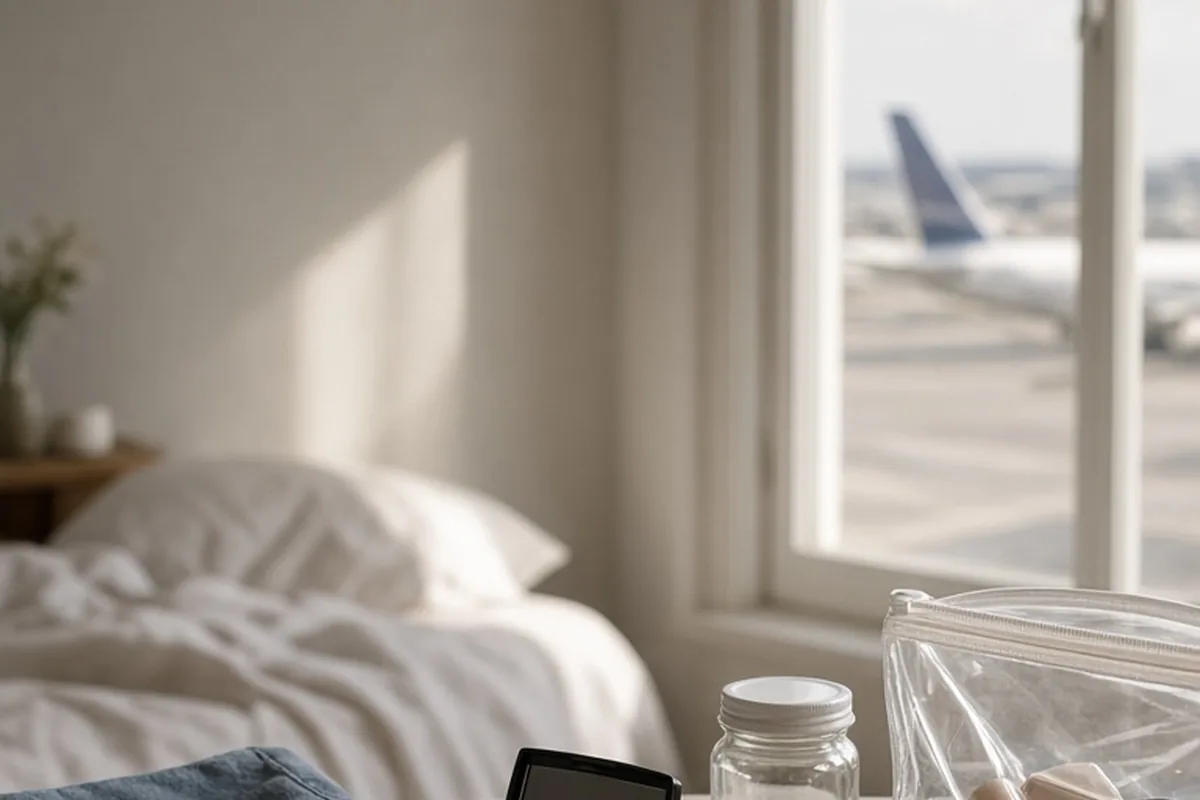
You can bring virtually any makeup on an airplane, but container format dictates where it must go. Solid and pressed powder products can travel in unlimited amounts in carry-on bags. Liquid, gel, cream, and aerosol cosmetics in carry-ons must fit in containers of 3.4 ounces (100 milliliters) or smaller and pack into a single quart-sized clear bag. Larger quantities must travel in checked luggage.
Planning your beauty routine for air travel requires knowing how aviation security agencies categorize different cosmetics. Transportation Security Administration (TSA) screeners and international airport authorities do not evaluate makeup based on brand, finish, or color, but rather on its physical texture, volume, and container safety.
The 3-1-1 Liquids Rule for Creams, Gels, and Glosses
Aviation security classifies any cosmetic item that can be poured, pumped, squeezed, or spread as a liquid, gel, or aerosol. This broad definition surprises many travelers because it includes products that do not look like water. Liquid foundation, tinted moisturizers, BB creams, concealers, liquid highlighters, lip glosses, liquid lipsticks, tube mascaras, gel eyeliners, and makeup setting mists all fall strictly under the TSA 3-1-1 liquids rule when packed in your carry-on luggage. Each individual cosmetic container must hold no more than 3.4 fluid ounces (100 milliliters), and every liquid product you intend to bring into the aircraft cabin must fit inside one transparent, quart-sized, resealable plastic bag.
Security personnel assess compliance based on the volume printed on the packaging rather than the remaining contents. For example, carrying a half-empty 5-ounce glass pump bottle of foundation will lead to confiscation at the screening gate, even if only one ounce of liquid remains inside. To keep your favorite formulas without sacrificing valuable luggage space, decant products into travel-sized pump bottles, dropper vials, or contact lens cases. Contact lens cases provide leak-resistant compartments that comfortably hold three to five days worth of liquid foundation, liquid blush, or heavy cream contour, allowing you to carry multiple essentials without filling your quart-sized bag.
Powder Guidelines and Security Screening for Dry Makeup
Pressed and loose dry powders present a much easier packing experience for carry-on travelers because they do not take up space in your clear liquids bag. Pressed powder compacts, eye shadow palettes, contour pans, and powdered blushes can be packed in your cabin baggage in any reasonable quantity. However, loose powders—such as translucent setting powders, baking powders, and loose mineral foundations—are subject to specific volume thresholds on domestic US flights and international flights bound for the United States. Under TSA guidelines, containers of loose powder larger than 12 ounces (roughly 350 milliliters, or approximately the size of a standard beverage can) must be placed in a separate bin for dedicated X-ray screening and may undergo manual inspection.
While dry powders easily pass through security checkpoints, they remain vulnerable to transit impacts and cabin pressure changes. Overhead bin shifting and turbulence can shatter delicate pressed powders into fine dust. You can shield compacts by placing a clean cotton round or cosmetic sponge directly over the powder cake inside the compact before snapping the lid shut, which absorbs physical shocks. For loose powders, cover the interior sifter holes with a strip of painter's tape or low-tack masking tape to prevent the powder from overflowing into the cap while your suitcase is in transit.
Solid Cosmetics and Strategic Stick Formulations
One of the most effective strategies for maximizing carry-on space is swapping liquid cosmetics for solid stick formulations. Standard bullet lipsticks, solid lip balms, stick foundations, twist-up cream concealers, stick blushes, solid contour bars, and solid perfumes do not count toward your liquid allowance under airport security protocols. Because these products hold their solid shape at room temperature and cannot flow or be sprayed, security screeners treat them as dry goods that can remain anywhere inside your regular carry-on tote or beauty organizer.
Transitioning several daily steps from liquid to solid formulas preserves room in your quart-sized clear bag for products that have no solid equivalent, such as specialty liquid serums or runny foundation formulas. However, travelers should account for destination temperatures and storage conditions. Stick foundations and solid cream blushes can soften or sweat if exposed to elevated temperatures, such as luggage left in direct sunlight or the trunk of a car in hot climates. Keeping these solid sticks inside your main cabin bag ensures they stay in an air-conditioned environment throughout the journey.
Beauty Tools, Tweezers, Scissors, and Lash Curlers
Applying makeup on the go requires dedicated tools, and most standard beauty instruments are fully approved for carry-on luggage. Soft makeup brushes, beauty sponges, silicone applicators, and traditional eyelash curlers face no restrictions in cabin baggage. Eyebrow tweezers—whether featuring slanted, pointed, or flat tips—are also fully permitted through security checkpoints because they are classified as non-bladed grooming tools rather than sharp cutting hazards.
Scissors and sharp shaping tools require careful measurement to avoid checkpoint confiscation. The TSA allows scissors in your carry-on only if the cutting blade measures four inches or less from the pivot point. If you carry small brow-trimming scissors or lash shears, verify their blade length before packing. Some international aviation authorities enforce even stricter limits, banning all pointed scissors regardless of size. Enclosed dual-pencil sharpeners with fixed, non-removable blades are permitted, but loose razor blades, utility blades, and straight-edge dermaplaning tools must always be placed in checked luggage with their cutting edges safely wrapped.
Aerosols, Setting Sprays, and Pressurized Cans
Aerosol makeup products—such as pressurized setting sprays, thermal mineral water mists, aerosol dry shampoos, and spray-on brush sanitizers—are permitted on airplanes under specific conditions. In carry-on luggage, aerosol beauty products must adhere to the standard 3.4-ounce limit and fit entirely inside your single clear quart-sized bag alongside your other liquids. If you wish to bring full-sized aerosol cans, they must travel in checked luggage under the Federal Aviation Administration (FAA) hazardous materials exceptions for medicinal and toiletry items.
The FAA limits the total aggregate quantity of personal toiletry and medicinal aerosols in checked luggage to 70 ounces (2 liters) per passenger, with no single container exceeding 18 fluid ounces (500 milliliters). Because aerosol cans operate under pressure, atmospheric shifts and physical impacts can trigger accidental release. Every aerosol container in your checked or carry-on luggage must be equipped with a tightly fitted protective cap, a locking collar, or a recessed actuator button that prevents the nozzle from depressing when your luggage is compressed during handling.
Checked Luggage Practices for Full-Sized and Fragile Cosmetics
Packing makeup in checked baggage offers the freedom to transport full-sized foundations, large setting sprays, specialty brush cleansers, and multiple palettes without liquid volume limits. However, the aircraft cargo hold experiences rough handling, heavy vibration, and distinct air pressure shifts that can compromise fragile packaging. Glass foundation jars, liquid dropper bottles, and ceramic compacts require substantial cushioning to survive transit intact against hard suitcase frames.
Pressure differentials in the cargo hold cause trapped air inside cosmetic bottles to expand, which often forces liquid formulas through screw threads and pump mechanisms. To prevent messy leaks across your wardrobe, unscrew the cap of each liquid bottle, place a small square of plastic wrap over the opening, and screw the cap back on firmly over the barrier. Always place full-sized liquids in heavy-duty zip-top storage bags or waterproof cosmetic pouches, and position them in the center of your suitcase surrounded by soft clothing to provide natural shock absorption.
Airport Checkpoint Procedures and International Variations
Navigating security lanes efficiently depends on how you present your cosmetics to screening officers. In standard TSA screening lanes, you must remove your clear quart-sized liquids bag from your carry-on luggage and place it in a separate plastic bin on the conveyor belt. In lanes equipped with newer Computed Tomography (CT) 3D scanners, passengers are generally instructed to leave all compliant liquids and cosmetics inside their luggage. Keeping your liquids pouch in an easily accessible exterior pocket ensures you can retrieve it instantly if an officer requests manual inspection.
When traveling internationally, be aware that aviation security standards can differ from domestic TSA protocols. While the 100-milliliter container threshold is nearly universal, many airports throughout the United Kingdom, the European Union, and parts of Asia require travelers to use a standardized plastic bag provided directly at the security line rather than personal quart-sized toiletry pouches. Additionally, loose powder screening rules can vary widely at foreign transit hubs, making it wise to review the specific security guidelines of your destination airport before returning.
Illustrative Scenarios
Organizing a Complete Carry-On Beauty Kit
A traveler planning a seven-day trip needed to fit an entire beauty routine into carry-on luggage without exceeding the single quart-sized bag limit. Her initial collection contained nine full-sized liquid cosmetics, including foundation, liquid blush, setting mist, tube concealer, and liquid bronzer, which collectively exceeded the clear pouch capacity. She resolved the bottleneck by replacing her liquid foundation and cream blush with solid stick versions, swapping liquid perfume for a solid fragrance balm, and decanting her liquid concealer into a tiny cosmetic pod. This strategic adjustment reduced her liquid count to four travel-sized containers, leaving plenty of room for essential skincare while her powder palettes and brushes traveled safely in a dry organizer.
Key point: Categorizing makeup by physical consistency lets you replace bulky liquid products with solid alternatives, freeing up limited clear-bag space for formulas that cannot be modified.
Frequently asked questions
Does mascara count as a liquid or a solid when flying?
Mascara is categorized as a liquid under TSA and international aviation security rules due to its thick gel-paste texture. It must be in a container holding 3.4 ounces (100 milliliters) or less and stored inside your quart-sized liquids bag. Standard commercial mascara tubes range from 0.2 to 0.4 ounces, making them well within individual size limits.
Can I bring full-sized makeup bottles in my checked luggage?
Yes, you can pack full-sized liquid, cream, and powder makeup products in your checked luggage without adhering to the 3.4-ounce carry-on cap. Ensure each container is sealed tightly with tape or plastic wrap and stored in leak-proof bags to protect against air pressure shifts. Cushion glass bottles thoroughly within soft layers of clothing to prevent breakage.
Are makeup pencil sharpeners allowed in carry-on bags?
Standard cosmetic pencil sharpeners with enclosed, non-removable blades are permitted in carry-on bags by airport security. However, loose utility blades or unshielded razor accessories must always be packed in checked luggage. Keep your sharpener stored alongside your eye and lip pencils in your dry makeup bag for straightforward screening.
Can I apply my makeup during a flight?
You are welcome to apply solid lipsticks, balms, compact powders, and touch-up concealers at your seat during a flight. However, avoid using strong-smelling nail polishes, aerosol sprays, or highly fragranced products in the enclosed aircraft cabin out of consideration for nearby passengers. Keep your in-flight touch-up items in a small pouch inside your personal item for easy access.
Your next step
Before packing, lay out your cosmetics and separate them into liquids, solids, and dry powders to confirm everything fits within the appropriate size limits.