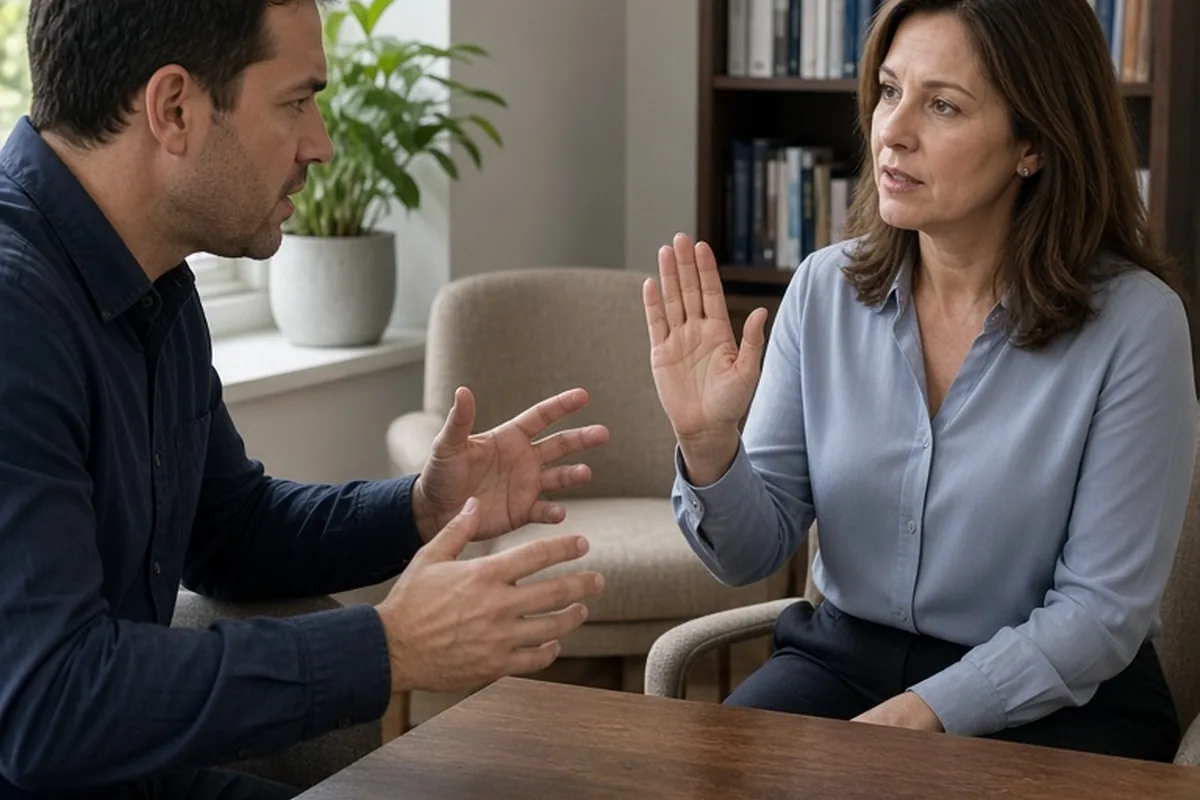
In marriage counseling after infidelity, expect an initial phase focused on de-escalating emotional crisis, establishing strict boundaries, and stopping ongoing secrecy. Therapy then shifts toward structured disclosure, understanding the vulnerabilities that preceded the affair, and testing genuine behavioral transparency. A counselor will not assign blame or force reconciliation; instead, they provide a neutral, structured environment to help both partners decide whether and how to rebuild trust.
Entering a therapist's office after a betrayal often feels like walking into an emotional minefield. Whether you were the partner who discovered the affair or the partner who stepped outside the marriage, the sheer weight of anger, shame, and confusion can make even a simple conversation feel exhausting.
The Initial Crisis Triage and Establishing Safety
The earliest sessions of counseling after an affair rarely look like traditional, reflective couples therapy. Instead, a qualified clinician approaches these meetings as crisis management. The primary objective is to lower the emotional temperature enough to prevent catastrophic decisions and continuous verbal combat at home. You can expect the counselor to prioritize emotional and relational safety above all else, which requires immediate, non-negotiable boundaries around outside contact.
During this stage, the counselor will typically ask direct questions about the status of the outside relationship. If the unfaithful partner maintains any secret contact with the affair partner, productive therapy cannot begin. The therapist helps create clear ground rules for communication outside the office, such as establishing agreed-upon time-outs when discussions turn volatile at home. This phase is not about resolving the entire marriage; it is about creating a secure container where both people can speak without the interaction descending into mutual destruction.
Navigating Truth-Telling and Structured Disclosure
A central component of post-infidelity counseling is determining what information needs to be shared. The betrayed partner often feels an urgent, obsessive need to know every single detail in an attempt to regain a sense of reality. Meanwhile, the unfaithful partner often attempts to minimize details out of shame, fear of causing more pain, or a desire to move forward quickly. A therapist steps in to regulate this process so that truth-telling promotes healing rather than inflicting secondary trauma.
Counselors generally distinguish between constructive facts and destructive graphic details. Essential information includes the general timeline, whether family finances were spent, whether protection was used, and the true nature of emotional or physical involvement. Conversely, counselors typically discourage grilling a partner for explicit physical comparisons or intimate mechanics, as these images tend to haunt the betrayed partner for years without offering practical safety. A clinician helps structure these questions, sometimes having the hurt partner write them down so they can be addressed calmly in session rather than during midnight interrogations.
Unpacking Underlying Dynamics Without Making Excuses
Once the acute crisis subsides, therapy moves into examining the context surrounding the infidelity. This stage often triggers defensiveness for both partners. A skilled counselor will hold a firm line: explaining the background of a relationship is not the same as excusing a betrayal. The decision to step outside marital vows remains the sole responsibility of the person who broke them, yet the general climate of the relationship beforehand usually contains vulnerabilities that both partners must understand.
In these sessions, you will look at long-term communication habits, emotional disconnection, unresolved resentments, or lifestyle pressures that left the marriage brittle. For example, a couple may discover that years of avoiding difficult conversations led to silent withdrawal, creating an emotional void that went unaddressed. Addressing these patterns helps ensure that if the couple chooses to rebuild, they are not simply returning to the fragile relationship dynamic that existed before the rupture occurred.
Implementing Daily Transparency and Behavioral Proof
Trust is an abstract concept, but after infidelity, it must be rebuilt through concrete, observable actions. Counseling provides a framework for defining what realistic transparency looks like in daily life. Words of reassurance carry almost no weight in early recovery; consistency over time is the only currency that matters.
Your therapist will help you negotiate practical measures tailored to your specific situation, rather than imposing punitive measures indefinitely. Common arrangements include full visibility into digital devices, consistent location sharing, and predictable check-ins during business trips or late evenings. The trade-off is clear: while these measures may feel intrusive or uncomfortable to the unfaithful partner, they serve as temporary scaffolding to help the anxious partner's nervous system relax. A good counselor ensures these boundaries remain constructive tools for reassurance rather than an endless surveillance state.
Managing Emotional Flooding and Inevitable Setbacks
Recovery from infidelity is notoriously non-linear. A couple may experience three consecutive days of warm conversation and cautious optimism, only for a casual song, a specific street corner, or an unexpected receipt to trigger an intense emotional spiral. Many couples interpret these sudden drops as proof that counseling is failing or that forgiveness is impossible.
In therapy, you will learn to expect these setbacks as a normal neurological response to trauma. The clinician teaches both partners how to identify emotional flooding—the physiological state where heart rate spikes, rational thought narrows, and fight-or-flight reactions take over. You will practice specific protocols to pause heated interactions, soothe physical distress, and return to the topic once both partners are emotionally regulated. Learning to handle a bad afternoon without undoing weeks of progress is one of the most critical skills therapy provides.
Discernment and Deciding on the Relationship's Future
A common misconception is that entering marriage counseling commits you to staying together. In reality, modern couples therapy after infidelity frequently incorporates discernment work. The goal is to provide clarity so that whatever decision you make is intentional, grounded, and free from reactive panic.
For some couples, therapy reveals that the foundation has eroded too thoroughly, or that one partner is unwilling or unable to offer genuine remorse and transparency. In those instances, counseling shifts toward helping the couple separate with dignity, minimal collateral damage, and effective co-parenting agreements. For couples who choose to remain together, counseling helps them close the chapter on their previous arrangement and negotiate the rules of an entirely new marriage built on mutual accountability.
Illustrative Scenarios
Navigating Obsessive Questioning
After discovering his wife's covert emotional and physical affair with a coworker, David spent weeks trapped in exhausting late-night interrogations. In their third therapy session, David demanded to know minute, intimate comparisons regarding what his wife felt during specific encounters. The counselor intervened, explaining that while David deserved complete clarity on the timeline and scope of the deception, graphic comparisons would act like mental shrapnel, deepening his intrusive imagery without helping him evaluate his safety. With the therapist's guidance, David shifted his questions toward logistical transparency, financial expenditures, and professional boundaries. This boundary allowed David to lower his adrenaline levels, while his wife provided verifiable documentation without either partner retreating into defensive stonewalling.
Key point: True disclosure focuses on restoring the factual narrative of your life, not collecting agonizing details that prolong trauma.
Overcoming the Frustration of Slow Progress
Marcus admitted to a brief infidelity and committed to full transparency, offering his phone passwords and agreeing to weekly counseling. However, by the second month, Marcus grew visibly frustrated whenever his spouse remained anxious or questioned his whereabouts during normal commute delays. He felt his genuine remorse was being ignored. In session, the therapist pointed out that Marcus was evaluating progress by his internal intentions, while his spouse could only evaluate it by observable patterns over time. The counselor helped Marcus understand that consistency over six months carries more weight than intense remorse over six days. Marcus stopped defending his integrity and instead offered calm, patient reassurance whenever anxiety surfaced.
Key point: Rebuilding trust requires accepting that emotional healing operates on a timeline far slower than logical problem-solving.
Frequently asked questions
Can counseling work if the unfaithful partner is still in contact with the third party?
No, marital therapy cannot make meaningful progress while an affair or outside emotional attachment is actively maintained. Total cessation of contact—including digital messaging and non-essential workplace interactions—is a necessary prerequisite for establishing relational safety.
How long does marriage counseling usually take after an affair?
Most clinicians consider affair recovery a process that spans anywhere from six months to two years depending on the depth of deception. While the acute crisis phase often settles within a few months, rebuilding fundamental trust and intimacy requires sustained, long-term practice.
Should both partners also see individual therapists alongside couples counseling?
Concurrent individual therapy is often highly beneficial for both individuals. The hurt partner frequently needs personal support to process acute trauma and grief, while the unfaithful partner benefits from unpacking internal rationalizations and shame without burdening the joint sessions.
Does attending counseling mean we are obligated to stay married?
Not at all. Entering therapy simply means you agree to explore the reality of your relationship with professional guidance. A successful outcome can mean either constructing a healthier marriage or realizing that an amicable, clear-headed separation is the healthiest path forward.
Your next step
Your immediate next step is to research and contact two or three licensed marriage and family therapists who specialize explicitly in infidelity recovery, and agree as a couple on one simple boundary regarding transparency while you await your initial consultation.