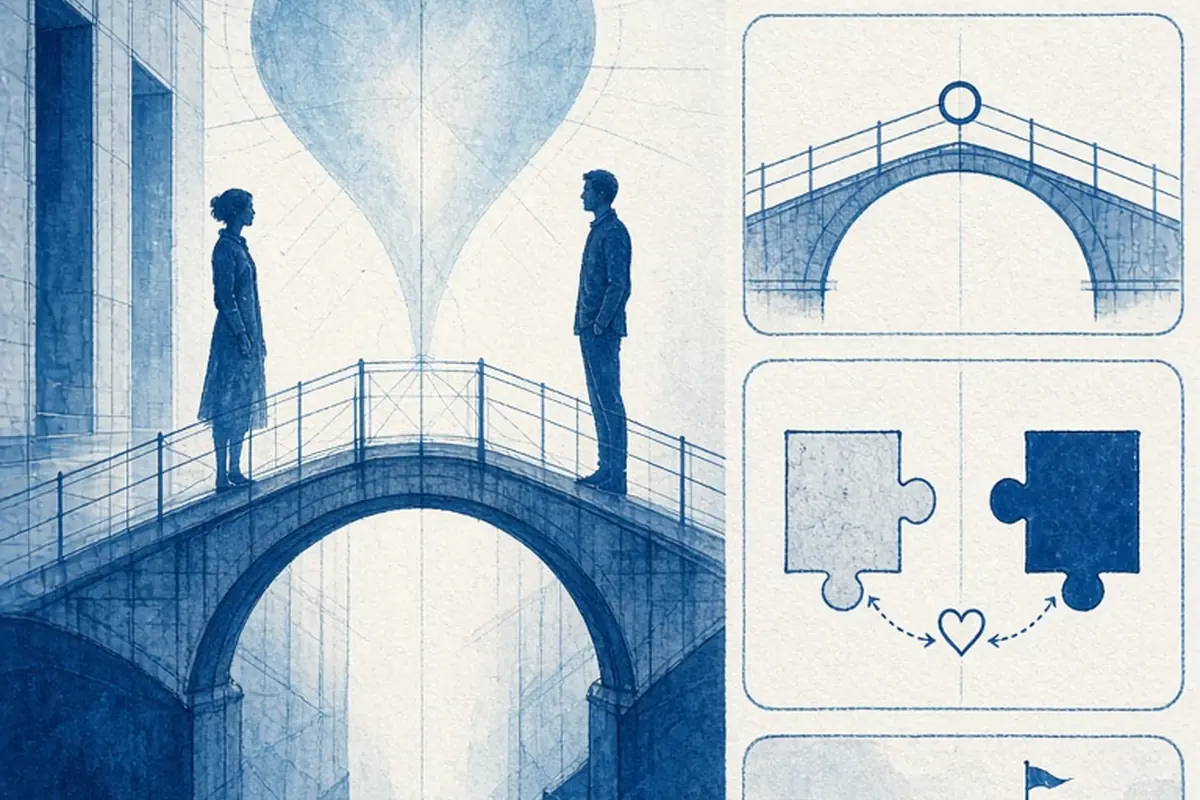
We fall in love when attraction, emotional safety, timing, and meaning line up. Someone catches our attention, we feel energized and seen around them, and repeated good moments turn interest into attachment. The spark is largely automatic, but lasting love also depends on choice: consistency, trust, and mutual effort decide whether the fall becomes something durable.
Almost everyone has felt it: the quickened pulse when a certain name lights up your phone, the way an ordinary Tuesday suddenly has a soundtrack. The experience feels mysterious, but it follows patterns you can actually see once you know where to look — and seeing them gives you more say in what happens next.
The Spark: What Falling in Love Actually Feels Like
Falling in love announces itself in the body before it reaches the mind. Your pulse jumps when their name appears on your phone. You replay conversations, notice songs that seem written about them, and find ordinary errands suddenly interesting because you might get to tell this person about them later. You have probably heard that brain chemicals like dopamine are involved; whatever the exact mechanism, the lived experience is strikingly similar across people — heightened focus, restless energy, and a sense that one particular person has become unusually important.
That intensity exists for a reason: novelty plus possibility is a powerful combination, and your attention naturally locks onto whatever promises both. The useful thing to remember is that the spark tells you a great deal about your own state — your readiness, your hopes, your hunger — and very little about long-term fit. Treat the rush as information rather than a verdict. It is a door opening, not a guarantee about what waits on the other side.
Why This Person: The Hidden Forces Behind Who We Choose
Nobody falls in love with a random stranger on the other side of the planet; we fall for the people we actually meet. Proximity does quiet work — the coworker you see daily, the friend of a friend who keeps showing up at the same dinners. Repeated contact builds comfort, and comfort lowers the guard that attraction needs to slip past. Similarity matters too: shared values, a matching sense of humor, a familiar rhythm of life. Sometimes a difference draws us in — the calm person fascinated by someone spontaneous — but the overlap underneath is usually what sustains it.
Timing may be the most underrated force of all. The same person can be invisible to you one year and magnetic the next, depending on whether you are open, lonely, healed, or restless. What feels familiar also shapes the pull: the way you were loved early in life becomes a rough template for what registers as chemistry later. That is worth knowing, because familiar is not always healthy — if chaos felt normal growing up, calm can feel boring at first. The template is a starting point, not a life sentence.
Falling in Love Is Not the Same as Loving Someone
Falling in love is largely involuntary — a rush of attention, idealization, and hope. Loving someone is different: it means knowing the actual person, flaws included, and choosing them anyway. In the falling stage, part of what we adore is our own projection. We fill in the blanks with the best possible guesses, then feel amazed at how perfect the other person seems.
Confusing the two stages causes real pain. People commit to a projection and then feel deceived when the real person shows up — the one who handles conflict badly or goes quiet under stress. Someone might realize he loved the version who sent good-morning texts, not the one who dismisses his feelings. The trade-off is worth accepting: real love is less cinematic than the fall, but it is sturdier, because it is built on evidence rather than imagination.
The Role of Feeling Seen, Safe, and Chosen
Underneath the chemistry, love deepens when someone sees us accurately. They remember the small details, get the joke without an explanation, take our fears seriously instead of waving them off. Being understood is powerfully bonding — it tells you, at a level below words, that you can stop performing. Many people describe the moment they fell hardest not as a grand gesture but as a quiet one: the person noticed something true about them that everyone else had missed.
Safety and reciprocity matter just as much. Affection that arrives steadily lets attachment grow; affection that arrives unpredictably — warm one day, cold the next — can produce a gripping anxiety that feels like passion but behaves more like a slot machine. The distinction matters: the relief of finally being chosen is not the same as the daily experience of being treated well. One is a spike; the other is a foundation.
When Falling in Love Goes Sideways
Falling in love has failure modes worth naming. Some people repeatedly fall for the unavailable — the taken, the distant, the almost-ready — because longing can feel safer than having. Others mistake intensity for intimacy: if the highs are dizzying and the lows are awful, the relationship can feel profound when it is mostly unstable. And early red flags get ignored precisely because the rush feels so good; nobody wants to audit a feeling that pleasant.
The way through is not to stop feeling but to start observing. Ask what you actually know about this person versus what you are hoping is true. Watch how they treat servers, exes, and you on a bad day — actions over words, patterns over promises. You can feel the full pull of attraction and still decline the ride; that is not coldness, it is self-respect. The goal is not to control your heart but to give it better information.
How to Fall in Love With Your Eyes Open
You cannot schedule a spark, but you can change how you handle one. Slow the timeline on purpose — not as a game, but because information needs time to accumulate. Keep your friendships, your routines, and your sleep; a person worth loving will fit into a life, not replace one. Let a few ordinary weeks pass before you decide someone is extraordinary, because almost everyone is charming in week two.
It also helps to interrogate the feeling gently. When you notice yourself falling, sit with a few honest questions rather than either suppressing the rush or obeying it:
- What do I actually know about this person, and what am I filling in with hope?
- How do they treat people who can do nothing for them?
- Do I like who I become when I am around them?
- Has my world gotten bigger or smaller since they entered it?
What Happens After the Fall
The obsessive phase does not last, and that is not a defect. For most couples the can't-stop-thinking-about-you intensity gradually cools — commonly within the first year or two — and what replaces it determines everything. Some people interpret the calm as falling out of love and go chasing a new spark. Others recognize it as a handoff: the fall got you to each other, and now something sturdier has to be built.
What keeps love alive after the fall is less mysterious than the fall itself. Curiosity keeps mattering — asking real questions instead of assuming you already know the answers. Repair matters more than avoiding conflict; couples who can say that came out wrong, let me try again recover from the fights that sink others. And shared novelty — new places, new projects, new problems solved together — feeds the same appetite for discovery that the early rush ran on. Love stops being something that happens to you and becomes something you do.
Illustrative Scenarios
The Late Reply That Felt Like a Verdict
Daniel had three genuinely good dates with a woman he met through friends. Then her replies, which had been arriving in minutes, started taking hours. His first interpretation was instant: she is losing interest, and I should demand clarity before I get hurt. He drafted a long message twice. Instead, he waited a day, noticed he had been filling silence with a story, and sent one light text proposing a specific plan for Saturday. She had been buried in a work deadline; on the date, they ended up laughing about texting pace. Nothing was resolved forever — but nothing spiraled, either.
Key point: The gap between what happened and what it means is where falling in love either steadies or spirals. Check the story before you send it.
The Instant Connection That Moved Too Fast
Priya met someone who felt like a soulmate inside two weeks — constant messages, talk of a trip together, declarations that he had never felt this way. She ignored that he dodged basic questions about his life and went sulky when she made plans with friends. Over coffee, a friend asked a plain question: do you like him, or do you like how he makes you feel? Priya slowed the pace on purpose, watched what he did rather than what he said, and saw the pattern clearly. She stepped back — disappointed, but intact.
Key point: Intensity is not the same as intimacy. Speed is a choice, and slowing down costs you nothing that was real.
Frequently asked questions
Can you control who you fall in love with?
Not the spark itself — attraction arrives uninvited. But you control the exposure and the follow-through: who you spend time with, what you encourage, and when you walk away. Think of the fall as weather and the relationship as the house you decide to build in it.
Why do I keep falling for the wrong people?
Often because familiar feels magnetic. If distance, drama, or chasing was normal in your early life, calm can register as boring at first. Noticing the pattern without blaming yourself is what lets you choose differently next time.
Is love at first sight real?
Attraction at first sight is real — plenty of people feel an instant, undeniable pull. Love, though, requires actually knowing someone, and knowing takes time. What gets called love at first sight is usually a strong first chapter that later turned out to be accurate.
Does the falling-in-love feeling ever go away?
The obsessive, can't-eat phase settles for most couples, often within the first couple of years. What can replace it is deeper — trust, shared history, chosen affection — but only if you do not mistake the calm for loss and abandon something good while chasing a new rush.
Your next step
Tonight, write down the last three times you felt strongly drawn to someone and what was happening right before each one. That short list is your personal recipe for falling in love — and seeing it clearly is the first step to choosing on purpose.