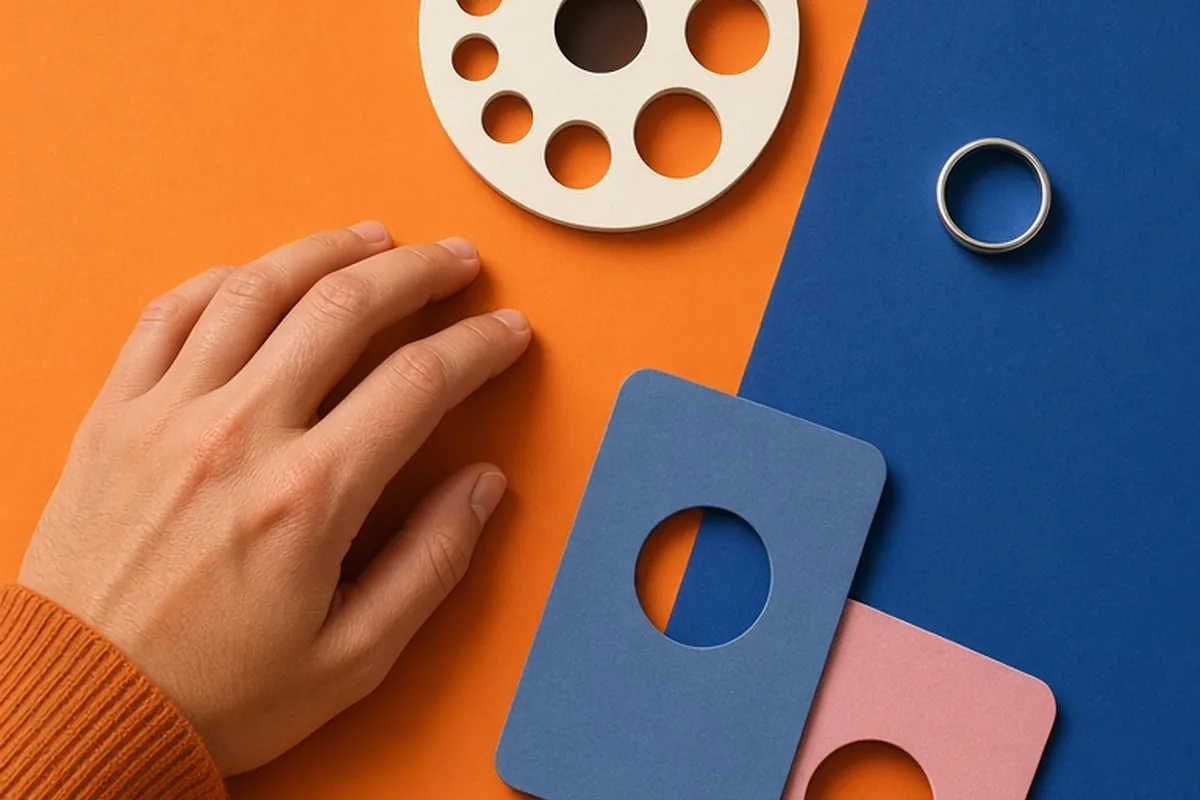
Yes, men's and women's ring sizes follow the exact same numerical measurement scale in the United States. A size eight ring has the identical inner circumference and diameter whether marketed toward men or women. The only differences lie in average hand dimensions and design widths, which significantly influence how tight a band feels against the skin.
Navigating jewelry counters or online ring retailers can feel confusing when browsing separate men's and women's sections. Understanding how standard sizing works removes the guesswork, whether you are picking out a wedding band, selecting a gift, or finding your own everyday ring.
The Universal Scale: How Ring Measurements Work Across Genders
In the United States, Canada, and several other regions, jeweler sizing relies on a standardized numerical system. Every half and full size corresponds to a precise inner circumference measured in millimeters. For example, a standard US size 7 corresponds to an inner circumference of roughly 54.4 millimeters, while a size 10 measures approximately 62.1 millimeters. Jewelers do not maintain separate dimensional tables for men and women because the millimeter baseline remains constant across all adult jewelry.
The separate gender categories found in retail stores exist purely for marketing, aesthetic proportions, and typical inventory stocking. Men's rings typically range from sizes 8 to 14, whereas women's selections typically span sizes 4 to 9. If a woman with broader hands needs a size 10, or a man with slender fingers wears a size 6, they can select rings from either section without any technical conversion. The number stamped inside the band represents the exact same physical space.
Why Band Width Dramatically Changes the Way a Ring Fits
Even though the numerical scale is identical, two rings of the same marked size can feel completely different on your finger depending on their width. Traditional women's engagement and fashion rings often feature delicate bands measuring between 1.5 and 3 millimeters wide. In contrast, traditional men's wedding bands frequently span 6 to 8 millimeters. A wider band covers significantly more surface area on your finger, displacing more skin and creating greater friction when you slide it on or off.
Because of this surface area dynamic, wide bands fit much more snugly than narrow ones. If your finger measures as a true size 9 with a slim measuring tool, a 2-millimeter band in size 9 will glide on easily, but an 8-millimeter band in size 9 might feel uncomfortably tight or get stuck over your knuckle. Most experienced jewelers suggest going up by a quarter to a half size when buying bands wider than 6 millimeters to ensure daily comfort.
Standard Fit Versus Comfort Fit: The Interior Edge Factor
Another crucial factor that creates perceived sizing differences between men's and women's rings is the interior profile of the metal. Traditional standard-fit rings feature a flat interior surface that rests flush against the skin from edge to edge. Comfort-fit rings, which are especially popular in wider men's bands, have a slightly domed, convex interior. This rounded interior reduces the contact area against the finger and allows the ring to glide smoothly over the knuckle.
Because comfort-fit bands have less surface friction, they often feel slightly looser than standard-fit bands of the exact same size. If you get sized on a standard flat sizing gauge but purchase a comfort-fit ring, the ring may feel loose enough to slip off unexpectedly, especially in cold weather. Always confirm whether the sizer you are using matches the interior profile of the ring you plan to purchase.
How to Measure Finger Size Accurately at Home
Getting an accurate measurement at home requires avoiding common shortcuts that introduce errors. Many people try wrapping a piece of string or a strip of paper around their finger, marking the overlap, and measuring it against a flat ruler. This method frequently leads to purchasing rings that are one or two sizes too large because paper and string flex, stretch, and wrap far tighter against soft tissue than a rigid metal circle ever could.
A far more dependable home method is using an inexpensive plastic ring-sizing belt with calibrated notches or ordering a set of metal sizing rings online. When sliding the sizer on, make sure it passes over your knuckle with mild resistance. The ring must be snug enough that it will not fall off when you shake your hand downward, but loose enough to slide over the joint without painful tugging or skin bunching.
Accounting for Knuckles, Swelling, and Daily Body Changes
Human fingers fluctuate in size throughout the day due to temperature, activity levels, sodium intake, and hydration. In the morning or during chilly weather, blood vessels constrict and fingers shrink slightly. In the evening, after a workout, or in hot summer humidity, fingers expand noticeably. Taking a single measurement at an extreme moment can result in a ring that pinches during the summer or spins freely during the winter.
To find a reliable baseline, take your measurements at three distinct times across several days, ideally in the late afternoon when your body temperature is moderate. Additionally, examine the proportion between your knuckle and the base of your finger. If you have prominent knuckles, measure both the knuckle and the finger base, then choose a size directly between the two numbers so the band clears the joint while remaining stable at the base.
Practical Strategies for Sizing a Partner Without Spoilers
Finding your partner's correct ring size for a surprise proposal or gift requires careful observation rather than guesswork. A common mistake is grabbing any ring from their jewelry box and assuming it matches their left ring finger. In reality, dominant hands are usually a half-size larger than non-dominant hands, and each finger on the same hand has distinct measurements. A ring worn on a middle or index finger will rarely fit a ring finger properly.
If you borrow an existing ring to check its size, make sure you know which specific finger and hand they wear it on. You can press the ring into a bar of soap to create an impression or slide it down your own finger and draw a line at the stopping point. Alternatively, enlist a trusted close friend or family member to casually try on costume jewelry together during a shopping trip to note their true size naturally.
Resizing Limits: Metal Types and Structural Constraints
While traditional precious metals like yellow gold, white gold, rose gold, and platinum can readily be sized up or down by a competent bench jeweler, modern alternative metals cannot. Contemporary men's rings frequently utilize titanium, tungsten carbide, cobalt chrome, ceramic, or carbon fiber. These materials are chosen for their durability, but their extreme hardness or molecular structure makes traditional cutting, stretching, or soldering impossible.
If you choose an alternative metal or a ring with continuous patterns or inset diamonds around the entire perimeter, getting the exact size right on the first attempt is mandatory. If an alternative metal band does not fit, it must be completely exchanged for a new ring rather than adjusted. Always review a jeweler's return and size-exchange policy before purchasing rings crafted from non-traditional materials.
Illustrative Scenarios
Accounting for Band Width Differences
Marcus decided to surprise his partner, Elena, with a custom wide gold band to wear on her right hand. He found a delicate silver stacking ring she wore on that exact finger and matched it to a standard size 6 mandrel at a local jewelry store. When the new 7-millimeter gold band arrived, Elena loved the design but found it painful to push over her knuckle and uncomfortably tight during wear. Marcus realized the narrow sample ring had not accounted for the added surface friction of a wide band. They took the piece back to the jeweler to resize it to a 6.5, creating an effortless, comfortable fit.
Key point: Whenever selecting a band significantly wider than your reference ring, adjust the measurement up by a quarter to a half size.
Navigating Alternative Metal Exchange Policies
David measured his own finger at home using a paper strip and ordered a size 10 tungsten carbide wedding band online two weeks before his wedding. When the package arrived, the ring was loose enough to slip off every time he washed his hands. Because tungsten carbide cannot be physically resized by a bench jeweler, David faced an urgent scramble to order a replacement size 9.5. By working directly with customer support to expedite an exchange before the ceremony, he secured the proper fit just in time.
Key point: Alternative metals cannot be altered on a jeweler bench, making precise initial sizing and flexible exchange windows essential.
Frequently asked questions
What is the average ring size for men and women in the US?
In the United States, the average ring size for adult women is between size 6 and 7 for the ring finger. For adult men, the average ring finger size ranges between size 9 and 10. Individual sizes vary widely based on frame, bone structure, and finger shape.
Can a man wear a ring from the women's section, or vice versa?
Yes, absolutely. Ring measurements are based on physical millimeters rather than gender, so any ring that matches your finger circumference will fit properly. The main distinction between sections is styling, band thickness, and stock size availability.
How should a properly sized ring feel on the finger?
A properly sized ring should slide over the knuckle with a slight push and sit comfortably at the base without pinching or squeezing the skin. When removing the ring, you should feel a brief resistance at the knuckle so it does not fall off during daily hand movements.
Does hand dominance affect ring size?
Yes, your dominant hand is typically about a half-size larger than your non-dominant hand because everyday use builds stronger muscles and denser tissue. Always measure the specific hand and finger where the ring will be worn.
Your next step
Determine the exact millimeter circumference of the specific finger you intend to wear the piece on, account for band width, and test the fit with a physical sizer before committing to a final purchase.