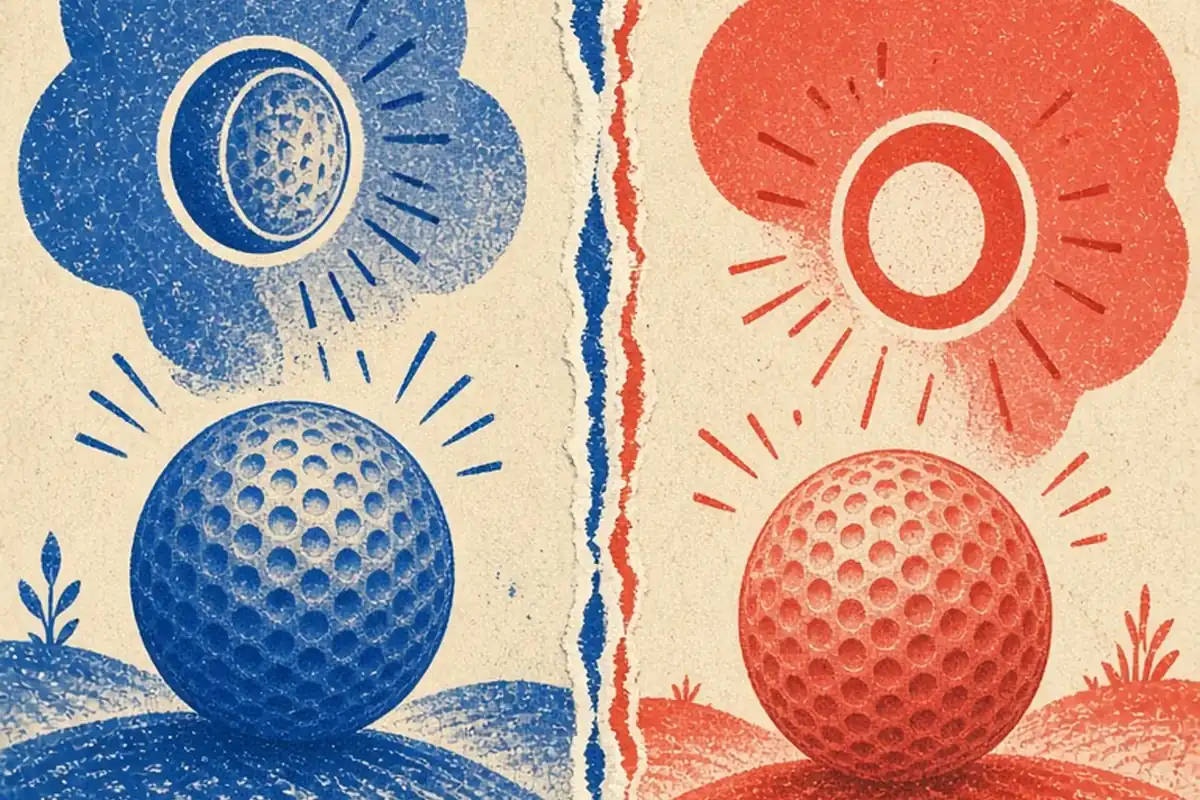
Yes, women's golf balls are functionally different from standard men's balls, primarily in compression rating and core design. Most balls marketed toward women feature ultra-low compression cores designed to compress fully at moderate swing speeds, maximizing launch and total distance. However, golf balls respond to swing speed and impact physics rather than gender, meaning performance depends on matching the ball to your mechanics.
Walking down the golf equipment aisle reveals walls of options divided by brand, construction, and gender labeling. While packaging often emphasizes distinct colors or softer styling, the genuine differences between men's and women's golf balls lie beneath the outer cover. Understanding how core compression, cover materials, and aerodynamic dimple patterns interact with your club delivery helps you select gear based on real performance rather than marketing categories.
Compression Ratings and Core Construction
The most significant technical distinction between men's and women's golf balls is the compression rating. Compression measures how much a golf ball deforms under impact when struck by a clubface. Balls historically marketed to men, particularly tour-level models, typically feature compression ratings between 85 and 105. In contrast, golf balls designed for women usually have compression ratings ranging from 35 to 65. The core of a lower-compression ball is made from softer synthetic rubber blends that require less kinetic energy to compress fully.
When a golfer swings at moderate speeds, a high-compression ball behaves almost like a solid rock, failing to compress sufficiently to generate optimal spring-like energy transfer off the clubface. A low-compression ball, however, deforms easily at lower impact speeds, acting like a spring that returns energy quickly to produce higher initial ball speed and an easier launch. The trade-off is that players with high clubhead speeds can over-compress very soft cores, leading to excess spin, ballooning trajectories, and reduced total distance off the tee.
Layer Design and Cover Materials
Golf balls vary widely in their internal architecture, ranging from simple two-piece builds to complex multi-layer designs. Most golf balls designated for women use a two-piece construction, consisting of an oversized soft core surrounded by a thin, durable outer cover. This straightforward structure maximizes distance and reduces side spin, helping players keep drives straighter down the fairway without needing high clubhead speeds.
The cover material on women's balls is predominantly an ionomer or Surlyn blend rather than cast urethane. Ionomer covers are resilient, resistant to scuffing from errant shots or cart paths, and inherently produce lower spin off full swings. Premium balls marketed toward advanced male players frequently employ multi-layer mantles paired with thin urethane covers, which maximize green-side spin and workability. While urethane offers superior control for delicate pitch shots, an ionomer cover on a soft core delivers the straight-line forgiveness and velocity that moderate-speed players prioritize.
Why Swing Speed Matters More Than Gender
Equipment manufacturers use gender labels primarily as an accessible shorthand for swing speed profiles. Industry statistics frequently note that the average amateur female golfer generates driver swing speeds between 60 and 75 miles per hour, whereas the average amateur male golfer swings between 80 and 95 miles per hour. Because of this distribution, manufacturers label low-compression, high-launch models as women's balls to direct consumers quickly to products that suit typical velocity ranges.
In reality, a golf ball cannot detect who is swinging the club; it responds exclusively to clubhead speed, angle of attack, and face contact. A male golfer with a smooth, moderate tempo or a senior player with reduced mobility will often see measurable distance gains by playing a low-compression ball labeled for women. Conversely, an athletic female player with a high swing speed who generates 90 miles per hour or more will benefit from playing a standard mid-to-high compression multi-layer ball to prevent losing distance to excess spin.
Launch Angle, Spin, and Trajectory Differences
Getting the ball airborne with sufficient height is essential for maximizing carry distance, especially when swing speed is limited. Balls engineered for women feature specialized dimple patterns designed to reduce drag and generate lift at lower velocities. Shallow, wide dimple arrays help promote a higher initial launch angle, allowing the ball to stay in the air longer before descending softly onto the target.
Spin generation also differs noticeably between these categories. High-compression balls require rapid impact forces to activate the outer layers while keeping driver spin low, but low-compression two-piece balls reduce spin across almost every club in the bag. For players who struggle with a persistent slice or hook, the reduced backspin and side spin of a soft women's ball helps straighten out curvature, resulting in more fairways hit even if shot-shaping capabilities are diminished.
Short Game Performance and Green-Side Feel
Impact feel is a subjective yet crucial aspect of putting, chipping, and short-iron play. Soft-core balls produce a muted, cushioned sound at impact that many golfers describe as pleasant and responsive. On the putting green, this lower acoustic frequency translates to a perceived softer touch, which can help build confidence on fast greens where a firm ball might feel harsh off an insert or milled putter face.
The main compromise with standard low-compression women's balls comes in wedge control around the green. Because two-piece ionomer balls generate less friction and backspin on partial wedge shots than tour urethane balls, they will typically release and roll out further after landing rather than stopping abruptly. Golfers who rely on soft, two-piece designs must adjust their course management by aiming for the front of the green and planning for roll-out on approach shots.
Visual Finishes and Alignment Features
Beyond internal mechanics, women's golf balls frequently feature unique exterior cosmetics, including high-gloss pearlescent finishes, pastel shades, and vibrant matte colors such as pink, yellow, and lavender. While these aesthetics are partly styled for visual appeal, high-visibility colors offer genuine practical utility on the course. Matte and bright finishes can significantly improve contrast against green turf and gray skies, making it easier to track ball flight and locate errant shots in deep rough.
Men's balls are also increasingly offered in high-visibility neon yellow or orange, but women's lines traditionally led the way in colored cover variety. Additionally, many modern balls across both categories now incorporate bold, multi-line alignment stamps on the side. These visual guides simplify aiming on the tee box and putting green, regardless of whether the underlying ball is a low-compression model or a tour-level construction.
How to Select the Right Model for Your Swing
Selecting the ideal golf ball involves evaluating your swing mechanics, course conditions, and personal feel preferences. Start by estimating or measuring your driver swing speed during a practice session or club fitting. If your driver speed sits below 80 miles per hour, testing low-compression balls (compression rating below 65) will almost certainly yield better carry and overall distance than playing a firm tour ball.
A reliable on-course testing method is to purchase two different sleeves—one soft low-compression model and one mid-compression multi-layer model—and play them head-to-head during a practice round. Pay close attention to three specific areas: sound and roll on putts, stopping power on short chips, and overall distance and dispersion off your driver. Whichever option provides predictable landing distances and confidence on the greens is the ball you should keep in your bag.
Frequently asked questions
Can male golfers legally play women's golf balls in official tournaments?
Yes. As long as the specific ball model is listed on the USGA or R&A Conforming Golf Ball List, any player can use it in sanctioned competition. The governing rules regulate size, weight, and velocity limits, but they make no restrictions based on gender labeling.
Will a soft golf ball automatically make me hit the ball farther?
A soft, low-compression ball will increase distance if your swing speed is moderate or slow, because it allows you to compress the core fully for higher launch and lower drag. However, if you already have a fast swing speed, a very soft ball can over-compress, causing high spin and reduced carry.
How do I know if a golf ball's compression is too low for my game?
You can tell a ball is too soft if your tee shots launch excessively high, balloon in the wind, and drop short of your usual distances. Additionally, if the ball feels mushy off the driver face and lacks crisp auditory feedback on full iron shots, you likely need a higher compression rating.
Are all colored golf balls considered women's balls?
No, colored golf balls are available across virtually every brand and performance category for both men and women. Premium tour balls, mid-tier models, and entry-level options are now widely manufactured in matte green, bright yellow, red, and orange to improve visibility for all players.
Your next step
Ignore gender branding on the packaging and choose a golf ball matched strictly to your swing speed and short-game preferences, using sleeve testing on the course to find the best balance of distance and feel.