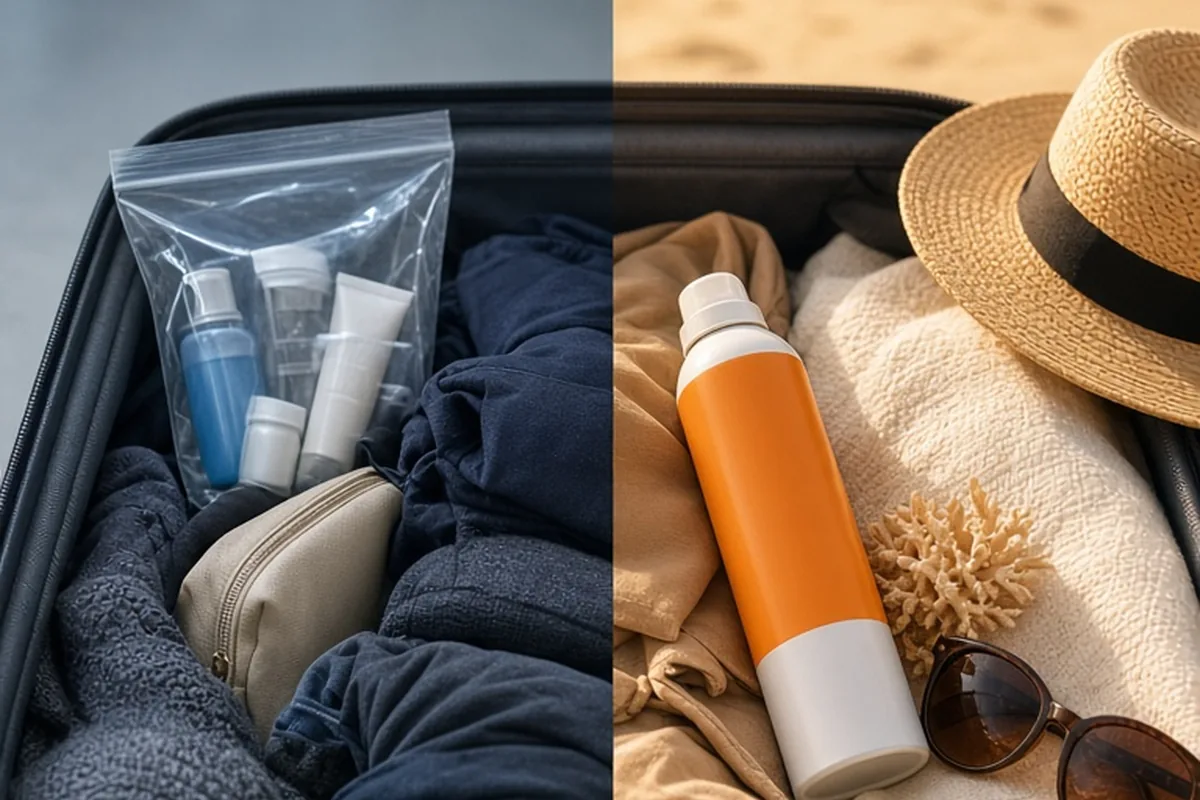
Yes, you can pack aerosol spray sunscreen in your checked luggage, provided it meets federal safety limits. The Transportation Security Administration (TSA) and Federal Aviation Administration (FAA) permit toiletry aerosols in checked baggage as long as each single container is 18 ounces (500 milliliters) or smaller, and your total toiletry aerosol volume per passenger does not exceed 70 ounces (2 liters).
Preparing for a beach vacation or an outdoor getaway often means bringing plenty of sun protection, but sorting through airline aerosol regulations can feel confusing.
TSA and FAA Volume Limits for Checked Aerosols
Aerosol sunscreens fall under the category of medicinal and toiletry articles according to the Federal Aviation Administration and the Transportation Security Administration. Because aerosol cans contain pressurized propellants, they are subject to strict capacity caps even when stowed in the cargo hold beneath the passenger cabin. The standard rule establishes that no single aerosol container may exceed a capacity of 18 ounces or 500 milliliters. Furthermore, the aggregate total of all medicinal and toiletry aerosols and liquids carried by one passenger cannot exceed 70 fluid ounces or 2 kilograms across all checked bags.
Most commercial spray sunscreens sold in retail stores come in standard sizes ranging between 5 ounces and 8 ounces. This means that a standard single can easily falls well below the maximum individual container threshold permitted by aviation authorities. However, travelers packing for large families or extended trips must remain mindful of the cumulative total. If you pack six 8-ounce cans of sunscreen along with aerosol hairspray, dry shampoo, and shaving cream, you can quickly approach or exceed the 70-ounce aggregate limit. Keeping your total aerosol count reasonable ensures that your bag passes through automated baggage screening without triggering a manual search and potential confiscation.
Safety Caps and Preventing Accidental In-Flight Release
Aviation regulations explicitly state that all aerosol containers transported in checked luggage must have a protective mechanism to prevent accidental discharge. During flight, luggage shifts dynamically inside the cargo hold, and bags are subjected to rough handling on conveyor belts and luggage carts. If a loose item presses against an unprotected nozzle, the entire contents of the spray can could empty directly into your suitcase, ruining clothing, electronics, and travel documents.
To comply with travel standards, your spray sunscreen must feature a secure snap-on plastic cap or an integrated twist-to-lock dispensing nozzle. A can with a missing or cracked cap should not be packed in checked luggage unless you secure the nozzle with heavy-duty tape or replace the cap entirely. Before placing the can into your luggage, verify that the locking collar is completely turned to the closed position. A simple test is to gently press down on the actuator; if there is any movement or hissing sound, the mechanism is not properly engaged.
Step-by-Step Packing Strategy to Protect Your Belongings
Even when an aerosol can is properly capped, fluctuations in cargo compartment air pressure and temperature can occasionally cause micro-leaks around the seal. To protect your wardrobe, you should never place unprotected aerosol cans loosely alongside your garments. A dependable method is to place each sunscreen can inside an airtight, heavy-duty zipper storage bag, pressing out excess air before sealing. For an extra layer of reassurance, you can wrap the sealed bag inside a soft packing cube or a secondary waterproof pouch.
Placement within the physical structure of your suitcase also plays a vital role in preventing damage. Position your sunscreen near the center of the suitcase, buffered on all sides by soft clothing items such as towels, denim, or sweaters. Avoid placing aerosol cans directly against the outer perimeter, corners, or zippered seams of soft-sided luggage, where external impacts from baggage handlers are most severe. This central positioning absorbs shock and prevents the pressurized metal container from being crushed or punctured during transit.
Navigating International Travel and Airline Variations
While domestic flights within the United States adhere strictly to FAA and TSA guidelines, international flights are governed by the International Air Transport Association along with individual national aviation authorities. Fortunately, IATA standards for personal toiletries align closely with United States regulations, maintaining the 500-milliliter per container and 2-liter total passenger threshold. Nevertheless, individual airlines occasionally impose their own stricter internal restrictions on hazardous materials and pressurized canisters.
Certain destination countries also have local environmental regulations regarding specific chemical sunscreen ingredients that can affect what products you are allowed to bring through customs. For instance, destinations with vulnerable marine ecosystems, such as Hawaii, the U.S. Virgin Islands, Mexico, and Palau, have banned specific ultraviolet filters like oxybenzone and octinoxate. Checking both your carrier's specific luggage guidelines and your destination's local environmental laws prior to packing will prevent unexpected delays or fines upon arrival.
Aerosol Sunscreen Versus Lotions and Solid Sticks for Travel
When planning your packing list, it is worth weighing the practical trade-offs between continuous aerosol sprays and alternative sunscreen formats. Aerosol sprays provide fast, convenient reapplication for broad areas of the body, particularly when you are outdoors or participating in active sports. However, a significant portion of an aerosol can's stated volume consists of propellant gas rather than active sunscreen liquid, meaning an aerosol can will generally be depleted much faster than an equivalent fluid volume of lotion.
Traditional lotions, creams, and solid sunscreen sticks offer several packing advantages over aerosol canisters. Lotions provide denser, more measurable coverage, and solid sticks are completely immune to cargo pressure changes and will never leak into your luggage. If you are packing tightly to meet airline baggage weight limits, packing a concentrated lotion or solid stick allows you to transport more usable product per ounce of weight while eliminating the need to monitor aerosol aggregate limitations.
Troubleshooting In-Flight Leaks and Handling Confiscation
If you open your suitcase at your destination and discover that a sunscreen can has discharged despite precautions, acting quickly will minimize permanent staining on your garments. Sunscreen formulations often contain oils, emulsifiers, and chemical filters that can leave greasy residues or yellow stains on natural fabrics. Immediately isolate the soiled clothing, rinse the affected areas with warm water, and treat the fabric with a grease-cutting dish soap or liquid laundry detergent before allowing the stain to set or dry.
In the event that airport security inspects your checked bag and removes an aerosol item, they will typically leave a written inspection notice inside your luggage explaining the removal. Confiscation generally occurs only if an aerosol exceeds the individual container size limit, lacks an accidental-discharge guard, or is classified as an industrial product rather than a personal toiletry. If your sunscreen is confiscated, visit a local pharmacy or grocery market upon arrival to purchase a compliant replacement rather than attempting to travel without adequate sun protection.
Frequently asked questions
Can I bring a full-size spray sunscreen in my carry-on bag instead?
No, carry-on bags are restricted by the TSA 3-1-1 rule to liquids and aerosols that are 3.4 ounces (100 milliliters) or smaller. Full-size spray sunscreens exceed this volume and must be packed in checked luggage.
Does altitude or pressure in the cargo hold cause aerosol cans to explode?
Modern commercial aircraft maintain pressurized and temperature-regulated cargo holds that prevent aerosol cans from exploding. As long as the container is undamaged and properly capped, standard flight conditions will not rupture the canister.
Can I pack non-toiletry aerosol sprays, like bug spray, in checked luggage?
Aerosol insect repellents designed for direct application to human skin are classified as personal toiletries and are allowed under the same 18-ounce individual and 70-ounce aggregate rules. However, industrial insecticides and pesticide sprays intended for broad environmental spraying are strictly prohibited.
How can I verify if my sunscreen can has an approved safety nozzle?
An approved nozzle has a built-in locking mechanism that turns to a shut position or comes with an outer protective cap that covers the actuator entirely. If the dispensing button cannot be inadvertently pressed down while packed, it meets airline safety requirements.
Your next step
Inspect your spray sunscreen cans to confirm they are 18 ounces or smaller, verify that each cap or lock is securely fastened, and seal them inside a leakproof bag in the center of your suitcase before heading to the airport.