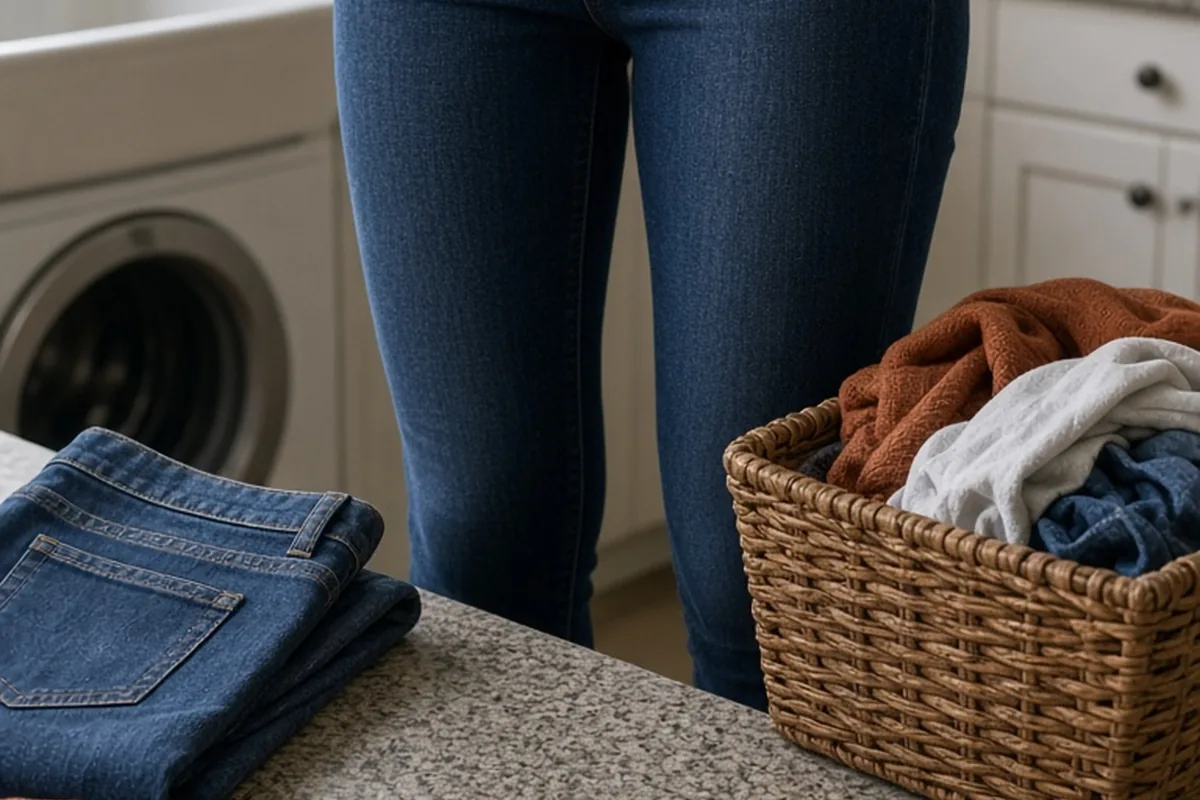
Yes, men can wear women's jeans. Fabric has no gender, but cut, rise, and sizing differ significantly. Women's denim often offers higher stretch, diverse rises, and closer leg tapering. To get a flattering fit, men simply need to adjust for hip-to-waist ratios, measure rise depth for comfort, and account for smaller pocket dimensions.
Many men explore women's denim because mainstream men's clothing lines frequently lack specific cuts, softer stretch blends, or high-rise silhouettes. Understanding structural differences allows any shopper to choose pieces that look intentional and feel comfortable all day.
Understanding the Structural Differences in Denim Construction
The primary differences between men's and women's jeans come down to pattern drafting rather than the denim itself. Women's jeans are traditionally cut with a higher ratio between the hips and the waist to accommodate natural curves. In contrast, men's jeans generally feature a straighter waistband-to-hip transition. When a man wears a women's pair cut for pronounced curves, extra fabric can bunch around the upper thigh or lower hip unless he has wider hips or selects a straighter cut like a boyfriend or relaxed fit.
Fabric composition also tends to vary widely between sections. Men's jeans are typically manufactured using heavier weight, 100% cotton denim or minimal elastane blends (1% to 2%), giving them a stiffer drape. Women's lines incorporate a broader spectrum of textiles, ranging from rigid vintage twill to ultra-flexible blends containing 3% to 5% spandex or modal. This elasticity offers significant comfort and contouring, though high-stretch fabrics tend to wear out faster in the inner thighs under everyday friction.
Converting Sizing and Measuring Your Body Accurately
Sizing systems are rarely standardized between departments, making waist tags an unreliable guide. Men's jeans generally use waist and inseam measurements in inches, such as 32x32. Women's sizing frequently relies on even-numbered vanity sizing (such as 6, 8, 10, or 12) or waist measurements that sit lower or higher on the torso than the actual labeled number. A general rule of thumb is that adding 21 or 22 to a women's dress size yields an approximate waist measurement; for example, a women's size 10 often equates roughly to a 31- or 32-inch waist.
To get an accurate fit, measure your body with a flexible tape measure rather than relying on labeled sizes. Measure your natural waist where you want the waistband to sit, your fullest hip circumference, and your desired inseam from crotch to ankle. When shopping online or inspecting garment spec sheets, prioritize the flat-lay waist and hip measurements. If your natural hips measure 38 inches and the flat hip measurement of the jean is 18.5 inches (37 inches doubled), rigid denim will feel tight, while high-stretch denim will expand to fit smoothly.
Evaluating Rise and Crotch Clearance for Male Anatomy
The most critical comfort factor for men wearing women's denim is the front and back rise. The front rise is the distance from the crotch seam up to the top of the front waistband. Many modern women's styles, especially low-rise or ultra-low-rise cuts, feature a front rise between 7 and 9 inches. For male anatomy, a rise this shallow often causes pinching, restricted movement, and uncomfortable pressure when seated.
Mid-rise and high-rise women's jeans, which typically feature a front rise of 10.5 to 13 inches, provide substantially more room. A higher rise allows the waistband to anchor securely above the pelvic bones, giving the crotch seam adequate drop and preventing tightness. Checking the curvature of the crotch seam is equally important; a flatter front curve may pull tightly across the front, so seeking slightly curved seams or relaxed boyfriend cuts creates a much more wearable profile.
Managing Pocket Dimensions and Daily Carry Essentials
One notable trade-off of women's denim is pocket utility. Fast-fashion and designer women's jeans regularly incorporate shallow front pockets or non-functional faux pockets designed to preserve a clean, smooth line across the front pelvis. Men accustomed to sliding a large smartphone, bulky wallet, and set of keys into their front pockets will find this nearly impossible with most standard women's cuts.
Adapting to this difference requires practical everyday carry adjustments. Many people transition essential items to back pockets, jacket pockets, or minimalist accessories such as crossbody bags, sling packs, or belt clips. Alternatively, some wearers take their jeans to a local tailor or add pocket extensions at home using scrap cotton fabric, extending pocket bags downward by three to four inches without altering the exterior look of the trousers.
Selecting Cuts That Complement a Straighter Frame
Certain silhouettes transition between body types more naturally than others. Boyfriend, girlfriend, and 'mom' jeans are popular starting points because they are intentionally designed with a relaxed seat and a gentle taper toward the hem. These cuts offer the subtle shaping of women's tailoring without clinging aggressively to the hips or thighs, resulting in an effortless, casual silhouette on straighter male frames.
Wide-leg, flare, and bootcut jeans from women's collections also provide distinct visual advantages. Men's fashion frequently limits wide-leg cuts to skater styles or workwear trousers, whereas women's lines produce high-waisted, tailored flares with beautiful drape and movement. When paired with structured footwear, these cuts balance broader shoulders by creating clean, vertical lines down through the legs.
Styling Women's Denim for Balanced Proportions
Creating a cohesive outfit with women's jeans centers on balancing visual proportions. Because women's jeans often fit more closely around the waist and seat, wearing an oversized or boxy top—such as a heavy cotton tee, an unbuttoned overshirt, or a structured chore jacket—creates a flattering contrast. Tucking in a clean t-shirt into a high-waisted pair highlights the natural waistline and lengthens the appearance of the legs.
Footwear choice anchors the overall aesthetic. Skinny or slim-tapered women's jeans pair cleanly with low-profile sneakers, Chelsea boots, or loafers that sit neatly beneath the hem. For wide-leg or flared jeans, heavier footwear like chunky derbies, combat boots, or platform sneakers keeps the cuffs from dragging on the ground while maintaining visual weight at the base of the outfit.
Smart In-Store and Online Shopping Tactics
Navigating retail spaces can occasionally feel intimidating if you are uncertain about sizing. If shopping in person, grabbing two adjacent sizes of a cut you like helps you find the right fit quickly. Remember that fitting rooms in modern retail stores are generally accommodating spaces intended for customers to test fit and comfort privately. Checking return policies beforehand makes at-home try-ons through online ordering another low-friction option.
When purchasing online, always review customer reviews for notes on stretch and shrinkage. If multiple reviewers mention that a pair runs large or relaxes significantly after two hours of wear, consider sizing down to maintain your desired structure. Taking note of the specific brand's size chart—especially waist, hip, and thigh measurements—ensures consistent results across different labels.
Illustrative Scenarios
Finding the Right Rise for Everyday Comfort
Marcus wanted a vintage high-waisted look that he could not find in local men's sections. He ordered a pair of low-rise women's flare jeans in what he thought was his equivalent waist size. When they arrived, the low front rise felt constricting whenever he sat down, leading him to believe women's jeans simply were not built for his body. Instead of giving up on the style, Marcus researched garment rises and exchanged them for a pair of high-rise wide-leg jeans with an 11.5-inch front rise. The higher waistband settled comfortably above his hips, providing generous room throughout the seat and giving him the exact classic silhouette he wanted.
Key point: Garment rise matters far more than waist labeling when choosing jeans for male anatomy.
Navigating Pockets and Proportions for Workwear
Julian loved the clean drape and stretch of a pair of women's straight-leg black jeans he bought for his office job, but he was immediately frustrated by the two-inch pocket depth, which could not hold his phone or wallet. Rather than returning a pair that fit him exceptionally well through the waist and legs, Julian purchased a slim leather cardholder and began carrying a compact canvas sling for his daily commute. He also had a local dry cleaner extend the front pocket bags for ten dollars, making the jeans fully functional for his routine without sacrificing their tailored look.
Key point: Small adjustments to daily habits and minor alterations can solve structural utility differences.
Frequently asked questions
Can people tell if a man is wearing women's jeans?
Generally, no. Once on the body, most observers notice how well the garment fits rather than the tag inside. The only subtle giveaways are occasionally smaller back pockets or button orientations on specific vintage models, both of which are rarely noticed in everyday settings.
How do I know what size women's jeans to buy?
Start by measuring your actual waist in inches where you plan to wear the pants. Cross-reference that number with the brand's specific measurement chart, typically looking for a size where the waist and hip measurements match your recorded dimensions.
Do women's jeans stretch out faster than men's jeans?
They can, depending on the fabric blend. Styles with higher elastane, polyester, or modal content stretch during the day to conform to your body and may require frequent washing to regain their shape compared to 100% rigid cotton.
Your next step
Take your waist, hip, and front rise measurements with a flexible tape measure today, and use those exact numbers to test a mid- or high-rise cut from a retailer with a flexible return policy.