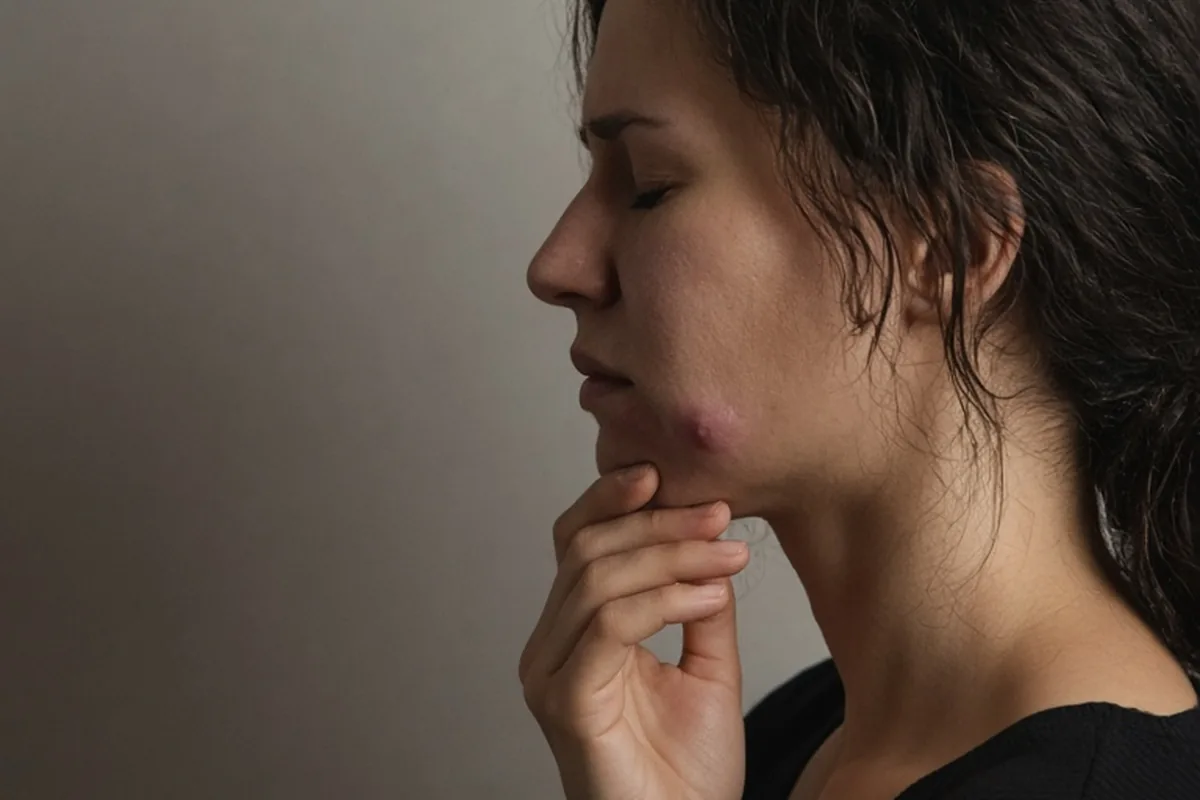
A tooth infection does not directly cause ordinary acne vulgaris, but an untreated dental infection can create a draining skin lesion known as a cutaneous odontogenic sinus tract that closely resembles a persistent, deep cystic blemish on the jawline, chin, or cheek. Furthermore, chronic oral inflammation stresses the immune system, potentially worsening existing inflammatory skin conditions nearby.
Dealing with deep, painful swellings around the lower face can be frustrating, especially when standard skincare routines fail to produce any noticeable improvement. While most people naturally assume that tender jawline lumps are hormonal cysts or stubborn clogged pores, the underlying issue occasionally originates beneath the gumline rather than within the hair follicle.
How Dental Infections Mimic Cystic Blemishes
The primary reason people link dental problems to cystic breakouts is a medical condition known as a cutaneous odontogenic sinus tract. When a tooth experiences deep decay, pulp necrosis, or trauma, bacteria proliferate inside the root canal system and spread into the surrounding alveolar bone. Seeking an escape route from the enclosed bony space, the resulting inflammatory exudate and purulent material burrow along the path of least resistance through soft tissue, eventually exiting onto the external skin of the face or neck.
When this drainage pathway reaches the dermis, it typically presents as an erythematous, smooth, or slightly crusted nodule that looks almost identical to an inflamed acne cyst. Because these lesions frequently emerge along the chin, lower border of the mandible, or submandibular area, patients and clinicians alike often misidentify them as localized cystic acne. Applying traditional acne washes, drying lotions, or benzoyl peroxide will have no effect on this nodule because the root cause lies deep within the alveolar bone rather than inside a blocked sebaceous gland.
A key characteristic of a dental sinus tract is its stubborn persistence. Unlike typical cystic blemishes that form, swell, and gradually resolve or remodel over a span of several weeks, an odontogenic skin lesion tends to remain indefinitely or periodically drain, flatten slightly, and flare up again in the exact same spot. Recognizing this pattern is essential because topical skincare interventions will continue to fail until the infected tooth is properly evaluated and treated by a dental professional.
The Biological Connection Between Oral Inflammation and Skin Health
Beyond direct anatomical drainage tracts, chronic oral infections can exert a broader systemic influence on inflammatory skin conditions. When the body fights a low-grade, persistent infection such as a dental abscess, advanced periodontitis, or chronic pericoronitis, it continuously releases pro-inflammatory mediators, including cytokines such as interleukin-1, interleukin-6, and tumor necrosis factor-alpha, into the bloodstream. This chronic low-level immune activation places extra stress on the body and can amplify systemic inflammation.
Acne vulgaris is fundamentally an inflammatory disease of the pilosebaceous unit. While oral bacteria like Streptococcus mutans or Porphyromonas gingivalis do not migrate to facial pores to directly create acne lesions, the systemic inflammatory burden caused by dental disease can lower your skin's resilience. An overactivated immune response can cause ordinary sebum oxidation and Cutibacterium acnes colonization in nearby facial pores to react with greater redness, swelling, and deeper pustular or cystic manifestations.
However, it is important to distinguish between correlation and causation. Resolving a dental infection will directly eliminate an odontogenic sinus tract, but it is not a guaranteed cure for widespread acne vulgaris. True acne involves multiple interacting factors, including hormonal fluctuations, follicular hyperkeratinization, excess sebum production, and genetic predisposition. Dental health is one piece of the wider systemic puzzle rather than the sole driver of facial breakouts.
Differentiating Between Dental Lesions and Hormonal Acne
Because both dental tracts and hormonal acne concentrate heavily in the lower third of the face, identifying subtle clinical differences can help you determine the appropriate specialist to visit. Hormonal cystic acne usually appears as multiple tender, subcutaneous nodules distributed across the jawline, chin, and upper neck. These breakouts typically wax and wane in alignment with menstrual cycles, high stress periods, or changes in diet, and they are often accompanied by smaller comedones, blackheads, and superficial papules.
In contrast, a skin lesion originating from a dental infection is almost always solitary and fixed in one specific location. It often appears directly over or adjacent to the root apex of the affected tooth. While true acne cysts can be intensely painful when palpated due to localized tissue distension, an odontogenic cutaneous nodule is sometimes surprisingly non-tender to the touch unless palpated firmly against the underlying jawbone, though the offending tooth itself may feel sensitive to tapping, hot liquids, or chewing pressure.
Another critical indicator is how the lesion responds to dermatological therapy. If a solitary lower-face cyst has resisted multiple rounds of topical retinoids, topical antibiotics, oral acne medications, or even in-office cortisone injections, the likelihood of a non-dermatological origin increases substantially. Examining your dental history for prior root canals, deep fillings, untreated cavities, or past facial trauma in that quadrant can provide vital clues.
Evaluating Face Mapping Claims and Anatomical Realities
Traditional face-mapping charts frequently claim that breakouts on specific zones of the chin or cheeks correlate directly to particular internal organs or dental meridians. While these concepts are widely shared on social media, scientific anatomy explains these patterns through physical proximity and vascular pathways rather than energetic maps. The lower face, including the mandibular angle and submental area, simply shares anatomical proximity with the roots of lower premolars, molars, and incisors.
When an infection in a lower tooth erodes through the outer cortical plate of the jaw below the attachment of the facial muscles, such as the buccinator or platysma, the infection is channeled outward into the subcutaneous tissue of the cheek or chin. If the infection erodes above the muscle attachment, it drains inside the mouth along the gumline as a parulis or gum boil. Whether an infection presents as an oral issue or a skin lesion is entirely a matter of anatomical muscle attachments and bone density, not an internal energetic reflection.
Understanding this anatomical reality helps prevent unnecessary delays in care. Instead of attempting holistic detoxes, aggressive dietary restrictions, or complex skincare layering to clear a stubborn lower-face nodule, an accurate assessment requires looking at physical structures. Checking for dental decay or periodontal pockets near the lesion yields far more actionable insight than relying on generalized face-mapping charts.
Diagnostic Procedures and Collaborative Care
If you suspect a persistent jawline or chin lesion might be linked to a tooth problem, arranging a comprehensive dental examination is the most definitive first step. A dentist will typically take periapical and panoramic radiographs or perform a cone-beam computed tomography scan to check for bone loss around tooth roots. They may also perform electric pulp testing or cold sensitivity tests to determine whether any teeth adjacent to the lesion have lost vitality.
In cases where a draining sinus tract is clearly visible on the skin, a dentist can gently insert a sterile, flexible gutta-percha point into the cutaneous opening and take a brief X-ray. The radiopaque material follows the tract directly back to the offending tooth, confirming the dental origin with high accuracy. This simple diagnostic step prevents unnecessary skin biopsies, surgical excisions, or prolonged courses of dermatological antibiotics that fail to reach the necrotic root canal.
Dermatologists and dentists frequently collaborate on these ambiguous cases. When a dermatologist observes a solitary, non-healing nodule with a central retraction or intermittent seropurulent discharge along the jawline, referring the patient for an endodontic evaluation is standard practice. Communicating openly with both your skin specialist and your dental provider ensures that you receive targeted care rather than treating symptoms in isolation.
Safe Treatment Approaches and What to Avoid
Resolving a skin lesion caused by a dental infection requires eliminating the source of the infection within the mouth. Depending on the condition of the tooth and the extent of bone loss, treatment generally involves nonsurgical root canal therapy to disinfect the internal canal system or, if the tooth is non-restorable, a dental extraction. Once the underlying reservoir of bacteria is thoroughly cleared, the cutaneous tract typically closes and heals spontaneously within one to two weeks without requiring direct surgical removal.
While waiting for your dental appointment, it is crucial to avoid aggressive self-treatment. Attempting to squeeze, lance, or puncture a deep nodule on the jawline can push bacteria deeper into the surrounding facial planes, increase localized scarring, and introduce secondary surface infections. Standard warm compresses can provide temporary comfort and encourage gentle natural drainage, but they will not resolve the underlying dental issue.
For patients who have both true acne vulgaris and a concurrent dental infection, a dual-track management plan works best. While the dental team handles the source of oral infection, you can maintain a gentle, non-comedogenic skincare routine focused on barrier support, utilizing mild cleansers, lightweight hydration, and physician-recommended acne actives for surrounding pores. This coordinated strategy prevents skin irritation while the deeper tissues heal.
Illustrative Scenarios
Resolving a Persistent Jawline Nodule Through Dental Care
A thirty-two-year-old woman experienced a solitary, red, cyst-like nodule on the lower edge of her left jawline that persisted for nearly five months. Assuming it was a stubborn hormonal acne cyst, she applied high-strength salicylic acid and received two localized cortisone injections, but the nodule continued to drain clear fluid intermittently and never fully flattened. During a routine dental checkup, her dentist noticed the lesion and took an X-ray of the lower left quadrant, revealing an asymptomatic periapical abscess under a molar that had sustained trauma years earlier. The patient underwent root canal therapy to remove the necrotic pulp tissue.
Key point: Solitary, non-healing blemishes near the jawline that fail to respond to standard dermatological therapies warrant a dental evaluation to rule out deep-seated oral infections before pursuing invasive skin procedures.
Frequently asked questions
Can curing a tooth infection clear up all of my facial acne?
Treating a tooth infection will resolve an odontogenic sinus tract that mimics a blemish, but it will not cure generalized acne vulgaris. True acne involves multiple factors such as genetics, hormones, and pore clogging, though reducing oral inflammation supports overall immune health.
Why do dental sinus tracts get mistaken for cystic acne so easily?
They appear in identical anatomical regions along the chin and jawline as red, raised, slightly tender nodules. Because many people experience acne in these zones, patients and practitioners often assume the lesion is dermatological before considering a dental source.
Does a tooth have to hurt for it to cause a skin problem?
No, a tooth with an abscess does not always cause significant pain if the nerve pulp inside has already died. Because the infection finds a drainage path through the skin, internal pressure does not build up within the tooth, leaving the issue surprisingly painless.
What happens to the skin after the infected tooth is treated?
Once the root canal or extraction eliminates the internal bacterial source, the cutaneous sinus tract generally closes and heals on its own within one to two weeks. A small dimpled scar or slight hyperpigmentation may remain initially, which gradually fades over time.
Your next step
If you have a solitary, persistent cyst-like bump along your jawline or chin that does not heal with acne treatments, schedule a dental examination with periapical X-rays to ensure the issue is not stemming from an asymptomatic tooth infection.