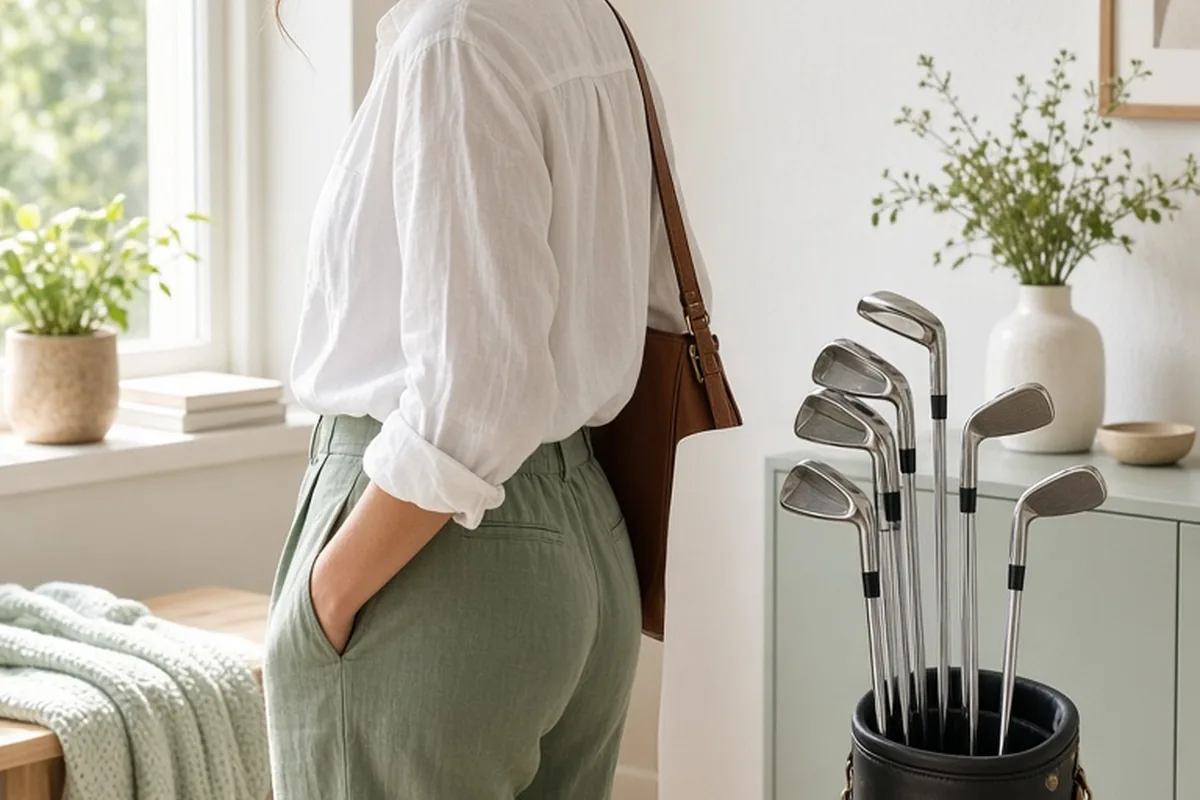
Yes, women can absolutely use men's golf clubs. Golf equipment selection depends on swing speed, physical height, athletic strength, and personal mechanics rather than gender. Many female golfers, especially those who are taller or have faster swing tempos, achieve greater distance, control, and consistent ball contact using men's senior, regular, or even stiff-flex clubs compared to standard women's models.
Walking into a pro shop or borrowing a set from a partner often brings up the question of whether golf clubs are genuinely divided by gender or if that distinction is mostly marketing. Understanding the physical mechanics behind club design helps you choose gear that matches your body and swing rather than an arbitrary label.
The Real Mechanical Differences in Club Construction
Golf equipment marketed to men and women differs primarily in physical specifications rather than proprietary technology. Standard women's sets are engineered around an assumed profile: an average height of roughly five feet five inches, moderate swing speeds, and smaller hands. To accommodate this baseline, manufacturers produce clubs that are typically one inch shorter than standard men's models, equipped with softer graphite shafts, lighter swing weights, and narrower grips. The clubheads also tend to have slightly higher lofts to assist players in getting the ball airborne with less effort.
Men's clubs, conversely, offer a much broader spectrum of configurations across weight, length, and stiffness. A standard men's set uses heavier steel or graphite shafts, standard-diameter grips, and lower lofts designed for faster acceleration through the impact zone. When a woman picks up a men's club, she is not using a different sport's implement; she is simply interacting with a different combination of mass, balance, and resistance. If her height, physical leverage, or athletic background generates more speed than an entry-level women's set can support, men's clubs often provide the stability she needs.
How Swing Speed and Shaft Flex Dictate Your Shot
Shaft flex is the measure of how much a golf shaft bends during the swing and releases at impact. When a golfer swings faster than a shaft is designed to handle, the shaft over-bends, causing erratic face angles at contact, high ballooning ball flights, and frequent hooks or pushes. Many athletic women, former college athletes, or regular gym-goers generate driver swing speeds well above seventy-five miles per hour. Standard women's clubs, built with high-flex shafts, often feel whippy and unstable in these hands, leading to inconsistent contact and lost energy transfer.
Transitioning to men's senior flex (often labeled lite or A-flex) or standard men's regular flex gives a stronger swing the structural integrity it demands. For instance, a player who consistently pulls her tee shots left with a flexible women's driver may find that a men's regular flex shaft keeps the clubface square through impact, producing a penetrating, controlled trajectory. The trade-off is that swinging a shaft that is too stiff for your natural tempo will reduce launch height and cut carry distance, making it essential to match flex to verified swing dynamics rather than guessing.
Height, Arm Length, and Static Fit Adjustments
Club length directly impacts posture, balance, and the swing plane. Standard women's clubs are proportioned for heights between five feet two inches and five feet six inches. A woman who stands five feet eight inches or taller will often find herself hunching excessively over a women's iron, disrupting her spine angle and forcing an overly steep, uncomfortable swing path. In such cases, an off-the-rack men's standard set immediately provides the upright address position required for rotational power and back comfort.
However, physical height is only one half of the equation; wrist-to-floor measurement determines the proper relationship between the club's sole and the ground. A taller golfer with relatively long arms might still require a shorter shaft than expected, whereas an average-height golfer with shorter arms may benefit from standard men's dimensions. If the club length is wrong, the sole of the club will tilt at address, pointing the toe or heel in the air and skewing horizontal accuracy. Taking basic static measurements prevents adopting a men's club that creates poor swing habits.
Managing Grip Size and Hand Fatigue
Grip thickness is one of the most immediate physical differences a player notices when holding a men's club. Standard women's grips are smaller in diameter (undisized) to accommodate smaller palm measurements and fingers. Men's standard grips are thicker, which changes how much pressure is required to hold the club securely. A grip that feels too large can inhibit the natural release of the wrists through the ball, leading to an open clubface and weak fades or slices.
Fortunately, grip sizing is the easiest and most affordable modification on any golf club. If a woman finds that the shaft weight and length of a men's iron set suit her swing perfectly, she can easily have the clubs regripped with undersize or thin standard grips. Conversely, players with larger hands or joint pain often find that standard men's or even midsize grips reduce tension in the forearms and wrists, creating a smoother, less strained takeaway and follow-through.
Clubhead Weight and Loft Considerations
Clubhead design in men's equipment emphasizes customizable lofts and varying weight distributions, ranging from ultra-forgiving game-improvement cavity backs to compact player blades. Women's clubheads are predominantly game-improvement style, engineered with deep center-of-gravity placement to maximize launch angle. When a golfer switches to men's clubs, she should pay close attention to the loft stamped on each head, especially in drivers, fairway woods, and long irons.
A standard men's driver typically features lofts between nine and ten-and-a-half degrees, whereas a women's driver often ranges between twelve and fifteen degrees. If a player does not generate high clubhead speed, moving to a low-lofted men's driver will reduce aerodynamic carry and drop total yardage. To leverage the stability of a men's club without sacrificing launch, choosing higher-lofted options—such as a ten-point-five or twelve-degree men's driver combined with an A-flex shaft—provides an optimal balance of launch height, low spin, and stability.
Navigating Shared Sets and Borrowed Gear
It is very common for couples, family members, or friends to share equipment or pass down an older men's set to someone new to the game. While using a partner's backup set is a budget-friendly way to get onto the practice range, playing with an ill-fitting set for extended periods can cause frustration or physical discomfort. If the clubs are significantly too heavy or too stiff, the player may instinctively compensate by over-swinging with their upper body, placing unnecessary stress on the lower back and shoulders.
When testing a borrowed men's set, focus on how your body feels after twenty to thirty full swings. If you notice persistent wrist strain, difficulty squaring the face, or excessive fatigue, the overall dead weight and swing weight are likely too heavy. A practical middle ground is testing individual clubs—such as a modern hybrid or a lightweight men's graphite wedge—before committing to a full bag of heavier clubs. This allows you to assess the benefits of standard length and firmer flex without overwhelming your mechanics.
The Custom Fitting Solution for Every Golfer
The modern golf industry is steadily moving away from rigid gender categorization toward data-driven custom fitting. Certified fitters utilize launch monitors to measure ball speed, launch angle, spin rate, angle of attack, and clubhead path. These empirical metrics remove guesswork and outdated assumptions, ensuring that every shaft, head, and grip is paired strictly to performance data rather than marketing demographics.
During a fitting session, many female players discover their optimal set consists of a hybrid build: lightweight men's graphite shafts in their irons, a men's senior-flex driver with adjusted loft, and undersized grips across the entire set. Investing in a professional fitting or attending a demo day allows you to hit various head-and-shaft combinations side by side. You leave with equipment built around your actual mechanics, giving you full confidence on every tee box and fairway.
Illustrative Scenarios
Finding Consistency on the Tee Box
Elena, an athletic recreational tennis player standing five feet nine inches tall, struggled with ballooning drives and wild hooks using her beginner women's boxed set. Her initial assumption was that her swing mechanics were flawed, causing her to doubt her technique and slow down her tempo. During a practice session, a teaching professional suggested she try a men's lightweight regular-flex driver with an adjusted ten-point-five degree loft. The firmer shaft prevented excess twisting at impact, immediately straightening her ball flight and adding twenty yards of carry. By replacing equipment that could not support her athletic swing speed, Elena eliminated her compensations.
Key point: Equipment that is too flexible for your natural swing speed causes erratic dispersion that no mechanical adjustment can reliably fix.
Adapting Borrowed Irons for Comfort
Marcus offered his spare set of standard men's steel-shaft irons to his partner, Chloe, so they could practice together on weekends. After two sessions, Chloe experienced hand soreness and struggled to elevate her five and six irons from the turf. Rather than forcing the heavy steel setup or buying an expensive brand-new set, they had a local shop check her swing speed. They swapped the heavy steel irons for lightweight men's graphite-shaft hybrids and installed slim, soft grips. The lighter overall weight restored her swing speed, and the revised grips removed joint strain.
Key point: Modifying specific components like grip thickness and shaft material makes standard men's clubheads comfortable and functional for different players.
Frequently asked questions
Will using men's clubs hurt my golf swing if I am a beginner?
Using men's clubs will not hurt your swing as long as the weight and length allow you to maintain balanced posture and clean rotation. If the clubs are excessively heavy or stiff, you may develop compensations to lift the ball, so lighter graphite shafts are generally recommended for beginners.
What is the best men's flex for a woman transitioning from women's clubs?
Men's senior flex (often marked as A-flex, lite flex, or senior) is typically the smoothest transition. It provides more stability and lower spin than standard women's flex without requiring the high swing speed necessary for standard men's stiff shafts.
Can I put women's grips on men's golf clubs?
Yes, any standard clubmaker or golf retail shop can install undersized or women's grips on men's club shafts. This quick, inexpensive change ensures your hands wrap comfortably around the handle without altering the club's shaft performance.
Are LPGA professionals playing with women's or men's clubs?
Most LPGA Tour players use clubheads and shaft specifications that are identical or very similar to men's tour equipment, customized to their exact swing speeds. They regularly play with men's regular, stiff, or extra-stiff shafts optimized for their elite ball-striking capabilities.
Your next step
Take your current driver or seven-iron to a local golf simulator or fitting bay to test your swing speed against men's senior and regular flex options.