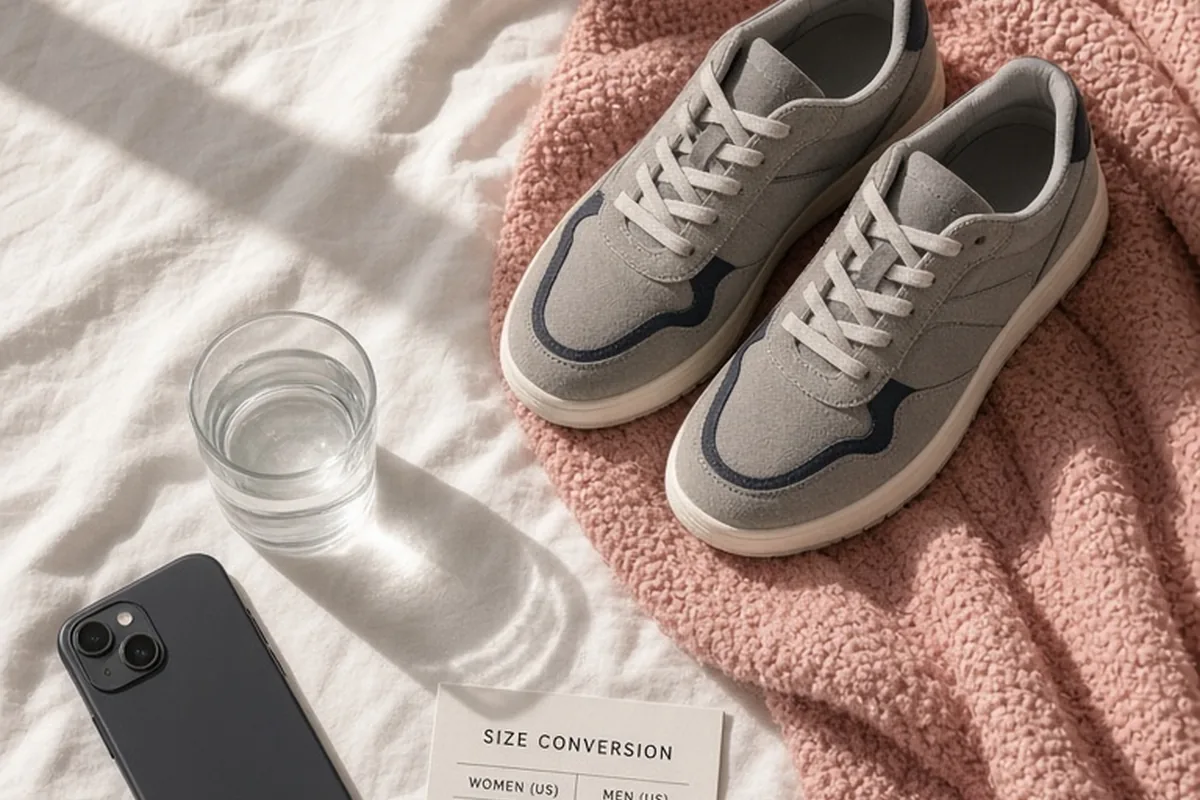
Yes, women can wear men's sneakers easily. The main differences involve sizing and width. In standard US sizing, men's shoes run approximately 1.5 sizes larger and are built on a wider D-width last compared to a women's standard B-width last. Women typically size down by 1.5 US sizes to achieve an equivalent length, though adjustments for foot width, heel shape, and brand-specific sizing charts remain essential.
Many of the most celebrated sneaker colorways, retro basketball models, and technical skate shoes are released primarily in men's sizing. Exploring men's footwear expands your available options significantly, but getting the right fit requires understanding how shoe lasts, volume, and proportions differ between categories.
Understanding the Standard Sizing Conversion Formula
The standard rule for converting women's shoe sizes to men's shoe sizes in the United States is to subtract 1.5 sizes from your usual women's size. For example, if you wear a women's US size 8.5, you will typically fit into a men's US size 7.0. If you wear a women's size 10, your baseline starting point in men's models is an 8.5. This conversion maintains an approximately equivalent internal length inside the footbed, preventing your toes from striking the front of the toe box.
While the 1.5 size drop works reliably across many popular sneaker labels, international sizing formats handle the transition differently. European (EU) sizing is generally unisex, meaning an EU 39 or EU 40 offers roughly the same footbed length regardless of whether a box is labeled for men or women. Similarly, sizing measured in centimeters (often listed as CM or JP sizing on the tongue tag) represents the absolute physical length of the footbed. Checking the centimeter measurement on a pair of sneakers that already fits you well is the most accurate way to verify your size across different brands and conversion tables.
Foot Width and Internal Volume Differences
Length is only one component of shoe geometry. The most significant structural difference between men's and women's footwear is the standard width and overall internal volume of the shoe last. In the footwear industry, a standard women's medium shoe is built on a B-width last, whereas a standard men's medium shoe is built on a wider D-width last. This means that even after you subtract 1.5 sizes for length, a men's sneaker will naturally offer more room across the ball of the foot and through the midfoot.
For women who have wider feet, high insteps, or bunions, wearing men's sneakers often provides immediate comfort and relief from the pinching sensations common in narrower women's profiles. However, women with narrow or low-volume feet may find that the extra lateral room causes their feet to slide from side to side. When lateral sliding occurs, your toes may repeatedly jam against the front bumper during sudden stops, which can cause bruising or blisters over a full day of walking.
Addressing Heel Proportions and Preventing Slippage
Beyond width across the forefoot, men's lasts feature wider, straighter heel cups. Women's feet frequently taper more dramatically from the ball of the foot back to the heel. When a woman wears a men's sneaker, the shoe's heel counter may not grip the calcaneus as snugly as a dedicated women's shoe would. This can lead to minor vertical heel slippage, where the heel lifts slightly with every stride.
To mitigate heel slippage without sizing down so much that your toes cramp, simple mechanical adjustments are highly effective. Utilizing the extra top eyelet for a runner's loop (also called lace locking) pulls the collar securely around the ankle without tightening the forefoot excessively. Alternatively, adding an aftermarket structured insole or a thin heel liner can fill negative space in the rear of the shoe, stabilizing your stride while preserving generous room for your toes to splay naturally.
Evaluating Performance Shoes Versus Lifestyle Footwear
Choosing to wear men's lifestyle or casual sneakers is straightforward because everyday walking puts relatively modest biomechanical demands on the footwear. Models such as classic canvas court shoes, retro skate sneakers, and heritage basketball shoes rely on simple cupsole or vulcanized rubber constructions that adapt comfortably to everyday wear once basic sizing and lacing are dialed in.
When selecting technical athletic footwear—such as long-distance running shoes, high-impact training trainers, or specialized trail runners—the distinctions between men's and women's designs become more consequential. Women's dedicated running models often feature lighter midsole foam densities to accommodate lower average body weights, as well as distinct flex grooves that align with a wider pelvic angle (Q-angle). If you plan to log high mileage or participate in intense athletic training, testing both dedicated women's performance models and converted men's models is advisable to confirm whether the cushioning stiffness and arch placement support your gait pattern comfortably.
Brand-Specific Conversion Nuances
Not all footwear manufacturers apply uniform conversion scales. Major athletic brands construct their lasts with subtle variations that can affect how a converted size feels on your foot. Familiarizing yourself with how specific companies calculate unisex and gendered sizing helps prevent unnecessary returns.
Keep these common manufacturer distinctions in mind when shopping across different collections:
- Nike and Jordan Brand: Follow the standard 1.5 size difference strictly (a women's US 8 is a men's US 6.5). Men's retro silhouettes tend to run true to size in length but slightly wider in the forefoot.
- Adidas: Many Adidas lifestyle silhouettes use a 1.0 size difference rather than 1.5, especially on unisex-labeled tags. If you wear a women's 8, an Adidas men's/unisex 7 often yields the best fit.
- New Balance: Utilizes the standard 1.5 conversion for US sizes, but offers multiple width options (such as D, 2E, and 4E in men's). Sticking to a standard men's D width gives a roomy, comfortable feel for average-to-wide feet.
- Vans and Converse: These brands frequently label boxes with unisex sizing prominently displayed side by side (e.g., Men's 6 / Women's 7.5). Converse Chuck Taylors often run a half size large overall, so many wearers drop 2 full sizes down from their standard women's size.
Styling Men's Sneaker Silhouettes for Balanced Proportions
Men's sneakers often carry a chunkier midsole profile, thicker padding around the collar, and a broader toe profile than their women's counterparts. When styling these silhouettes, balancing the visual weight of the footwear with the rest of your outfit creates a cohesive, intentional look rather than an oversized appearance.
Pairing broad or technical men's sneakers with relaxed, wide-leg trousers, straight-cut raw denim, or heavyweight sweatpants allows the hem to fall naturally over the top of the shoe without exaggerating the foot's footprint. If you prefer wearing slimmer bottoms, cropped cuts, or midi dresses, choosing lower-profile men's retro runners or canvas court styles provides the expanded colorway choices of men's releases while maintaining clean, streamlined lines.
Illustrative Scenarios
Adjusting for Heel Slippage in Retro Basketball Shoes
Jordan wanted a pair of high-top retro basketball sneakers that were only available in men's sizing. Knowing the standard conversion, she purchased a men's 7.5 to match her usual women's 9.0. When the shoes arrived, the toe length was perfect, but she noticed her heel lifted uncomfortably with every step because the rear cup was noticeably wider than her typical women's pairs. Instead of returning the shoes for a smaller size that would have pinched her toes, she laced them using the top eyelet with a runner's loop knot and swapped in a slightly thicker supportive insole. The adjustments locked her heel firmly into place, making the sneakers completely stable for full-day city walking.
Key point: When a converted men's shoe fits in length but feels loose in the rear, adjust the lacing pattern and internal volume rather than downsizing and compromising toe space.
Finding Relief for Wider Forefeet
Taylor frequently dealt with side pinching and blistered outer toes when wearing standard women's lifestyle sneakers, especially during long commutes. After learning that standard men's shoes are built on a wider D-width last compared to women's narrower B-width lasts, Taylor decided to try a men's retro runner converted down 1.5 sizes. The men's cut provided enough room across the ball of the foot for natural toe splay without adding unnecessary length. The pressure points along the outer edges disappeared immediately, providing comfortable all-day wear without needing to hunt down rare specialty wide-width women's models.
Key point: Men's standard D-width lasts offer a practical, widely available alternative for anyone who finds standard women's sneakers restrictive across the forefoot.
Frequently asked questions
Is a men's size 7 the exact same as a women's size 7?
No. In US sizing, a men's size 7 is approximately equivalent to a women's size 8.5 in length. Men's shoes are also built on a wider standard last (D width) than women's shoes (B width), making a men's 7 both longer and wider than a women's 7.
Do men's sneakers look noticeably bulkier when worn?
Some men's models feature slightly wider outsoles and thicker collar padding, which can add subtle visual volume. However, classic court shoes, canvas low-tops, and slim heritage runners look nearly identical on foot once properly sized to your foot length.
What is the most accurate measurement to check before buying men's sneakers?
The most reliable metric is the length in centimeters (CM or JP sizing) printed on the tongue label of your best-fitting current sneakers. Matching the centimeter length directly to the manufacturer's size chart eliminates confusion caused by brand-specific conversion variations.
Your next step
Check the centimeter (CM) measurement on the tongue label of your most comfortable current sneakers, subtract 1.5 sizes as a starting point for US men's sizing, and verify the brand's official conversion chart before purchasing.