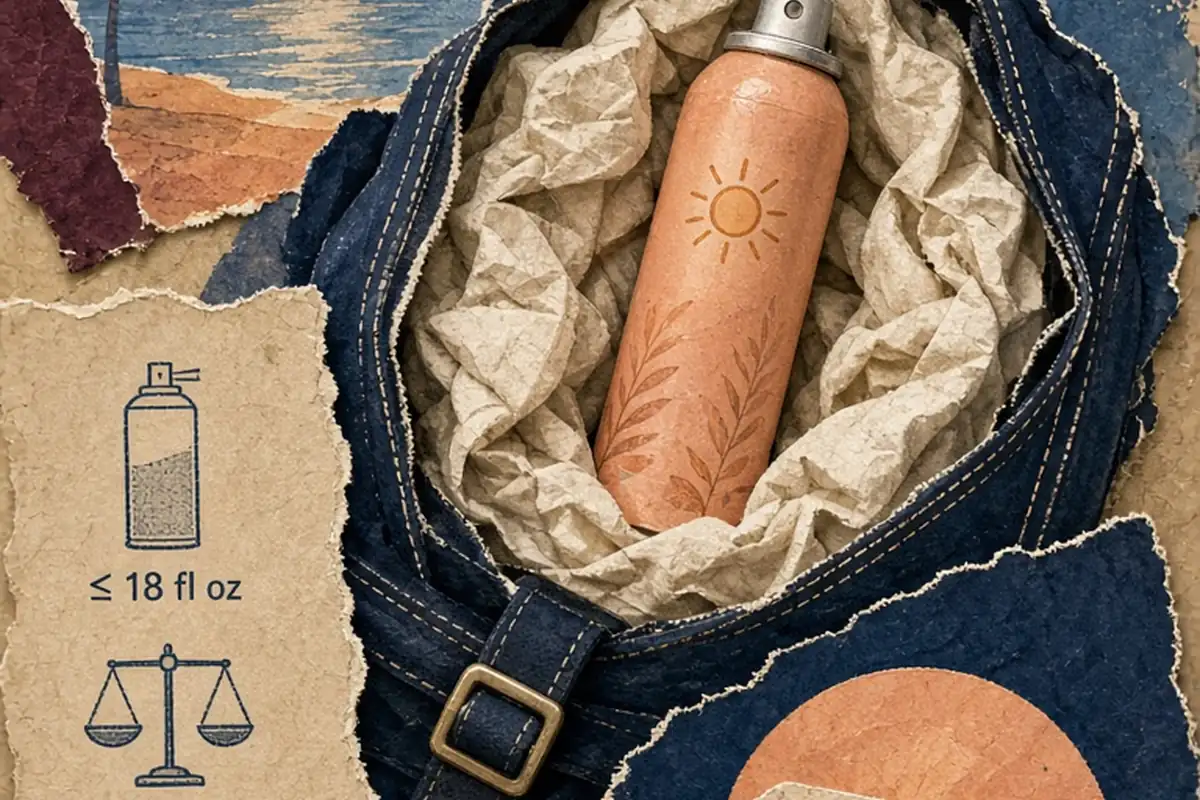
Yes, you can bring spray sunscreen in a checked bag, but you must follow specific federal limits. The Federal Aviation Administration (FAA) and TSA permit aerosol toiletries in checked luggage provided each container does not exceed 18 fluid ounces (500 milliliters) and the total aggregate volume of all medicinal and toiletry aerosols per passenger does not exceed 70 fluid ounces (2 liters).
Preparing for a sunny destination often involves gathering adequate sun protection, and aerosol sprays offer quick, convenient body coverage. However, because pressurized aerosol cans carry unique safety considerations during flight, packing them requires an understanding of aviation rules and practical luggage safeguards.
Aviation Guidelines and Quantity Allowances for Checked Aerosols
Aerosol spray sunscreens fall under the category of personal care and toiletry articles regulated by the Federal Aviation Administration and the Transportation Security Administration. Unlike carry-on bags, which strictly enforce the 3.4-ounce (100-milliliter) liquid rule, checked baggage allows standard full-sized spray cans. To comply with hazardous material regulations, the single-container maximum capacity is 18 fluid ounces or 500 milliliters. Standard retail sunscreen sprays typically range between 5 and 8 fluid ounces, meaning almost all commercially sold personal sunscreens easily satisfy this individual container threshold.
While individual cans are generally well below the single-item limit, travelers must also observe the cumulative threshold. Federal guidelines restrict the total aggregate quantity of all toiletry aerosols and non-radioactive medicinal items to 70 fluid ounces (or 2 kilograms / 2 liters) per traveler across all checked baggage. If an individual packs multiple cans of spray sunscreen alongside other aerosol items, the collective volume must remain under this ceiling. Security screeners inspect luggage using automated imaging, and luggage containing excessive quantities of pressurized canisters can trigger manual inspection or removal.
- Single container maximum: 18 fluid ounces (500 milliliters / 0.5 kilograms)
- Total aggregate maximum per passenger: 70 fluid ounces (2,000 milliliters / 2 kilograms)
- Classification: Permitted exclusively as a non-radioactive personal toiletry or medicinal item
Mandatory Valve Protection and Pressure Safety Requirements
A critical regulation that travelers often overlook is the requirement for valve protection. Federal rules mandate that the release mechanism on every aerosol container must be protected by a cap or other suitable means to prevent accidental discharge while in transit. When baggage handlers move suitcases or when items shift inside the aircraft cargo hold, unprotected actuator buttons can easily be depressed by heavy objects, discharging continuous chemical mist inside the bag.
Most standard consumer spray sunscreens feature either a removable plastic safety cap or a twist-lock integrated nozzle. Before packing, travelers should ensure that twist nozzles are fully clicked into the locked orientation or that original plastic caps snap securely into place. If a cap is cracked, loose, or missing entirely, the container does not meet safety standards and runs a high risk of being confiscated during routine baggage screening.
Calculating Total Household and Personal Aerosol Allowances
When packing for an extended vacation or a multi-person trip, it is common to pack several types of personal care sprays into a single large suitcase. However, the 70-ounce aggregate limit applies per person, not simply per can. This total pool is shared among all personal care items, including dry shampoo, hairspray, shaving foam, aerosol deodorant, insect repellent, and spray sunscreen. Packing four 6-ounce sunscreen cans already accounts for 24 fluid ounces of that individual allowance.
Consider a practical scenario where one traveler packs a suitcase containing three 6-ounce spray sunscreens (18 ounces), one 8-ounce hairspray, one 4-ounce dry shampoo, and two 6-ounce cans of insect repellent (12 ounces). The combined volume reaches 42 fluid ounces. While well within the 70-ounce individual ceiling, consolidating multiple family members' toiletries into one person's checked bag can quickly approach the limit. Distributing aerosol items across the checked bags of each traveling party member keeps individual totals transparent and compliant.
Differences Between Checked Baggage and Carry-On Packing
Understanding where to pack spray sunscreen often comes down to container size and accessibility. In carry-on luggage, the TSA 3-1-1 liquids rule requires all liquids, gels, and aerosols to be in containers of 3.4 ounces (100 milliliters) or smaller, all fitting within a single quart-sized clear zip-top bag. Because full-sized spray sunscreen cans almost always exceed 5 ounces, they cannot pass through passenger security checkpoints and must go into checked luggage.
Travelers relying exclusively on carry-on bags must seek out travel-sized aerosol sunscreens, which are generally available in 1.5 to 3-ounce formats. However, these compact cans provide very few full-body applications. For vacations lasting longer than a couple of days, packing full-sized cans in checked luggage offers substantial cost savings and eliminates the need to hunt for sunscreen upon arrival, provided the traveler accepts checked baggage fees and transit times.
Effective Packing Methods to Prevent In-Flight Leaks
Commercial aircraft cargo holds are pressurized and temperature-controlled, but they still experience mild pressure drops and vibrations during flight. While these ambient changes rarely cause intact aerosol cans to burst, minor mechanical pressure against an unprotected button can cause a slow, continuous leak. The oily chemical carrier liquids in sunscreen can stain clothing, ruin electronics, and degrade shoe leather if a leak occurs inside a packed suitcase.
To safeguard clothing and personal belongings, place each aerosol can inside an individual, heavy-duty sealable plastic bag, pressing out excess air before sealing. For added security, a small piece of painter's tape or masking tape can be wrapped around the twist-lock collar to prevent it from rotating into the open position during transit. Place the wrapped canisters in the center of the suitcase, nestled between soft clothing layers like towels or sweaters, away from the rigid outer frame or sharp shoe heels.
International Flight Variations and Destination Restrictions
While the International Civil Aviation Organization (ICAO) and the International Air Transport Association (IATA) maintain aerosol regulations broadly harmonized with FAA standards, specific airlines or destination countries may enforce distinct guidelines. Some international carriers set individual container limits at 500 milliliters (approximately 16.9 fluid ounces) and restrict the total weight to 2 kilograms per passenger. Verifying your specific carrier's hazardous materials policy is advisable when flying on foreign regional airlines.
Additionally, travelers should research local environmental ordinances at their destination. Certain coastal destinations, marine reserves, and island states (such as Hawaii, the U.S. Virgin Islands, Palau, and parts of Mexico) have enacted bans on specific chemical sunscreen ingredients like oxybenzone and octinoxate to protect coral reef ecosystems. If traveling to these locations, packing conventional chemical aerosol sunscreens may lead to confiscation at local entry points or fines if used on protected beaches, making mineral-based or reef-safe alternatives the practical choice.
Comparing Spray Sunscreens to Creams and Solid Sticks for Travel
Aerosol sunscreens offer rapid application and easy reapplication over broad areas, making them popular for beach trips and outdoor sports. However, they carry luggage trade-offs that travelers should weigh. Spray cans are relatively heavy, bulky, and contain a significant proportion of propellant gas, meaning a 6-ounce can provides fewer full-body applications than a 6-ounce lotion bottle. In windy conditions at outdoor destinations, aerosol spray can also disperse unevenly, leading to patchy coverage and accidental inhalation.
In contrast, solid sunscreen sticks and concentrated lotions maximize luggage space and eliminate the risk of accidental aerosol discharge. Sunscreen sticks do not count toward liquid limits in carry-on bags and cannot leak inside checked baggage. Many seasoned travelers choose a hybrid packing strategy: checking one or two full-sized spray cans for quick body touch-ups while carrying a lotion tube or solid mineral stick for precise facial protection and immediate use upon landing.
Frequently asked questions
Can spray sunscreen explode in a checked suitcase due to cargo pressure?
Modern commercial airplane cargo holds are pressurized, making aerosol explosions extremely rare. The primary risk during flight is accidental valve depression caused by shifting luggage contents rather than atmospheric pressure changes.
Does insect repellent with sunscreen follow the same checked baggage rules?
Yes, combination insect and sun protection sprays are classified as personal care toiletries. They are permitted in checked luggage under the standard 18-ounce individual and 70-ounce aggregate limits, provided the valve is securely capped.
What happens if a checked aerosol can is missing its original protective cap?
Aerosol cans without a protective cap or locking mechanism violate FAA safety rules and may be removed from your suitcase during TSA screening. If the original cap is lost, use a secure locking cap from another container or tape the nozzle securely before traveling.
Can I pack commercial or industrial-sized sunscreen sprays in my luggage?
No, oversized commercial cans that exceed 18 fluid ounces (500 milliliters) are prohibited in both carry-on and checked luggage. Only standard personal-sized toiletries meeting individual volume thresholds are accepted on passenger aircraft.
Your next step
Before packing, check that each sunscreen can is under 18 fluid ounces, verify that all safety caps or nozzle locks are fully secured, and place each container in a sealed plastic bag inside your checked suitcase.