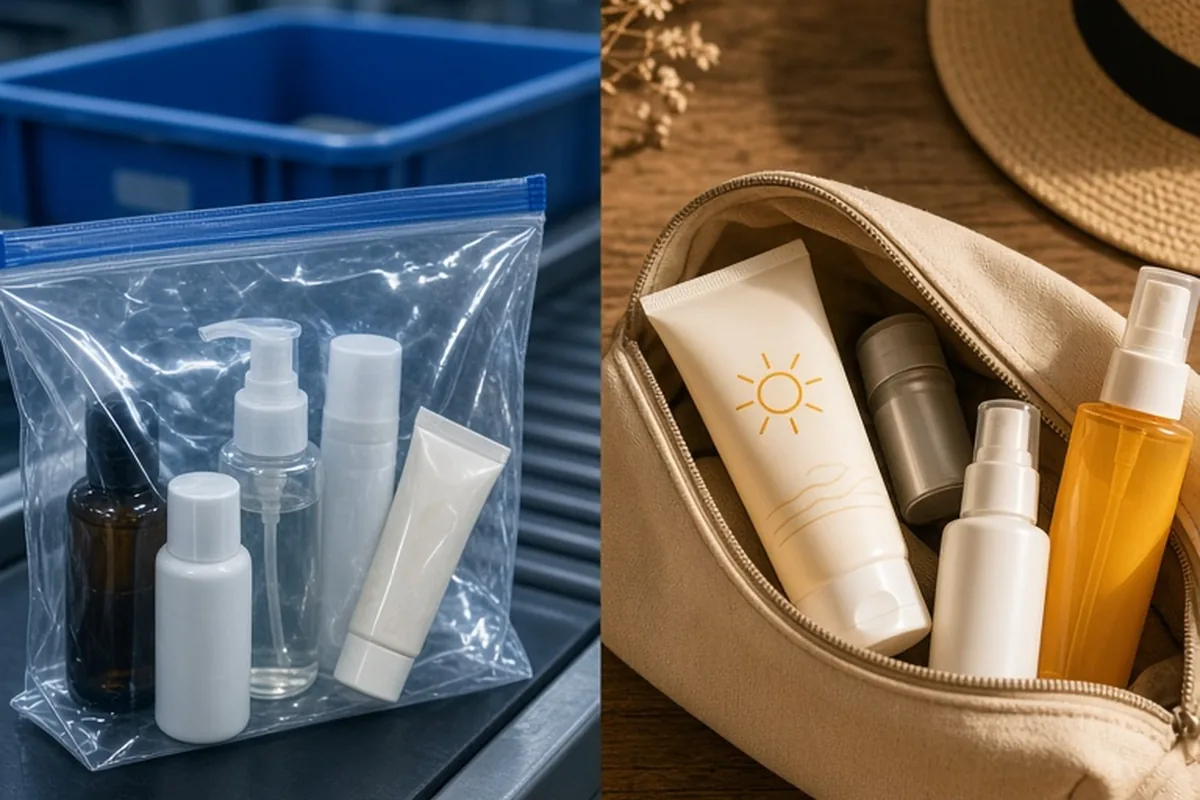
Yes, you can bring sunscreen on a plane in both carry-on and checked luggage, but specific quantity limits apply. For carry-on bags, liquids, creams, lotions, and aerosol sprays must be in containers of 3.4 ounces (100 milliliters) or less and fit inside a single clear quart-sized bag. Checked baggage allows full-size bottles and larger aerosol cans, provided they meet standard airline hazardous material volume caps and have secure caps.
Preparing your skincare routine for air travel often comes down to balancing aviation security regulations with the desire to keep your skin shielded from intense sun exposure. Knowing exactly how airport security categorizes different formulations helps prevent unexpected confiscations at the screening checkpoint.
Navigating Carry-On Liquid Rules for Sunscreen
Transportation security agencies worldwide classify traditional sunscreen lotions, gels, and creams under standard liquid and aerosol restrictions. Under the Transportation Security Administration (TSA) 3-1-1 rule in the United States and similar global civil aviation guidelines, any liquid, gel, or aerosol product placed in your carry-on baggage must be housed in a container holding no more than 3.4 ounces, or 100 milliliters. All of your travel-sized liquids must fit comfortably within a single clear, resealable quart-sized bag, which you may need to remove from your luggage for separate scanning depending on the checkpoint equipment in use.
A common point of confusion arises when travelers carry a larger container that is only partially filled. Security officers determine compliance by the stated capacity printed on the bottle rather than the remaining volume of product inside. For instance, bringing a six-ounce bottle that contains only two ounces of sunscreen will still result in confiscation at the security line. If you want to carry your preferred daily face screen or body lotion into the passenger cabin, you must transfer the formula into a certified travel-sized dispenser or purchase factory-sealed mini versions before your trip.
Packing Full-Size Sunscreen Bottles in Checked Baggage
If your itinerary involves extended beach days or outdoor sports requiring substantial amounts of body sunscreen, checked luggage provides a far more practical solution. Checked bags do not fall under the strict 3.4-ounce limit, allowing you to pack standard eight-ounce, twelve-ounce, or family-sized pump bottles without intervention from security screeners. This option lets you bring economical, high-volume products without the hassle of decanting formulas into multiple tiny containers.
However, checked baggage allowances are still subject to general airline regulations regarding medicinal and toiletry articles. In the United States, the Federal Aviation Administration (FAA) limits the total aggregate quantity of personal care items containing non-radioactive medicinal or toiletry materials to 70 fluid ounces (two liters) per passenger, with no single container exceeding 18 fluid ounces (500 milliliters). Standard retail sunscreen bottles easily fit well within these generous maximum thresholds, making checked luggage the easiest way to transport adequate sun protection for a multi-week vacation.
Choosing the Best Sunscreen Formulation for Travel
The physical consistency of your sun protection product directly impacts how security agents treat it at the checkpoint. Solid stick sunscreens are generally classified as solid toiletries rather than liquids, gels, or pastes. This distinction means that solid mineral or chemical sunscreen sticks do not count against your single quart-sized liquid bag allowance, freeing up valuable space for items like liquid serums, cleansers, or contact lens solutions.
Powdered mineral sunscreens, which frequently come with built-in brush applicators, offer another space-saving alternative for touch-ups during transit. While the TSA does subject large containers of non-essential powders exceeding 12 ounces (350 milliliters) to secondary screening, standard pocket-sized mineral sunscreen powders fall well beneath this threshold. Opting for a solid stick for broad coverage and a compact powder for mid-day facial reapplication significantly streamlines your transit experience while keeping your sun protection readily accessible.
Regulations for Aerosol and Continuous Spray Sunscreens
Continuous spray sunscreens are exceptionally popular for quick, mess-free application, but they require extra care when traveling by air. In carry-on luggage, small aerosol cans are permitted only if they conform to the 3.4-ounce limit and feature a secure mechanism to prevent accidental discharge, such as a locking nozzle or a protective plastic cap. Because continuous spray cans run out quickly due to the propellant mix, a 3.4-ounce aerosol can rarely lasts more than two or three full-body applications.
When packing larger aerosol sunscreen sprays into your checked luggage, safety guidelines require that every can possesses an intact release-prevention cap or locking collar. Baggage handlers and shifting cargo can press unprotected nozzles against other luggage contents, resulting in empty cans and ruined clothing upon arrival. If an aerosol nozzle cannot be locked or lacks a snug cap, it is safer to leave it behind and purchase a full-sized spray at your destination.
Preventing Pressure Leaks and Bottle Explosions in Flight
Aircraft cargo holds and passenger cabins experience substantial atmospheric pressure changes during ascent and descent. As the cabin altitude climbs toward cruise levels, the air trapped inside sealed plastic sunscreen bottles expands. If a container is filled to the absolute brim with liquid and trapped air, this internal expansion can pop flip-top lids, crack brittle plastic walls, and push greasy lotions across your packed wardrobe.
To safeguard your belongings against pressure leaks, adopt a few straightforward packing precautions before heading to the airport:
Squeeze a small amount of excess air out of flexible plastic bottles before tightly twisting on the cap to create slight negative pressure inside the container.
Place a small square of plastic wrap over the bottle opening before screwing the dispenser lid back down to create a leak-proof barrier.
Group liquid containers inside heavy-duty, reusable silicone travel pouches or clear zip-top freezer bags rather than thin disposable sandwich bags.
Position your sunscreen near the center of your suitcase, surrounded by soft clothing layers, to insulate the container from sudden temperature drops and mechanical impact.
- Squeeze a small amount of excess air out of flexible plastic bottles before tightly twisting on the cap to create slight negative pressure inside the container.
- Place a small square of plastic wrap over the bottle opening before screwing the dispenser lid back down to create a leak-proof barrier.
- Group liquid containers inside heavy-duty, reusable silicone travel pouches or clear zip-top freezer bags rather than thin disposable sandwich bags.
- Position your sunscreen near the center of your suitcase, surrounded by soft clothing layers, to insulate the container from sudden temperature drops and mechanical impact.
Destination Regulations and Reef-Safe Ingredients
Packing sunscreen is not merely about clearing domestic airport checkpoints; it also involves complying with environmental legislation at your destination. Several coastal regions and island territories—including Hawaii, the U.S. Virgin Islands, Palau, Aruba, Bonaire, and selected marine parks across Mexico and Thailand—have instituted legal bans on specific chemical ultraviolet filters, most notably oxybenzone, octinoxate, and octocrylene. These chemicals have been linked to coral bleaching and marine ecosystem disruption.
If you are flying to a tropical or coastal destination with reef-preservation ordinances, check your product ingredient labels before packing. Mineral sunscreens formulated with non-nano zinc oxide or titanium dioxide are widely accepted under these regional laws. Packing the correct reef-compliant formula in advance saves you from having non-compliant products confiscated at regional marine park entry points or paying premium tourist prices at resort gift shops.
In-Flight Sun Protection and Cabin UV Exposure
Many travelers pack all their sun protection away without realizing that high-altitude flights expose skin to elevated levels of ultraviolet radiation. While commercial airplane windshields and passenger cabin windows effectively filter out UVB rays—the primary cause of sunburn—standard acrylic cabin windows allow a substantial portion of UVA rays to penetrate directly into the seating area. UVA rays penetrate deep into the dermis and contribute significantly to premature skin aging and hyperpigmentation.
Because atmospheric filtration diminishes significantly at cruising altitudes between 30,000 and 40,000 feet, ambient UVA intensity is noticeably higher than at sea level. If you sit in a window seat or keep the window shade open during daytime flights, applying a broad-spectrum, travel-sized facial sunscreen before boarding and reapplying it every few hours provides valuable defense against cumulative high-altitude radiation.
Illustrative Scenarios
Streamlining Skincare for a Multi-Leg Tropical Trip
A traveler embarking on a week-long island vacation wanted to avoid checking a bag while ensuring adequate sun protection for both daily sightseeing and water activities. Rather than trying to cram three large lotion bottles into a single carry-on liquid bag, they packed a 1.7-ounce mineral face cream in their compliant clear toiletry pouch, brought two solid sunscreen sticks for easy neck and arm coverage, and scheduled a brief stop at a local market after landing to pick up an economical full-sized body lotion.
Key point: Combining travel-sized facial lotions and exempt solid sticks for your transit allows you to stay fully protected without violating carry-on restrictions or sacrificing luggage space.
Frequently asked questions
Can I bring a full-size sunscreen bottle in my carry-on bag if it is almost empty?
No, airport security regulations enforce limits based on the container volume marked on the packaging rather than the amount of lotion left inside. A full-size bottle exceeding 3.4 ounces will be confiscated at the checkpoint regardless of how empty it feels.
Does solid stick sunscreen count toward my quart-sized liquid bag limit?
Solid sunscreen sticks are categorized as solid toiletries and are exempt from the standard 3-1-1 liquid allowance. You can pack them freely in your carry-on luggage without placing them inside your clear plastic liquids bag.
Are aerosol spray sunscreens permitted in checked luggage?
Yes, you may pack aerosol sunscreens in checked baggage as long as each can does not exceed 18 ounces and is fitted with a secure cap or locking mechanism to prevent accidental release during transit.
Will sunscreen freeze or degrade in the aircraft cargo hold?
Commercial airplane cargo holds are pressurized and temperature-controlled to stay above freezing, so standard cosmetic formulas remain stable. However, packing bottles securely within clothing provides extra thermal and physical cushioning.
Your next step
Check the printed fluid ounce capacity on your sunscreen bottles today, set aside solid sticks for your personal bag, and place any full-sized containers securely in checked luggage with taped caps.