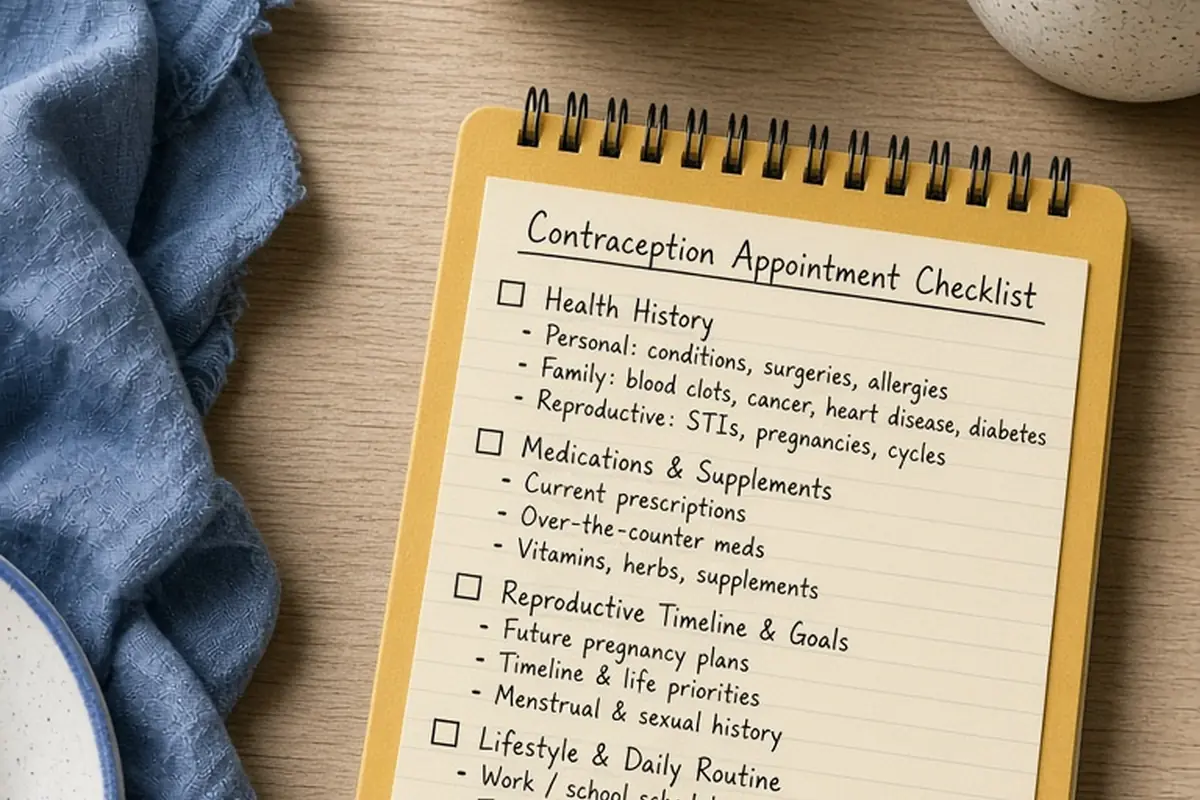
A complete contraception appointment checklist covers five core areas: your personal and family medical history, current prescriptions and supplements, your reproductive timeline, your daily routine preferences, and your insurance or payment details. Preparing these details in advance allows your clinician to eliminate medically contraindicated options, evaluate drug interactions, and help you select a birth control method that aligns with your health background, schedule, and future pregnancy plans.
Scheduling a contraceptive visit is an important step in managing your reproductive wellness, but walking into an exam room without preparation often leads to rushed conversations or missed questions. Taking time to organize your health records, lifestyle priorities, and financial questions ensures that you and your clinician can evaluate suitable options together without overlooking critical health details.
Assembling Your Medical and Prescription History Before the Visit
Your clinical history serves as the primary screening tool for determining which birth control methods are safe and appropriate for your body. Many contraceptive options contain hormones, such as estrogen and progestin, which carry specific medical precautions. Before your appointment, write down any personal history of cardiovascular issues, blood clotting disorders, stroke, uncontrolled high blood pressure, liver conditions, or breast cancer. You should also record whether you experience migraines, noting specifically whether your headaches involve sensory disturbances such as visual auras, blind spots, or tingling sensations, because estrogen-containing methods are often medically inadvisable for individuals with migraine with aura.
Equally important is a comprehensive record of everything you ingest on a regular or occasional basis. Compile a written list containing the exact names and dosages of your prescription medications, over-the-counter pain relievers, allergy medications, and dietary or herbal supplements. Certain medications, including specific anti-seizure drugs, antiretrovirals, and herbal products like Saint John's wort, can interact with hormonal contraception and lower its effectiveness or alter how your liver metabolizes the compounds. Bring your menstrual tracking data as well, noting the start date of your last menstrual period, the average length of your cycle, typical flow heaviness, and any history of debilitating cramps or irregular bleeding.
Family health history also plays a meaningful role during your consultation. Check with close biological relatives regarding any premature cardiovascular events, deep vein thrombosis, pulmonary embolisms, or hereditary cancers. If you have previously used any form of birth control, write down what you tried, how long you used it, why you stopped, and any specific physical or emotional changes you noticed. Having this documentation ready prevents memory gaps during the intake process and gives your clinician the clear clinical picture needed to recommend personalized options.
Further reading: CDC: Contraception and birth control methods
Further reading: Office on Women's Health
Mapping Your Reproductive Timeline and Lifestyle Priorities
Choosing a birth control method requires looking beyond clinical safety to assess how a method fits into your day-to-day life and long-term plans. Start by defining your reproductive goals over the next several months and years. If you hope to become pregnant in the near future, short-acting methods such as barrier options, combined oral contraceptive pills, patches, or vaginal rings allow for a rapid return to your baseline fertility once discontinued. Conversely, if you want reliable prevention for several years without thinking about daily administration, long-acting reversible contraceptives like intrauterine devices or subdermal hormonal implants may suit your timeline better.
Examine your honest daily habits and personal preferences without judgment. Oral contraceptive pills demand consistent daily adherence, often within a narrow time window depending on whether they contain combined hormones or progestin only. If your job involves erratic shift work, frequent travel across time zones, or unpredictable schedules, remembering a daily pill can become an unnecessary source of stress and missed doses. Other methods require attention on a weekly, monthly, or quarterly basis, while intrauterine devices and subdermal implants function continuously for multiple years once placed by a healthcare provider.
Consider secondary benefits and trade-offs that matter to you. Many individuals seek contraception not only for pregnancy prevention but also to manage heavy menstrual bleeding, severe dysmenorrhea, hormonal acne, or symptoms associated with conditions like endometriosis or polycystic ovary syndrome. Decide whether your priority is lighter or absent periods, cycle regularity, non-hormonal protection, or total privacy from partners or household members. Clarifying these personal priorities before you enter the exam room helps your provider tailor their guidance to your lived experience.
Further reading: CDC: Contraception and birth control methods
Further reading: Office on Women's Health
Questions to Ask About Side Effects, Insertion, and Daily Maintenance
A successful consultation is a collaborative dialogue rather than a one-way lecture. Preparing targeted questions ensures that you leave the clinic with clear expectations regarding how your body may adjust over the coming weeks and months. Start by asking your clinician about expected side effects during the initial three to six months of use. Common adjustment symptoms across various hormonal methods can include breakthrough spotting, breast tenderness, mild nausea, or temporary shifts in mood and skin clarity. Ask your provider what degree of spotting is typical, how long the adjustment window usually lasts, and at what point persistent symptoms warrant a reevaluation.
If you are considering an in-office procedure such as an intrauterine device or a subdermal implant, ask detailed questions about the insertion and removal processes. Inquire about the clinician's standard pain-management protocols for intrauterine device placement, including options for pre-procedure nonsteroidal anti-inflammatory medication, cervical numbing blocks, topical lidocaine, or non-pharmacological comfort measures. Ask how long the procedure takes, what post-placement cramping feels like, how to verify correct placement, and what the removal procedure involves when you decide to discontinue the method.
Make sure to establish clear operational protocols for routine management and unexpected issues. Ask your provider what specific steps to take if you miss a pill, experience a detached patch, or have an expelled vaginal ring, including whether and when backup barrier protection is necessary. Clarify whether the method requires an initial waiting period before it provides full contraceptive protection, as some options are effective immediately only when initiated during specific days of your menstrual cycle. Finally, establish who you should call within the practice if you experience acute side effects after clinic hours.
Further reading: CDC: Contraception and birth control methods
Navigating Contraceptive Insurance Coverage, Formulary Tiers, and Clinic Billing
Financial surprises can disrupt ongoing contraceptive care, making insurance verification a critical pre-appointment task. In the United States, preventive services mandates under federal guidelines require most non-exempt commercial health plans to cover at least one contraceptive product within each recognized category without patient cost-sharing, copayments, or deductibles. However, exemptions exist for certain religious employers, grandfathered plans, and short-term health policies, and plans may restrict zero-cost coverage to specific generic formulations or preferred formulary tiers while charging out-of-pocket fees for brand-name equivalents.
Contact your health insurance member services department before your appointment date to ask precise questions about your pharmacy and medical benefits. Ask the representative whether your plan covers office visits coded for contraceptive counseling at one hundred percent without an office copay. If you are considering a procedure like an intrauterine device or implant, request the exact medical billing codes for both the contraceptive device itself and the clinician's insertion procedure fee, as these are often billed separately. Confirm whether prior authorization is mandatory before the clinic can order the device or perform the procedure.
If you are uninsured, underinsured, or seeking care outside your primary network, ask the clinic staff about their self-pay fee schedules and sliding-scale payment options before scheduling. Community health centers, Title X family planning clinics, and specialized reproductive health organizations frequently provide subsidized or income-based clinical services and supplies. Inquire whether device manufacturers offer patient assistance programs or whether local discount pharmacy cards can reduce the out-of-pocket price of self-administered methods such as pills, patches, or barrier supplies.
Further reading: Office on Women's Health
Same-Day Procedures: What to Expect for IUDs, Implants, or Prescriptions
Depending on your clinic's scheduling practices and your medical history, you may have the opportunity to receive your chosen method during the very same visit. If you hope to have an intrauterine device or contraceptive implant placed on the day of your appointment, notify the clinic scheduling coordinator when booking. Some practices require an initial consultation visit before ordering specialty devices, while others maintain in-clinic stock and perform same-day insertions if pregnancy can be confidently excluded based on your menstrual history and recent sexual activity.
Preparing for a potential procedure requires a few practical physical steps on the day of your visit. Eat a balanced meal or light snack an hour or two before arriving to help stabilize your blood glucose levels, and stay well hydrated. Many people experience temporary vagal nerve responses, lightheadedness, or cramping during cervical manipulation or subdermal placement, and arriving on an empty stomach can exacerbate these sensations. Wear loose, comfortable clothing with two-piece separation so you do not need to undress completely if only a pelvic exam or arm placement is needed.
If you are receiving a prescription for oral contraceptives, a transdermal patch, or a vaginal ring rather than undergoing a procedure, confirm how your prescription will be fulfilled before leaving the exam room. Verify that the provider sends the order to your preferred local or mail-order pharmacy and ask how many refills are authorized on the script. Inquire whether your state allows your clinician to write a twelve-month supply all at once, which minimizes pharmacy trips and reduces the risk of unintended gaps in method adherence.
Further reading: CDC: Contraception and birth control methods
Further reading: Office on Women's Health
Post-Appointment Follow-Up, Adjustment Periods, and When to Call the Clinic
Leaving your appointment with a chosen method is the beginning of the adjustment phase rather than the end of your care. The human body often takes several menstrual cycles to adapt to changes in exogenous hormone levels or the presence of an intrauterine device. Keep a dedicated symptom journal on your phone or in a notebook during your first three to six months. Track bleeding frequency and intensity, pelvic sensations, mood patterns, breast changes, and headaches so you can share objective observations with your healthcare team rather than relying on general impressions.
Establish an explicit communication protocol with your clinic before discharge. Ask whether follow-up questions should be submitted through an online patient portal, addressed during a telehealth check-in, or handled by a telephone triage nurse. For intrauterine device users, clarify whether your provider recommends a routine thread-check visit four to six weeks post-placement or prefers that you monitor threads at home and return only if you notice changes in string length, pain, or bleeding irregularities.
Know the specific clinical warning signs that necessitate prompt professional evaluation. While mild cramping and irregular spotting are expected during early adjustment, you should contact your clinician immediately if you experience severe lower abdominal pain, high fever or chills, unusual or foul-smelling vaginal discharge, or sudden unilateral leg swelling, warmth, or pain. Persistent visual changes, shortness of breath, severe chest pain, or unmanageable depression should prompt urgent medical evaluation. Having these guidelines documented gives you confidence to navigate the adjustment period safely.
Further reading: CDC: Contraception and birth control methods
Further reading: Office on Women's Health
Frequently asked questions
Can I get an IUD or implant inserted on the same day as my consultation?
Same-day insertion depends on individual clinic policies, device inventory, and your menstrual history. Many practices can perform same-day placement if you request it when scheduling and pregnancy can be reasonably excluded. Call your clinic ahead of time to confirm their specific protocol and whether prior authorization from your insurer is required.
Do I need a pelvic exam or Pap smear to get birth control pills?
Routine pelvic examinations, Pap smears, and clinical breast exams are generally not required to safely prescribe most hormonal birth control methods, including oral contraceptive pills, patches, rings, and injections. A blood pressure measurement and a focused review of your health history are the primary clinical assessments needed. However, physical pelvic exams are necessary before placing an intrauterine device.
What should I do if my health insurance denies coverage for my chosen method?
If your insurer denies coverage or charges cost-sharing for a contraceptive product, request an official explanation of benefits to identify the denial code. Under federal rules, health plans must provide an accessible exceptions process when an alternative contraceptive is medically necessary. Your clinician can submit a letter of medical necessity detailing why non-preferred or brand-name options are required.
How long does it take for a new birth control method to become effective?
Onset of protection varies widely based on the specific method and where you are in your natural menstrual cycle when you initiate it. Some methods, such as copper intrauterine devices, provide immediate contraceptive protection, while hormonal pills, patches, rings, or implants may require up to seven full days of continuous use before you can safely rely on them without a backup barrier method.
Your next step
Review your family history and current medication list today, write down your top three lifestyle priorities, and call your insurer to confirm your specific contraceptive coverage benefits before walking into the clinic.