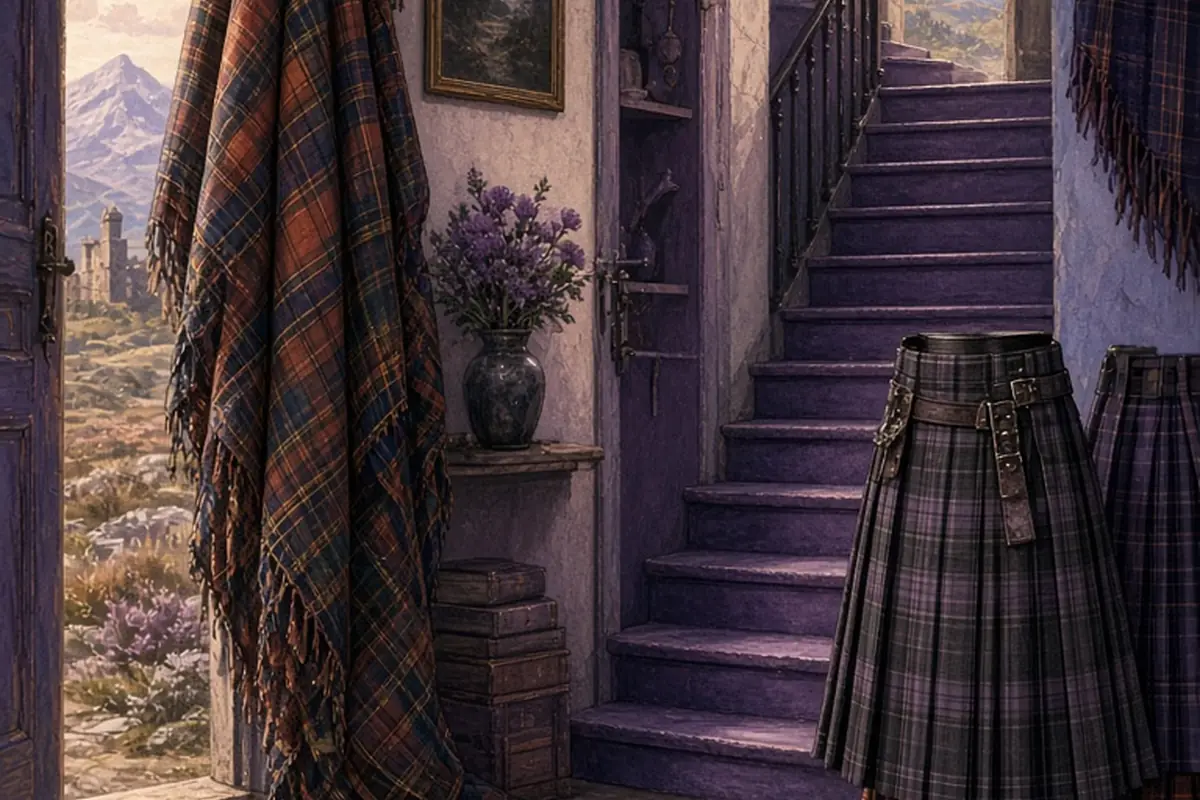
Historically, Scottish women did not wear the traditional male belted kilt; instead, they wore the earasaid, a flowing tartan draped garment. However, starting in the nineteenth century, women adopted pleated tartan kilt skirts for outdoor sports and Highland dancing. Today, women freely wear traditional kilts, pleated kilt skirts, and modern utility kilts for formal events, pipe bands, Highland games, and everyday heritage fashion without breaking cultural etiquette.
Exploring traditional Scottish clothing often raises questions about who wore what, how garments evolved, and what rules apply today. While men in the Highlands developed the belted plaid into the modern tailored kilt, women created their own sophisticated tartan traditions that met the practical and social demands of Highland life.
The Earasaid: Traditional Highland Dress for Women
In the sixteenth, seventeenth, and early eighteenth centuries, Highland women did not wear the belted plaid (feileadh mòr) associated with male clansmen. Instead, their signature traditional dress was the earasaid (also spelled arisaid or arisad). The earasaid was a wide length of woven wool, typically unlined and dyed in lighter, brighter tartan or plaid patterns with large fields of white, cream, red, or green. Rather than being sewn into fixed pleats, it was gathered around the waist with a leather belt and fastened at the breast with an ornate silver or brass brooch.
The earasaid served as both clothing and shelter against harsh Scottish weather. The upper section could be pulled over the head as a protective hood or folded across the shoulders like a mantle during heavy rains and cold winds. Beneath the earasaid, women wore a long linen shift (chemise) and petticoats. This garment offered maximum versatility for working in rural crofts, caring for livestock, and attending formal community gatherings without restricting movement or compromising warmth.
Victorian Revival and the Rise of the Kilt Skirt
The nineteenth century brought a romanticized revival of Scottish heritage, largely driven by Queen Victoria and Prince Albert's fondness for the Scottish Highlands and Balmoral Castle. As tartan surged in international popularity, tailors began adapting traditional male Highland clothing into fashionable garments for women. This period marked the birth of the tailored tartan kilt skirt, designed with deep pleats, buckled leather straps, and fringed aprons patterned directly after men's kilts.
These new skirts quickly moved beyond high-fashion parlors into practical sporting wear. Active Victorian and Edwardian women adopted sturdy wool kilt skirts for hillwalking, cycling, golfing, and shooting, appreciating the heavy fabric's durability and natural water resistance. Highland dance competitions also evolved during this era; while early dancers were predominantly male soldiers, female competitors eventually entered the arenas, requiring standardized Highland dress that incorporated either tailored kilt skirts or the distinct Aboyne dress.
Pipe Bands, Military Influence, and Identical Kilts
Throughout the twentieth century, civilian and military pipe bands played a crucial role in normalizing women wearing identical kilts to men. As women earned places as drummers and pipers in competitive and ceremonial bands, band uniforms prioritized cohesion and visual symmetry. Rather than creating separate skirt patterns, bands fitted all members in full-weight, eight-yard wool kilts in matching regimental or clan tartans.
This shared standard reinforced the kilt as a functional performance garment rather than an exclusively male uniform. Today, female pipers, drummers, and Highland athletes wear standard eight-yard and five-yard kilts on identical terms with their male counterparts. This practical adoption demonstrated that the dignity and presence of the kilt come from its construction, movement, and heritage rather than the gender of the person wearing it.
Key Differences in Construction, Fit, and Fastening
When purchasing or wearing a kilt today, women have several styling and construction options depending on the setting and personal comfort. Traditional men's kilts fasten with the outer apron overlapping from right to left, secured with leather straps on the left hip. Many custom women's kilt skirts reverse this fastening so the outer apron overlaps from left to right, following traditional womenswear conventions, although modern unisex and band kilts often retain the classic right-to-left wrap.
Body proportions also affect how a kilt sits. Traditional male kilts are designed to sit high on the natural waist, usually two inches above the belly button, falling straight over narrower hips to the middle of the kneecap. Women's kilt skirts and bespoke female kilts frequently incorporate a shaped waistband, flared pleating across the hips, and flexible drop lengths ranging from above the knee to ankle length. Choosing between a tailored skirt and a structured box-pleated kilt depends on whether you want a lighter everyday drape or the substantial swing of sixteen-ounce woven wool.
How Women Style Clan Tartans and Formal Highland Accessories
Women have broad freedom when accessorizing tartan for formal occasions such as weddings, ceilidhs, and St. Andrew's Day banquets. If you choose not to wear a full kilt or kilt skirt, a traditional and popular alternative is the tartan sash. Worn over an evening gown or white blouse, the sash is pinned at the shoulder with a clan brooch. Formal heraldic tradition suggests pinning the sash on the right shoulder for clan members, chiefs' wives, and standard wearers, or on the left shoulder for spouses of clan chiefs and specific dynastic ranks, though contemporary wear is generally flexible.
When wearing a structured kilt skirt, accessory choices should complement the silhouette without cluttering it. While men traditionally wear a front-facing leather or fur sporran, women wearing kilt skirts often omit the sporran in favor of a sleek side bag, or choose an understated, smaller pouch to avoid distorting the garment's front apron. Pair your kilt with clean leather brogues, Ghillie flats, or heeled boots, adding a subtle kilt pin to the lower right corner of the outer apron for both weight and decorative balance.
Highland Games and Event Etiquette for Guests and Participants
Attending Highland games or Scottish cultural gatherings does not require Scottish ancestry or rigid traditionalism. Guests of all backgrounds are welcome to wear tartan, provided the garments are treated with respect and situational awareness. If you do not belong to a specific Scottish clan, universal patterns such as Black Watch, Royal Stewart, Scottish National, or district and state tartans are classic, universally accepted choices.
For daytime festivals and outdoor events, practical comfort should guide your outfit. A pleated knee-length tartan skirt or a durable utility kilt made of heavy cotton canvas pairs naturally with a casual knit sweater, a tailored jacket, or a simple collared shirt. Avoid overly theatrical costume pieces, plastic accessories, or novelty items that treat heritage wear as a caricature, and instead lean toward clean tailoring and functional outdoor layers.
Illustrative Scenarios
Navigating Formal Attire for a Scottish Wedding
Elena was invited to a formal evening wedding in Edinburgh and wanted to honor her host's heritage without making an etiquette misstep. Initially, she worried that wearing a tartan kilt skirt might be seen as wearing a costume or overstepping cultural boundaries since she was not Scottish by birth. Instead of guessing, she consulted the wedding party dress code and chose a knee-length pleated skirt in the universal Isle of Skye tartan, paired with a dark velvet blazer and low leather pumps. Her outfit was praised by local guests for its understated elegance and respectful nod to Highland tradition.
Key point: Selecting universal tartans and pairing them with tailored contemporary pieces allows you to celebrate Scottish tradition tastefully without infringing on specific clan customs.
Fitting a Band Kilt for Performance Comfort
Rachel joined a regional pipe and drum corps and was issued a heavy wool eight-yard band kilt. Because the garment was tailored on a traditional straight-sided block, the waistband dug into her ribs while the front apron pulled unevenly across her hips during marches. Rather than continuing with an uncomfortable fit, she took the kilt to a certified kiltmaker to have the side buckles adjusted and the waistband shaped slightly to fit her natural waistline without altering the regimental pleat pattern.
Key point: Proper adjustments to buckles and apron rise ensure that heavy wool performance garments hang evenly and remain comfortable through hours of movement.
Frequently asked questions
Is it considered culturally acceptable for women to wear kilts?
Yes, women wear kilts, pleated kilt skirts, and tartan sashes regularly across Scotland and worldwide. Modern Highland culture embraces women wearing tartan in pipe bands, dance competitions, formal dinners, and daily life.
Do women wear sporrans with their kilts?
Women playing in pipe bands or participating in formal ceremonies often wear sporrans as part of their standard uniform. In casual or semi-formal settings, many women omit the sporran and use a small leather shoulder bag or clutch to keep the front apron smooth.
Can women wear any clan tartan they like?
While anyone can technically purchase any tartan, tradition favors wearing your own clan tartan, a partner's tartan, or a universal design. Tartans such as Black Watch, Isle of Skye, and Scottish National are open for anyone to wear without specific clan affiliation.
Your next step
To start incorporating Scottish dress into your wardrobe, measure your natural waist and drop length, choose an open or personal tartan, and select a well-made pleated kilt skirt or sash tailored to your occasion.