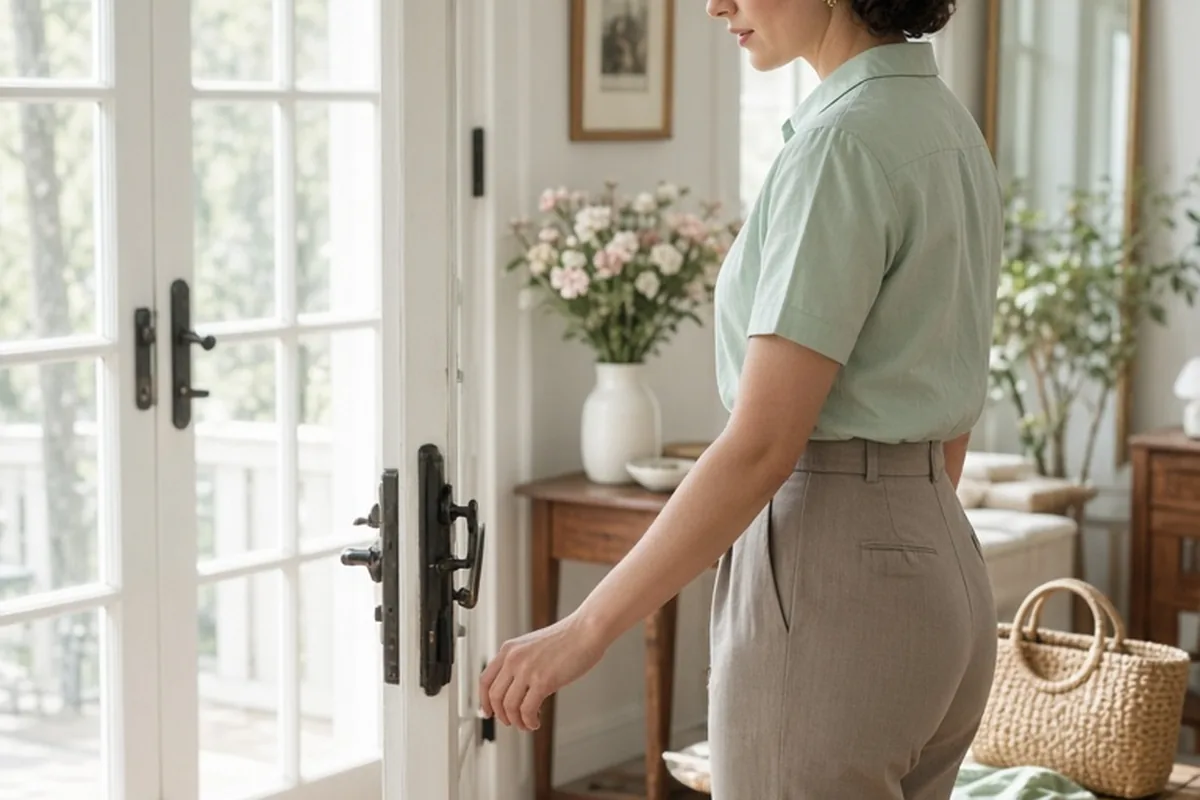
Yes, women frequently wore pants during the 1950s, though mostly in casual, domestic, and recreational settings. Popular styles included high-waisted cigarette pants, pedal pushers, capris, and denim dungarees. However, strict social etiquette and institutional dress codes still required skirts or dresses for school, church, white-collar workplaces, and formal public outings.
Popular imagery of the 1950s often centers on full-skirted dresses and tailored pencil silhouettes, but everyday wardrobes were far more diverse. Postwar changes in lifestyle, suburban living, and garment manufacturing allowed trousers to become a staple for women across North America.
The Rise of Suburban Leisure and Casual Domestic Wear
The economic expansion and suburban migration of the 1950s fundamentally changed how families spent their time at home. As more households moved into single-family homes with backyards and informal living spaces, daily wardrobes adapted to prioritize comfort and practicality. Women engaged in active gardening, home maintenance, informal neighborhood hosting, and childcare found structured dresses with stiff petticoats impractical for routine chores. Trousers stepped into this gap as functional everyday wear that allowed free movement while remaining tidy and presentable.
This shift marked a quiet evolution in domestic presentation rather than a full rebellion against femininity. Women paired tailored slacks with tucked-in knit sweaters, collared blouses, or halter tops for backyard cookouts and relaxed Saturday afternoons. Wearing pants around the house became culturally acceptable because it was framed as practical domestic efficiency. The trade-off remained clear: trousers were embraced as leisurewear for private and semi-private spaces, but stepping outside that domestic circle required careful attention to social context.
Popular Trouser Styles and Defining Silhouettes
The 1950s introduced distinct trouser cuts that differed sharply from the wide-legged, utility-focused slacks of the 1940s wartime era. Designers emphasized structured tailoring, high natural waistlines, and tapered ankles that maintained an hourglass silhouette. Women had several specific cuts to choose from depending on the season and setting, each offering a specific balance of modesty, comfort, and visual style.
Understanding these cuts clarifies how versatile mid-century casual fashion actually was across different age groups and regions:
Cigarette Pants: Fitted closely through the hip and thigh, tapering all the way to the ankle bone with a side or back zip to keep the front flat.
Capri Pants: Ending several inches above the ankle, often featuring small side slits at the outer hem for ease of movement.
Pedal Pushers: Hitting right below the knee, originally popularized for cycling and warm-weather outdoor activities.
Bermuda Shorts and Culottes: Knee-length tailored alternatives that provided the ease of pants while maintaining a conservative, modest profile.
Dungarees and Blue Jeans: Heavy cotton denim trousers, often worn with rolled cuffs for yard work, farming, or informal teenage gatherings.
- Cigarette Pants: Fitted closely through the hip and thigh, tapering all the way to the ankle bone with a side or back zip to keep the front flat.
- Capri Pants: Ending several inches above the ankle, often featuring small side slits at the outer hem for ease of movement.
- Pedal Pushers: Hitting right below the knee, originally popularized for cycling and warm-weather outdoor activities.
- Bermuda Shorts and Culottes: Knee-length tailored alternatives that provided the ease of pants while maintaining a conservative, modest profile.
- Dungarees and Blue Jeans: Heavy cotton denim trousers, often worn with rolled cuffs for yard work, farming, or informal teenage gatherings.
Social Etiquette, Formal Spaces, and Institutional Dress Codes
Despite the popularity of casual slacks, the 1950s maintained rigid boundaries regarding where pants could be worn. Public institutions, corporate offices, public schools, and religious institutions strictly enforced skirt-only dress codes for women and girls. A woman entering a department store, a restaurant, a business office, or a house of worship in pants would typically face social disapproval or outright denial of entry. Etiquette manuals of the era explicitly warned that trousers belonged exclusively to sport and home settings.
This boundary created a dual wardrobe for mid-century women. A homemaker or working woman might start her morning in denim or cropped slacks while doing housework, change into a dress and stockings to run errands downtown or attend a parent-teacher meeting, and return to comfortable slacks in the evening. Navigating these expectations required careful planning, as ignoring dress norms carried social consequences that could affect personal reputations and professional standing.
Hollywood Influence and the Glamorization of Slacks
Celebrities and film icons played a decisive role in making trousers feel chic, aspirational, and feminine. Actresses like Audrey Hepburn, Marilyn Monroe, Brigitte Bardot, and Grace Kelly demonstrated that wearing pants did not mean sacrificing elegance. Audrey Hepburn, in particular, popularized the minimalist aesthetic of black cigarette pants paired with black turtlenecks and ballet flats, turning casual trousers into a symbol of European-influenced sophistication.
Similarly, television programs brought pants directly into the living rooms of millions of viewers. Lucille Ball frequently wore trousers on I Love Lucy during domestic scenes, normalizing slacks as standard clothing for active, modern women. By presenting trousers as fashionable rather than merely utilitarian, media representation dismantled older stigmas that associated women in pants with wartime emergency labor or an absence of refinement.
Youth Culture and the Emergence of Denim
The 1950s saw the emergence of a distinct teenage demographic with its own cultural identity, music, and fashion preferences. Teenage girls, often referred to in media as bobby soxers, embraced denim jeans and dungarees as a statement of relaxed independence. They paired rolled-up jeans with oversized men's button-down shirts, saddle shoes, and white crew socks, creating a casual counterpoint to the formal, ladylike expectations promoted by adult fashion magazines.
This youth trend met significant pushback from school administrators and conservative commentators who viewed denim as unkempt or rebellious. Many high schools updated their dress codes specifically to ban denim and trousers for female students, requiring skirts that reached past the knee. For young women, wearing jeans during weekends was an accessible way to establish camaraderie with peers while enjoying the freedom to move naturally without the restrictions of girdles and petticoats.
How to Style 1950s-Inspired Pants for Modern Wardrobes
Incorporating 1950s trouser styles into a modern wardrobe allows you to enjoy classic tailoring and clean lines without looking like you are wearing a period costume. The secret lies in balancing the structured, high-waisted cut with contemporary basics and functional footwear. High-rise cigarette or ankle-grazing capri pants naturally define the waist and offer a clean silhouette that works in both creative office settings and casual social environments.
To achieve a balanced look, pair high-waisted, slim-fit cropped trousers with a tucked-in fitted tee, a modern silk button-up, or a boxy cropped cardigan. Keep accessories streamlined with minimalist leather loafers, clean low-profile sneakers, or pointed-toe flats. By focusing on quality fabrics like structured cotton-twill, wool blends, or heavy stretch ponte, you capture the tailored elegance of the mid-century look while retaining modern ease of movement.
Illustrative Scenarios
Navigating Vintage Authenticity in Modern Styling
Elena, an interior designer, wanted to incorporate authentic 1950s fashion into her work wardrobe. Her first attempt involved pairing reproduction high-waisted cigarette pants with a vintage petticoat-era blouse, cat-eye glasses, and heavy retro styling. At a professional client consultation, she felt overly theatrical and self-conscious about looking like she was wearing a costume rather than a professional outfit. Instead of abandoning mid-century cuts entirely, Elena decided to isolate the cigarette pants as a standalone statement piece. She paired them with an unadorned cashmere crewneck, neutral leather loafers, and a structured modern tote bag.
Key point: Vintage silhouettes look natural and polished when balanced with understated, contemporary wardrobe basics rather than full period accessories.
Frequently asked questions
Could women wear pants to work in the 1950s?
In white-collar offices, retail stores, and schools, women were almost universally expected to wear skirts or dresses. Pants were generally restricted to manual labor, agricultural work, and specific industrial roles remaining from the postwar transition.
What is the difference between capri pants and pedal pushers?
Capri pants generally taper down the calf and end just above the ankle bone, often featuring small side slits. Pedal pushers are slightly shorter, terminating just below the knee, originally designed to keep fabric clear of bicycle chains.
Did high schools allow girls to wear pants in the 1950s?
Most middle and high schools had formal dress codes that strictly prohibited girls from wearing slacks, jeans, or shorts during class hours. Exceptions were made occasionally for outdoor physical education classes or severe winter weather in rural districts.
Your next step
To explore 1950s casual style for yourself, try a pair of high-waisted, ankle-length cigarette pants paired with a simple tucked-in knit top and classic flat shoes.