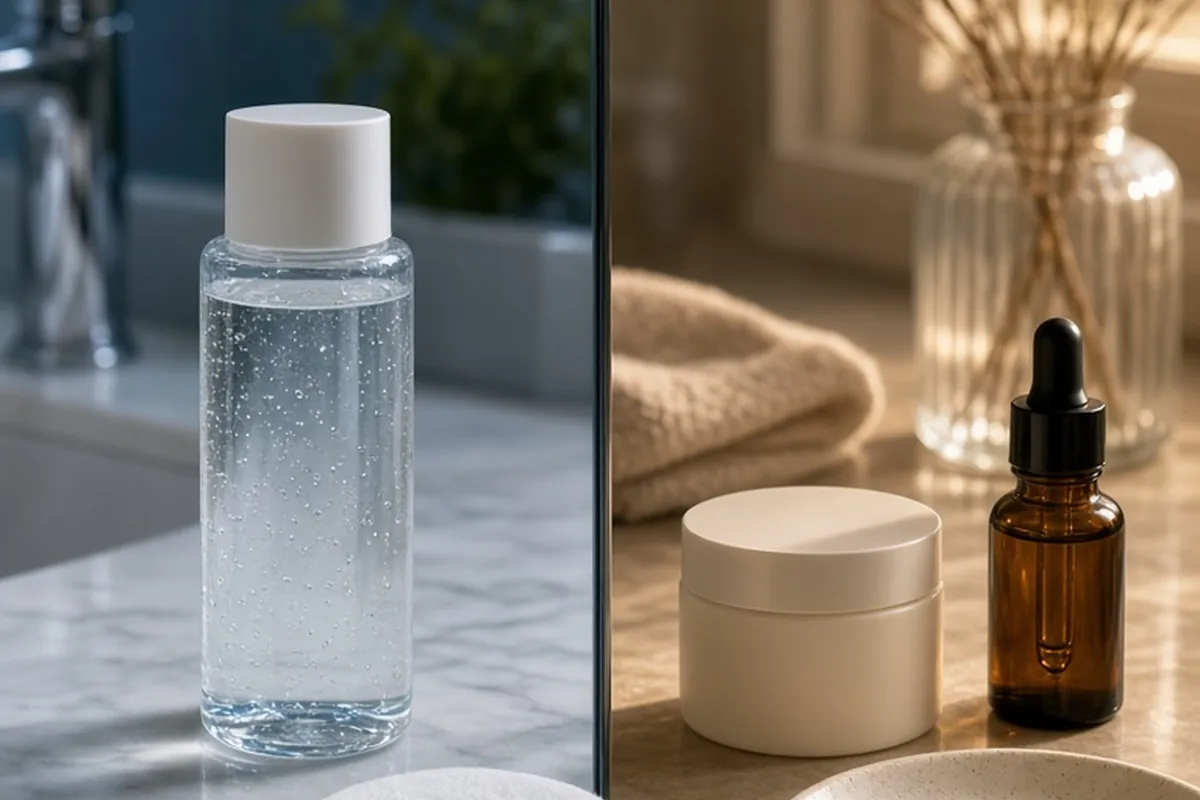
Toner always goes before moisturizer. In a standard skincare routine, products should be applied from the thinnest consistency to the thickest consistency. Because toner is lightweight and water-based, applying it directly after cleansing allows it to hydrate the skin surface and balance pH levels. Moisturizer is thicker and contains emollients or oils, designed to lock in hydration. Applying moisturizer first would block the toner from absorbing.
Navigating the correct order of skincare products can quickly become confusing when multiple bottles, liquids, and creams sit on your bathroom counter. Knowing precisely when to apply each formula ensures your skin receives the maximum benefit from your daily routine without wasting expensive products.
The Core Rule of Skincare Product Layering
The fundamental rule of skincare layering is straightforward: always apply products from the thinnest, most watery texture to the thickest, richest consistency. Toners have a fluid, water-like viscosity, whereas moisturizers are emulsions containing water, oils, humectants, and occlusives. Because water cannot easily penetrate oil or dense waxes, applying a lightweight liquid over a heavy cream causes the lighter product to pool on top of the skin, evaporate into the air, and offer virtually no benefit to the skin barrier.
When you apply your lightweight toner first, it easily saturates the outer layer of the epidermis, delivering immediate hydration and any targeted active ingredients directly to clean skin. Subsequent layers, such as treatment serums and creams, can then rest comfortably over that hydrated base. This sequential approach respects the molecular structure of modern skincare formulations, allowing each product to perform its intended job without interfering with the absorption of the next step.
How Toner Prepares the Skin Surface
Historically, toners were formulated primarily with high concentrations of astringent alcohol to strip away excess sebum and soap residue left behind by harsh, alkaline cleansers. Modern toners, however, serve a vastly different purpose. Today's formulas are formulated to replenish immediate hydration, rebalance the skin's surface pH after washing, and prime the stratum corneum so that it becomes more permeable and receptive to subsequent treatments.
Think of your skin like a dry kitchen sponge. If you place a thick drop of dish soap or lotion onto a stiff, completely dry sponge, the liquid simply sits on the surface without sinking in. If you lightly dampen the sponge with water first, it immediately becomes supple, absorbent, and capable of drawing in whatever you place on top. Applying a hydrating toner performs that exact dampening step for your face, ensuring your serums and moisturizers glide on smoothly and absorb more uniformly across your entire complexion.
The Protective and Sealing Role of Moisturizer
Moisturizers serve as the ultimate protective seal in a basic skincare routine. While toners introduce water and water-soluble humectants like glycerin, hyaluronic acid, or panthenol to the surface, that water will quickly evaporate into the environment through transepidermal water loss if it is left unsealed. Moisturizers contain a blend of emollients to smooth rough skin texture and occlusive agents like ceramides, squalane, shea butter, or dimethicone that form a breathable physical barrier over the skin.
Because of this protective barrier, placing moisturizer on before toner acts like putting an umbrella up before stepping into a gentle shower. The water-based toner cannot penetrate through the lipid-rich layer of the moisturizer. To get the full benefits of both products, the moisturizer must always come after the toner, functioning as the lid that traps all the humectant hydration underneath and shields your skin against dry air, indoor heating, and external stressors.
Where Other Steps Fit Between Toner and Moisturizer
A complete skincare regimen frequently involves more than just washing, toning, and moisturizing. If you use targeted treatments such as vitamin C serums, hyaluronic acid boosters, niacinamide, or prescription retinoids, these steps generally sit in the middle of your routine between your toner and your moisturizer. Applying toner first creates a receptive canvas, allowing these concentrated active ingredients to spread evenly across the face.
To maintain optimal application order, follow a clear progressive sequence from morning to night. In the morning, you will generally finish with sunscreen, whereas in the evening, your moisturizer may be your final step or be followed by an optional facial oil.
Understanding where each common product fits helps prevent confusion when building a customized routine that matches your specific daily needs:
- Cleanser: Removes oil, dirt, makeup, and sunscreen from the surface.
- Toner: Rebalances pH and provides the first layer of light hydration.
- Essence or Treatment Lotion: Delivers concentrated hydration just after toner.
- Targeted Serums: Addresses specific concerns like discoloration, texture, or fine lines.
- Eye Cream: Hydrates delicate under-eye skin before heavier face creams.
- Moisturizer: Locks in all previous water-based layers and supports the skin barrier.
- Facial Oil or Sunscreen: Facial oils go last at night to lock in moisture; broad-spectrum sunscreen is always the final step in the morning.
Different Types of Toners and How Application Varies
Not every toner functions identically, and understanding which variety you have will determine the best way to apply it before your moisturizer. Hydrating toners rich in botanical extracts, beta-glucan, and humectants are meant to be patted directly into the skin with clean hands. You do not need to let a hydrating toner dry down completely before moving on to your moisturizer; in fact, applying your moisturizer while the skin is still slightly dewy helps humectants bind even more moisture to the skin surface.
Exfoliating toners containing alpha hydroxy acids like glycolic or lactic acid, or beta hydroxy acids like salicylic acid, require slightly different handling. These clarifying formulas are often swept over the face using a reusable cotton pad to remove dead skin cells and clear pore congestion. Unlike gentle hydrating toners, it is often helpful to allow an exfoliating acid toner a minute or two to settle and work at its low pH before applying a richer moisturizer over top to soothe the barrier.
Common Layering Mistakes and Practical Fixes
One frequent error is waiting too long between applying a hydrating toner and applying moisturizer. If you allow a water-based toner to evaporate completely in a dry or air-conditioned room, it can actually pull moisture out of the upper skin layers, leaving your face feeling tighter than before. The ideal window to apply your serum or moisturizer is within thirty to sixty seconds of applying your toner, while your face still feels noticeably cool and damp.
Another common misstep is relying on toner as a complete replacement for moisturizer, especially among individuals with oily or combination skin. While a hydrating toner feels light and refreshing, it lacks the lipid content required to sustain the skin barrier over many hours. Skipping moisturizer entirely after toner can lead to rebound oiliness as your sebaceous glands attempt to compensate for the missing lipid barrier. Even oily skin types benefit from following toner with an oil-free, lightweight gel moisturizer.
Tailoring the Routine to Your Skin Type
Individual skin types will influence how much product you use and how rich your following steps should be. If you have dry or dehydrated skin, you might benefit from the popular layering technique of applying two or three light splashes of hydrating toner consecutively before sealing everything in with a dense, ceramide-packed moisturizing cream. This stacks multiple layers of water-based hydration without creating a heavy or greasy feel.
If you have sensitive or reactive skin, simplicity is key. Choose an alcohol-free, fragrance-free toner with calming ingredients like centella asiatica, colloidal oatmeal, or green tea extract. Apply a moderate amount, let it soothe any post-wash redness, and promptly follow with a minimalist, barrier-repairing moisturizer. Keeping your product count low and maintaining the correct toner-before-moisturizer order minimizes friction and reduces the chance of irritation.
Frequently asked questions
Should I let my toner dry completely before applying moisturizer?
If you are using a hydrating toner, apply your moisturizer while your skin is still slightly damp to lock in maximum hydration. If you are using an exfoliating acid toner with AHAs or BHAs, give it one to two minutes to absorb and perform its chemical exfoliation before applying your moisturizer.
Can I skip moisturizer if my toner is very hydrating?
It is generally not recommended to skip moisturizer even if your toner feels deeply hydrating. Toners provide water and humectants but lack the emollient and occlusive ingredients needed to prevent that moisture from evaporating into the air throughout the day.
Do I use cotton pads or my hands to apply toner before moisturizer?
You can use either method depending on the type of toner. Hydrating and soothing toners are best applied by pressing a few drops directly into your skin with clean hands to prevent product waste, while exfoliating toners work well when swept across the face with a soft cotton pad.
What happens if I accidentally put moisturizer on before toner?
Your skin will not be harmed, but the toner will be unable to penetrate the oily barrier created by the moisturizer and will simply sit on top or evaporate. For your next routine, simply return to the correct order by cleansing, applying toner to bare skin, and finishing with moisturizer.
Your next step
For your next skincare routine, place your toner bottle directly beside your cleanser so you remember to apply it onto fresh skin before reaching for your moisturizer.