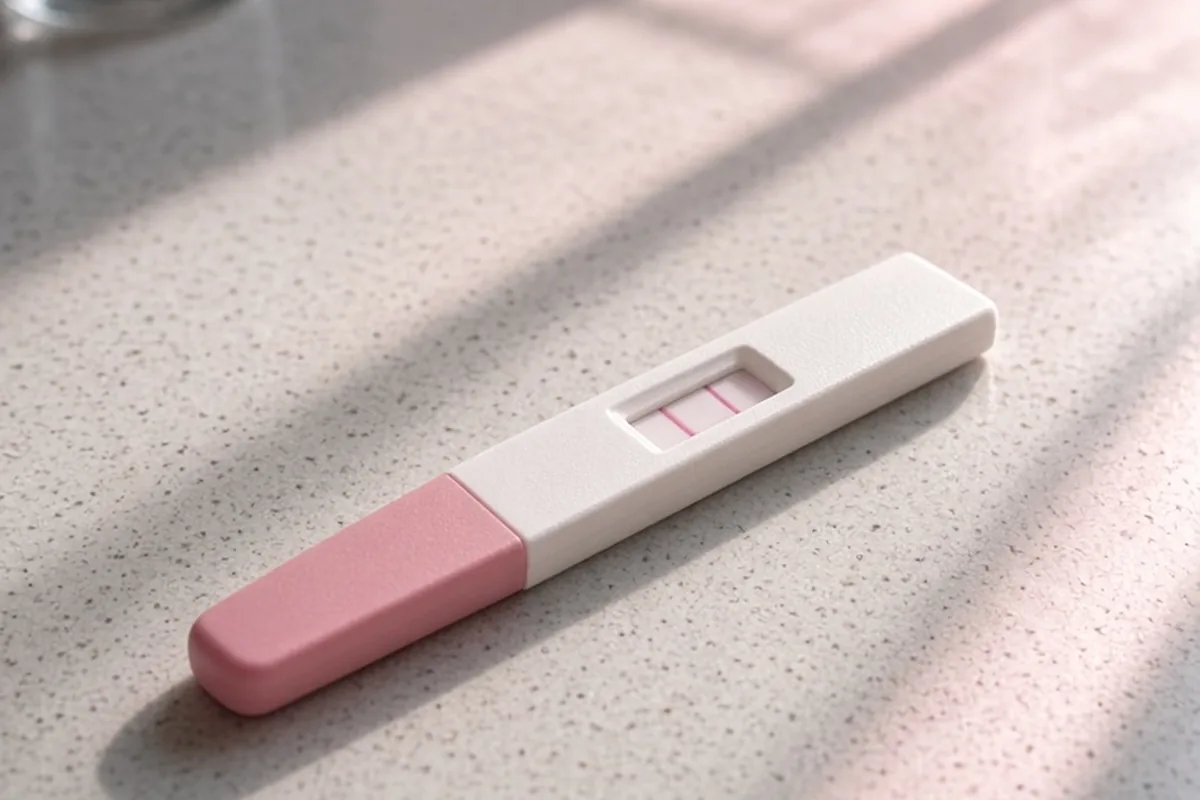
An evaporation line is a faint, colorless, or grayish mark that appears after urine dries on a test strip, usually well past the manufacturer designated reading window. A faint positive displays distinct pigment, such as pink or blue matching the test dye, and appears within the strict reading timeframe, signaling the detection of human chorionic gonadotropin. Line color and timing are the two most reliable factors for distinguishing between the two.
Staring at an ambiguous line on a home pregnancy test can bring an immediate wave of confusion and anxiety. Because home pregnancy tests rely on chemical dye reactions across absorbent paper strips, ordinary drying processes can occasionally leave behind confusing physical marks that mimic an early positive result. Understanding the scientific differences between dye activation, physical indents, and evaporation marks helps you interpret your results accurately without unnecessary guesswork.
Color and Pigment: Identifying True Dye vs Dried Indents
The presence of true color is the most critical distinction between an evaporation line and a faint positive result. Home pregnancy tests utilize immobilized antibodies paired with colored dye particles, usually pink colloidal gold or blue latex beads. When human chorionic gonadotropin (hCG) is present in the urine sample, it binds to these mobile antibody-dye conjugates. As the fluid travels across the nitrocellulose membrane via capillary action, the conjugated molecules become trapped at the test line zone, creating a visible stripe that matches the specific dye color of the test brand.
An evaporation line, by contrast, contains no active dye particles. Instead, it is a physical artifact caused by urine evaporating from the strip, leaving behind dried chemical salts, proteins, and minerals in the pre-treated antibody groove. Under direct, natural light, an evaporation line appears completely colorless, grayish, off-white, or like a faint shadow. If you must tilt the test at extreme angles or shine a bright flashlight through the back of the plastic casing to detect a line, the mark is almost certainly an unpigmented evaporation or indent mark rather than a legitimate positive result.
When evaluating color, always inspect the test under bright, neutral white light or daylight rather than warm bathroom bulbs. True positive lines, even when extremely faint due to low hormone concentrations, will still display a perceptible hint of pink or blue across the entire width of the line. A mark that looks like a thin pencil scratch, a partial smudge, or a gray watermark lacks the uniform dye saturation required for a positive reading.
The Reaction Window: Why the Clock Determines Validity
Every home pregnancy test comes with explicit instructions defining a valid reading window, typically between three and ten minutes after sample application. This reaction window is calibrated based on the speed of the lateral flow assay. During these initial minutes, the test strip is fully saturated with liquid, allowing the chemical reagents to interact specifically with target hormones while preventing non-specific background binding.
Once the allocated time window passes, ambient air causes the liquid on the strip to evaporate. As moisture leaves the nitrocellulose membrane, the chemical balance shifts, and residual compounds settle into the structural depression where the test antibodies reside. Checking a test an hour later, or retrieving it from the wastebasket several hours after testing, frequently reveals these drying artifacts. A line that develops after the maximum time limit specified in the product leaflet is invalid and should never be interpreted as a positive result.
To prevent confusion caused by time-delayed evaporation lines, use a digital timer on your phone the moment you apply the urine sample. Read the result precisely at the time instructed by the manufacturer, note whether a colored line has formed, and immediately discard the test casing. Lingering over a test strip as it dries over the course of an afternoon is the single most common cause of false-positive interpretation.
Pink Dye vs Blue Dye: Structural Differences in Test Strips
The type of chemical dye used in a pregnancy test significantly influences how prone the device is to producing confusing visual artifacts. Pink dye tests utilize colloidal gold nanoparticles, which produce a soft rose or magenta line when bound to hCG. Colloidal gold is chemically stable and tends to wash cleanly across the nitrocellulose membrane, leaving a bright white background that makes faint positive lines easier to verify. When pink dye tests dry, they rarely produce colored evaporation lines, though faint gray indent shadows can still occur.
Blue dye tests, which use colored latex microparticles, have a well-documented tendency to produce misleading evaporation lines and dye pooling. Blue latex particles are physically larger and more prone to getting trapped in the microscopic pores of the paper strip as liquid dries. This can result in thin, dark blue threads, hazy blue halos, or shadowy vertical lines even when no hCG is present in the urine. Because blue dye can seep into the antibody channel during evaporation, an evap line on a blue test can sometimes appear faintly tinted.
If you are testing in the very early stages of a cycle or trying to resolve an ambiguous result, switching to a high-sensitivity pink dye test or a reliable digital test reduces ambiguity. Pink dye strips make it much easier to confirm whether a faint line possesses true pigment or is merely an optical trick caused by moisture drying over an indent groove.
Indent Lines: Understanding Pre-Wetted Strip Channels
An indent line is distinct from both an evaporation line and a faint positive, though it is frequently conflated with both. During manufacturing, automated machines stamp a specific strip of antibodies across the test membrane. This stamping process creates a slight physical depression or groove on the strip. Before any urine is applied, this channel is completely invisible, but wetting the membrane can cause light to refract differently off the edges of the depression.
When clear fluid or urine with no hCG passes over this indent, the structural groove can cast a subtle shadow or look slightly translucent while still wet. Unlike an evaporation line, which requires drying to become visible, an indent line can appear within the valid testing window. However, like an evap line, an indent line completely lacks color. It looks like a clear, unprinted watermark or an embossed stamp embedded in the paper.
To tell an indent line apart from an early positive, check whether the line has the same thickness and solid color fill as the control line. A genuine positive line will have solid, edge-to-edge pigment, whereas an indent line often appears as two faint, parallel gray borders with a hollow, colorless center.
Hormone Concentrations: When a Faint Line Is Truly Positive
When an early pregnancy occurs, the developing blastocyst begins producing human chorionic gonadotropin around the time of implantation, which typically occurs between six and twelve days after ovulation. In these earliest days, circulating hCG levels in the blood and urine start very low, often under ten to twenty-five milli-international units per milliliter (mIU/mL). Because standard home tests have sensitivity thresholds ranging between ten and twenty-five mIU/mL, low hormone levels naturally generate faint, delicate lines.
A true faint positive will always display discernible dye color across the entire antibody zone, appearing within the designated testing window. In a healthy progressing pregnancy, hCG levels typically double approximately every forty-eight hours in early gestation. Consequently, a true faint positive will darken visibly when retested two days later under identical conditions, confirming that the initial faint line was caused by active hormone rather than an artifact.
In some instances, an extremely faint positive line that appears within the timeframe but subsequently disappears on future tests may indicate a chemical pregnancy, which is a very early pregnancy loss occurring shortly after implantation. Distinguishing between an evaporation line and an early chemical pregnancy relies on whether the initial test showed legitimate dye color during the valid window and whether blood testing detects transient hCG.
Best Practices for Retesting: Timing and Urine Concentration
If you observe an ambiguous line and cannot confidently classify it as an evaporation line or a faint positive, following a disciplined retesting routine will give you a definitive answer. The concentration of hCG in urine is directly affected by your hydration levels. Drinking large volumes of water before testing dilutes the sample, which can weaken the reaction and make a true positive look like an inconclusive shadow or cause a test to read negative entirely.
For the most accurate retest, wait at least forty-eight hours from your initial test and collect your first morning urine. First morning urine represents the longest period of bladder retention, providing the highest concentration of metabolic waste and pregnancy hormones. If testing with first morning urine is not possible, perform a four-hour urine hold during the day without consuming excessive fluids prior to taking the test.
When taking your follow-up test, place the cassette on a flat, non-absorbent surface, set a timer for the exact duration listed in the package insert, and inspect the result immediately when the timer sounds. Take a clear, well-lit photograph at that moment if you wish to track progression, and then throw the physical test away so you are not tempted to re-examine it after it dries.
- Wait 48 hours to allow potential hCG concentrations to double naturally.
- Use first morning urine or execute a strict four-hour fluid hold.
- Read the result strictly within the manufacturer 3 to 10 minute window.
- Discard the test cartridge immediately after the window closes.
Managing Uncertainty During the Testing Window
Navigating early pregnancy testing can be emotionally taxing, particularly when ambiguous lines create cycles of hope and disappointment. In an effort to resolve uncertainty, many people resort to digital photo manipulation, adjusting the exposure, contrast, and inversion filters on smartphone images of test strips. While these adjustments highlight subtle structural differences in the paper, they also make colorless evaporation lines and indent grooves look dark, creating false impressions of a positive result.
Setting healthy boundaries around testing helps protect your emotional well-being. Avoid testing multiple times in a single day, as urine dilution fluctuations across short intervals produce erratic line darkness that causes needless stress. Sticking to a structured schedule of one test every two mornings gives your body the necessary time to produce measurable hormone changes while eliminating the confusion of dry strip analysis.
If multiple home tests remain ambiguous or your menstrual period is significantly delayed despite negative home tests, contact a healthcare provider for a quantitative serum hCG blood test. Blood tests measure the exact amount of hormone in your bloodstream without the visual ambiguity of paper lateral flow strips, providing an absolute medical answer.
Illustrative Scenarios
Illustrative Scenario: Differentiating an Evaporation Line from Early hCG
A person testing ten days after estimated ovulation leaves a pink dye test on the counter and checks it forty-five minutes later, noticing a faint, grayish line across the result window. Unsure if the result is positive, they avoid manipulating photos or digging the test from the trash and instead wait two full days. Retesting with first morning urine at twelve days post-ovulation, a distinct, soft pink line appears across the full width of the test channel within three minutes.
Key point: Delayed marks that appear after a test dries are colorless evaporation lines; genuine positive results display visible pigment within the active testing timeframe and show noticeable darkening over a forty-eight-hour period.
Frequently asked questions
Can an evaporation line ever look slightly pink or blue?
Evaporation lines are generally colorless or gray because they consist of dried urine residue without dye particles. However, on blue dye tests, trapped latex particles can occasionally leave a very faint, irregular blue tint along the edge of the dried channel. True positive lines have consistent, solid color across the entire width of the line.
How quickly does an evaporation line develop on a pregnancy test?
Evaporation lines typically appear after the manufacturer reading window has expired, usually starting ten to twenty minutes after testing as moisture evaporates. In very dry or warm environments, evaporation can begin sooner, which is why reading tests strictly within the designated timeframe is essential.
Does holding a pregnancy test up to a flashlight help confirm a faint positive?
Backlighting a test strip with a flashlight often creates a false positive impression by illuminating the physical indent channel where antibodies are stamped. Legitimate test lines must be clearly visible under normal, direct room lighting or daylight without artificial backlighting or photo inversion.
Why would a strip test show a faint line while a digital test says not pregnant?
Digital pregnancy tests typically require higher concentrations of hCG, often 25 mIU/mL or more, to trigger a positive readout. Sensitive manual strip tests can detect levels as low as 10 mIU/mL, meaning an early positive may show as a faint line on a manual strip before a digital sensor registers enough hormone.
Your next step
To resolve an ambiguous result, discard any test read outside its time limit and take a fresh pink dye test in 48 hours using first morning urine.