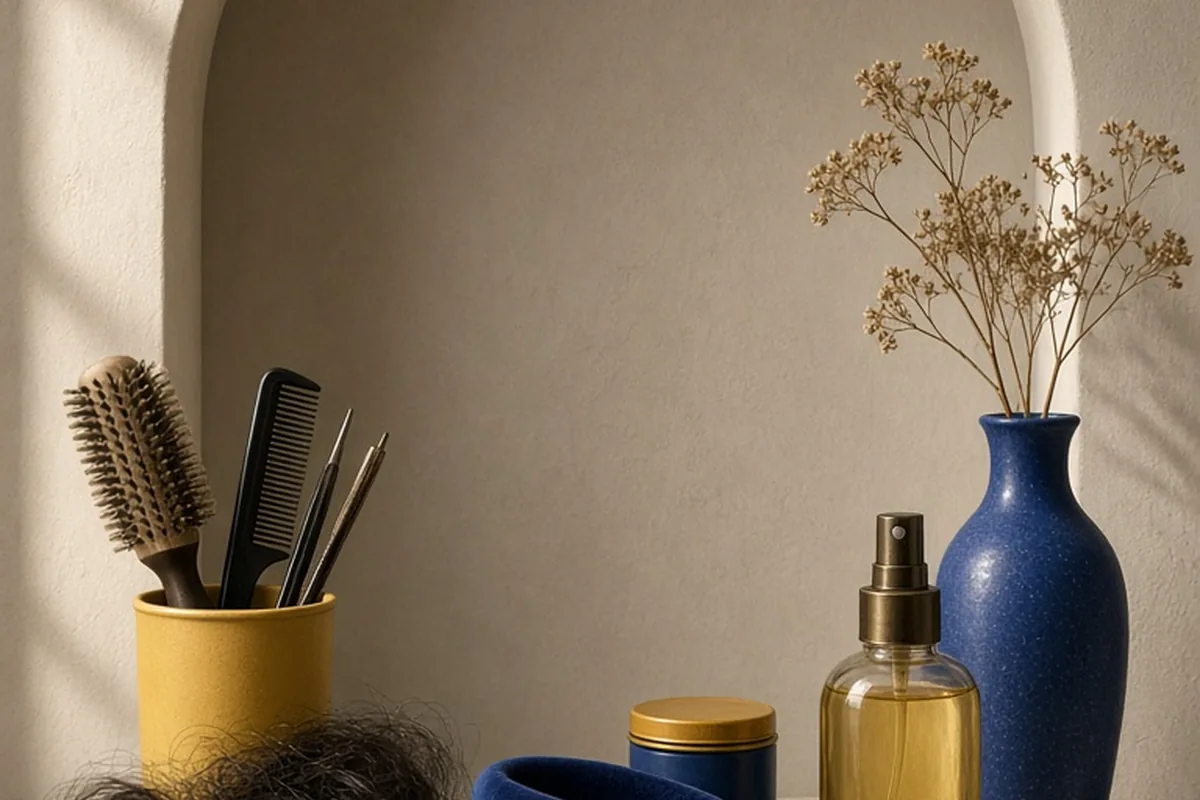
Women achieved dramatic hair volume in past decades by combining structural padding, directional tension, and strong setting agents. They built internal support using hair rats, wire forms, or rigorous backcombing at the root, set the shape with giant rollers under heat, and locked the height in place with heavy aerosol lacquers or chemical perms that reshaped hair protein bonds.
From the towering pompadours of the Edwardian era to the architectural beehives of the 1960s and the cloud-like perms of the 1980s, voluminous hair has repeatedly served as a major cultural statement. Understanding how past generations achieved these heights reveals a fascinating mix of physical mechanics, chemistry, and dedicated daily maintenance.
Internal Foundations: Hair Rats and Structural Padding
Long before aerosol sprays existed, historic volume relied on physical armatures hidden beneath the natural hair. In the late Victorian and Edwardian eras, women gathered shed strands from their vanity brushes into dedicated ceramic containers called hair receivers. Once enough loose fiber accumulated, they rolled and shaped the collected hair into firm, lightweight cushions known as hair rats. Stylists and individuals pinned these cushions directly against the scalp, then carefully smoothed outer layers of natural hair over the top to conceal the filler entirely.
When shed hair was unavailable or insufficient for extreme height, women turned to wire mesh rolls, crepe wool forms, and rolled stockings. These structures provided immediate vertical lift and rigid support that natural density could rarely sustain on its own. The primary limitation of this method was weight and heat retention; wearing dense internal cushions for extended periods pulled at the perimeter hairline and trapped warmth against the scalp, requiring strategic pin placement to avoid tension headaches or localized hair thinning.
The Mechanics of Backcombing and Teasing
During the late 1950s and 1960s, styling shifted toward self-supporting structural volume created directly from the wearer's own hair. Backcombing, also known as teasing, ratting, or French lacing, involves taking small, clean sections of hair and running a fine-toothed comb or boar-bristle brush firmly downward from the mid-shaft toward the scalp. This action forces the shorter and inner strands of the hair shaft to compact into a dense, tangled matrix at the root.
This cushion of compacted fiber created an elevated shelf capable of supporting the length above it. Stylists worked from the crown outward, methodically building rows of teased knots before smoothing only the outermost millimeter of hair with a soft brush to hide the tangled structure underneath. While backcombing produced exceptional height without external pads, it caused significant friction on the cuticle layer, making gentle, bottom-up detangling with conditioning oils essential to prevent widespread mechanical breakage.
Wet Sets and Mechanical Roller Geometry
The true foundation of mid-century volume was the wet set, which temporarily reshaped the hydrogen bonds in the hair shaft. Women saturated damp hair with viscous setting lotions, often made with gum karaya, gelatin bases, or commercial gels, and wrapped taut sections around cylindrical rollers. The diameter, angle, and placement of each roller determined the final lift. To maximize height, stylists placed rollers directly on-base, meaning the hair was pulled slightly forward before wrapping so the roller sat squarely over its own root footprint.
In home settings, women improvised with empty aluminum cans, plastic mesh cylinders, or cardboard tubes to achieve massive diameters that modern curling irons cannot replicate. Drying under a rigid hood dryer or sleeping in wire-mesh rollers evaporated the moisture while the hair was under maximum tension. Once dried completely and brushed out, the hair retained an expanded, curved memory that resisted falling flat, creating expansive silhouettes that lasted for days.
Chemical Alteration: The Cold Wave Perms of the 1980s
By the 1980s, volume shifted from smooth, sculpted forms to dynamic, all-over expansion powered by chemical manipulation. The primary engine of this aesthetic was the cold wave permanent. Stylists applied ammonium thioglycolate to break the internal disulfide bonds that give hair its natural structure. After wrapping tiny sections around slender perm rods, they applied an oxidizing neutralizer to reform those bonds in the new, tightly coiled shape.
This chemical process expanded the physical diameter of the hair strand and created microscopic texture that prevented hairs from lying flat against each other. When combined with root-lifting perms, crimping irons, and aggressive blow-drying upside down, the altered hair fiber produced exponential volume. The trade-off was substantial moisture loss and porosity, leaving hair vulnerable to split ends and requiring heavy leave-in moisturizers to prevent a brittle, straw-like texture.
Aerosol Lacquers and Gravity-Defying Fixatives
Even the most meticulous teasing and roller sets required rigid external bonding to withstand humidity and gravity. The post-World War II introduction of consumer aerosol valves enabled the mass adoption of hair lacquer. Early formulas used synthetic polymers, shellac, and vinyl resins dissolved in volatile solvents. When misted over a finished style, the solvent rapidly evaporated, leaving behind a continuous, plasticized film that welded neighboring hair strands together.
Women applied multiple coats of stiff fixatives, creating a hard shell that protected the internal backcombing from wind and motion. While these lacquers provided unprecedented hold that could maintain a beehive or spiked fringe for over a week, they left heavy residues that resisted standard shampoos. Overuse often resulted in dullness, flaking, and cuticle damage if combed out dry without first dissolving the resin with warm water.
Preservation Routines and Weekly Maintenance
Maintaining extreme volume was an investment in time and preservation rather than a daily styling habit. Because a salon wash, set, and tease could take several hours, women structured their weekly routines around protecting the architectural style. Instead of washing hair every day, they visited beauty parlors once a week or bi-weekly, relying on dry powders such as cornstarch, arrowroot, or early powdered dry shampoos to absorb scalp oils without wetting the roots.
At night, preserving the silhouette required specialized sleeping strategies. Women wrapped their heads in silk scarves, used satin pillowcases to minimize surface friction, or gently bound toilet paper bands around the perimeter of bouffants to prevent crushing the teased foundation. Some slept on specialized cylindrical neck rolls that kept their head elevated without pressing the back of the hairstyle against the mattress, sacrificing overnight comfort to extend the life of their look.
Illustrative Scenarios
The Theater Production Silhouette
A wardrobe stylist preparing actors for a mid-century theatrical production struggled to create authentic 1960s bouffants. She initially relied on modern high-heat curling irons and lightweight flexible sprays, but the hairstyles collapsed under stage lights within thirty minutes. Recognizing that heat alone could not provide structural stability, she switched to a traditional wet set with firm-hold setting lotion, followed by systematic backcombing at the crown and targeted mesh padding. The rebuilt styles maintained crisp, towering height throughout multiple high-energy performances.
Key point: Authentic vintage height relies on structural foundation and root tension rather than surface heat and light finishing products.
The Retro Photoshoot Challenge
A creative director attempting an authentic 1980s editorial look initially tried to tease dry, smooth hair with heavy modern hair oil, resulting in greasy clumping and flat roots. After consulting historic styling techniques, the team washed the model's hair with a clarifying cleanser to remove residue, blow-dried the roots upside down with volumizing mousse, and used a micro-crimper hidden beneath the crown layers to mimic perm texture before backcombing. The result delivered full, airy volume without visible frizz or excessive lacquer.
Key point: Creating massive volume requires removing heavy surface residues and building internal texture beneath the visible top layers.
Frequently asked questions
Did women really use household food items like sugar water or beer to style their hair?
Yes, before commercial hairsprays and modern gels became widespread, people frequently used diluted sugar water, beer, or dissolved gelatin as setting agents. When these solutions dried on the hair, the sugars and proteins hardened to form a rigid structural bond that held teased hair upright.
How did women wash out heavy vintage hair lacquer without damaging their hair?
Women soaked their hair thoroughly with warm water and generous amounts of conditioner to soften and dissolve the polymer resins before attempting to shampoo or comb it. Brushing out heavily lacquered or backcombed hair while dry often led to significant cuticle snapping and strand breakage.
Can you recreate 1960s or 1980s volume today without causing permanent damage?
Modern volume can be achieved safely by replacing harsh teasing with root-crimping on hidden under-layers, applying silica-based volumizing powders, and using flexible-hold polymers. These contemporary tools mimic the physical lift of historic methods while allowing easy washability and preserving hair health.
Your next step
To experiment with vintage height today, start by applying a lightweight root-lifting spray to damp hair, blow-dry upside down to set the base direction, and use a hidden foam rat or gentle root backcombing to support the structure without causing unnecessary breakage.