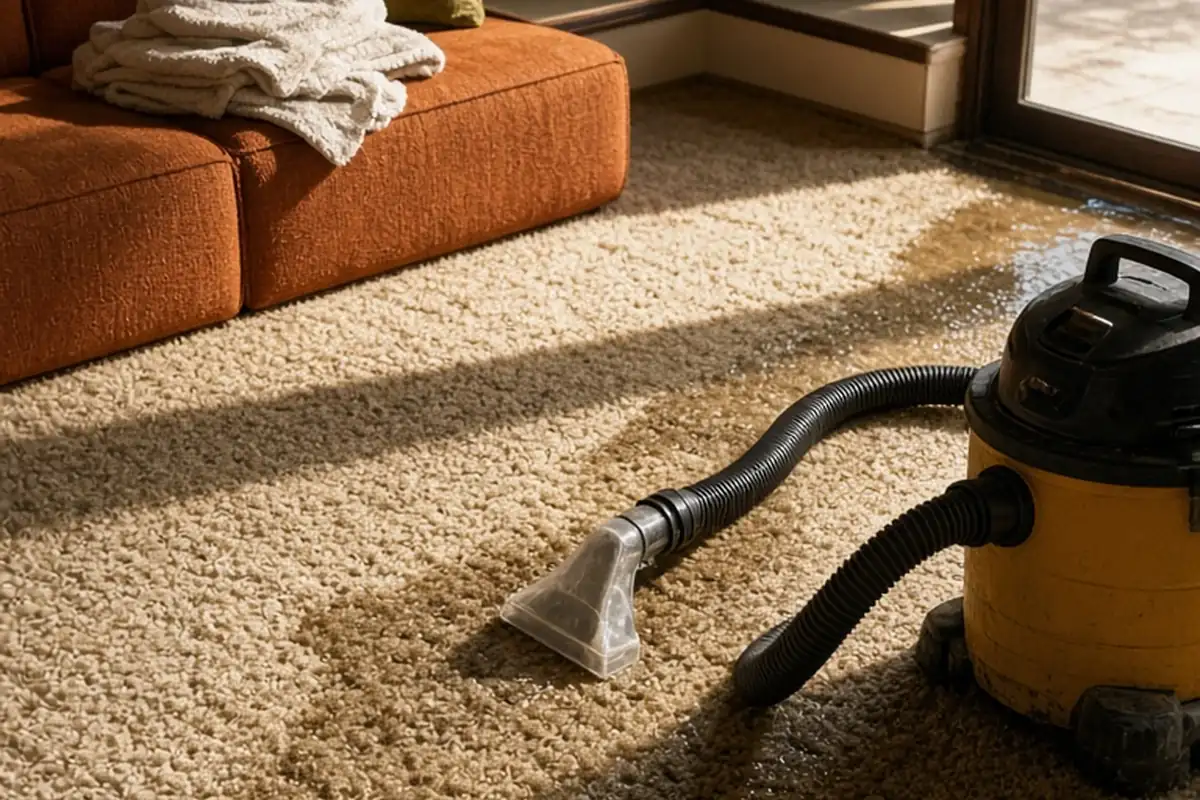
To get moisture out of carpet, immediately remove standing water using a wet-dry vacuum or by pressing heavy stacks of clean towels into the fibers. Next, maximize evaporation by aiming high-velocity fans directly at the surface and running a dehumidifier continuously. If water soaked through to the padding, lift the carpet edges to circulate warm air underneath until both layers feel completely dry.
Whether you are dealing with a spilled drink, an overflowing appliance, or rainwater creeping through a doorway, damp carpeting demands fast, systematic action to prevent structural damage, unpleasant odors, and long-term deterioration.
Assessing Saturation Depth and Water Cleanliness
Before beginning the extraction process, identify the source of the water and how deeply it has penetrated the flooring layers. Water contamination falls into distinct categories that dictate your safety precautions and drying strategy. Category one clean water originates from broken supply pipes, overflowing bathtubs, or spilled drinking water and carries minimal immediate health risk. Category two gray water comes from washing machines, dishwashers, or sump pump overflows and contains minor contaminants. Category three black water involves sewage backups or outdoor floodwater, which introduces hazardous pathogens and generally requires professional disposal rather than basic residential drying.
Next, determine whether the moisture remains confined to the surface pile or has reached the underlying carpet cushion and subfloor. Perform a simple pressure test by kneeling firmly on a dry paper towel placed over the damp area for twenty seconds. If liquid immediately wells up through the fibers or your knee sinks into a squishy underlayer, the padding below is thoroughly saturated. Dense polyurethane foam cushions act like giant sponges, retaining water long after the upper yarn feels dry. Identifying this depth early helps you choose between surface-level blotting and pulling back the carpet to expose the subfloor.
Extracting Standing Water from the Carpet Surface
Physical extraction is the most critical phase of carpet drying because mechanical suction removes liquid significantly faster than passive air evaporation. If you own or can rent a dedicated wet-dry vacuum, remove its paper dust filter to avoid damaging the motor before operating. Place the vacuum nozzle firmly against the carpet and pull it backward in slow, overlapping strokes, applying steady downward pressure. Empty the collection canister frequently to maintain peak suction power, and continue vacuuming until the transparent nozzle no longer pulls visible water droplets from the yarn.
When a wet-dry vacuum is not immediately accessible, thick cotton bath towels and heavy weights serve as an effective manual alternative. Spread clean, highly absorbent towels flat across the entire wet zone, overlapping the edges by several inches. Walk across the towels or place heavy, flat-bottomed items on top, such as plastic storage bins filled with books or water jugs. Replace the towels every fifteen to twenty minutes as they reach full saturation, working progressively from the dry outer boundaries inward toward the center to avoid spreading the damp perimeter into surrounding dry rooms.
While manual blotting extracts substantial liquid from the upper fibers, recognize its practical limitations. Towels lack the mechanical lift needed to draw moisture out of thick carpet pads or dense looped weaves. Treat manual pressing as an immediate containment strategy to minimize lateral spread while you assemble motorized extraction tools or arrange for high-volume air movement equipment.
Floating the Carpet to Dry the Padding and Subfloor
When water penetrates through the primary backing into the cushion beneath, surface airflow alone is rarely sufficient. In these scenarios, floating the carpet is a reliable technique that introduces forced air directly between the damp cushion and the floor. Begin by finding the corner of the room nearest the saturated section. Using a pair of pliers, grasp the carpet edge near the wall and pull gently upward and inward away from the tack strip, taking care not to tear the backing or pull individual tufts loose.
Once the carpet is peeled back to reveal the wet cushion, inspect the condition of both the padding and the underlying subfloor. Plywood and oriented strand board (OSB) subfloors can swell, delaminate, or warp if trapped moisture cannot escape, while concrete slabs hold cool moisture that slows natural evaporation. Position the snout of a high-velocity utility fan or centrifugal air mover directly beneath the pulled-back carpet, blowing air across the exposed pad and subfloor. The air pressure inflates the carpet like a tent or balloon, circulating warm, dry air continuously across all damp surfaces simultaneously.
Keep in mind that handling carpet edges requires caution due to the sharp, angled nails embedded in perimeter tack strips. Wear sturdy work gloves to protect your fingers during the lifting and repositioning process. If the foam cushion has begun to crumble, disintegrate, or emit strong sour odors from prolonged soaking, cutting out the damaged pad section and replacing it with a new matching piece is often far faster and more hygienic than attempting to dry degraded foam.
Optimizing Airflow and Ambient Humidity Control
Carpet fibers release moisture into the surrounding air through evaporation, but that process stalls when the relative humidity inside the room climbs too high. High-speed fans accelerate the movement of air across the carpet surface, breaking the boundary layer of saturated air resting directly above the damp fibers. Place several box fans, oscillating fans, or commercial air movers around the perimeter, angling their airflow downward at roughly forty-five degrees to maintain rapid air circulation across the wet floor.
Pairing high-velocity airflow with continuous dehumidification is essential for effective drying. A compressor-based or desiccant dehumidifier pulls moisture vapor out of the circulating air, maintaining a steep vapor pressure gradient that encourages carpet fibers to surrender their water. Close all exterior windows and doors in the affected room to create a closed drying chamber, preventing humid outdoor air from entering. Set the dehumidifier to its continuous collection mode, emptying the reservoir regularly or attaching a drainage hose routed to a nearby sink or floor drain.
Maintain an ambient room temperature between seventy and eighty degrees Fahrenheit during the active drying phase. Warmer air holds more moisture vapor than cool air, accelerating evaporation rates. However, avoid applying direct, concentrated heat from hair dryers or space heaters directly onto synthetic carpets, as extreme heat can warp nylon or polyester fibers, soften backing adhesives, and cause permanent ripples in the floor.
Treating Residual Moisture and Neutralizing Odors
Even after the bulk of the water is removed, damp carpets can develop musty smells caused by volatile organic compounds and moisture trapped deep within the backing. Pure sodium bicarbonate, commonly known as baking soda, is a practical household desiccant and deodorizer. Wait until the carpet feels merely damp rather than soaked to the touch, then sprinkle an even, generous layer of baking soda across the entire affected area. The fine powder draws out residual trace moisture from the upper yarn while absorbing acidic odor compounds.
Allow the baking soda to sit undisturbed for at least eight to twelve hours, or overnight, while maintaining continuous air circulation. Once the carpet is entirely dry, vacuum the powder thoroughly using an upright vacuum equipped with a clean bag or a high-efficiency particulate air (HEPA) filter. Avoid applying dry powders to sopping wet carpet, as the powder will turn into a dense, pasty residue that embeds itself into the tuft roots and becomes difficult to remove without deep mechanical washing.
If a faint sour odor lingers after vacuuming, mist the fibers lightly with a mixture of equal parts distilled white vinegar and warm water using a fine spray bottle. The mild acetic acid helps neutralize alkaline odor molecules and refreshes the pile. Always test this solution on an inconspicuous spot, such as inside a closet corner, to verify colorfastness before treating larger sections of carpet.
Adapting Drying Methods for Different Carpet Materials
The fiber composition and construction style of your carpet significantly influence how moisture behaves and how carefully you must manage the drying process. Synthetic fibers such as nylon, polyester, and polypropylene (olefin) are inherently non-porous and hydrophobic. They hold water primarily between the strands rather than absorbing it into the core of the fiber, making them highly resilient during aggressive extraction and rapid forced-air drying.
Natural fibers, particularly wool and cotton blends, require much gentler handling. Wool fibers can absorb up to thirty percent of their dry weight in liquid moisture before feeling noticeably wet, meaning a wool rug or carpet may conceal substantial water volume. Natural wool is sensitive to high heat, which can trigger irreversible shrinkage, fiber browning, or pile distortion. When drying wool, use cool or room-temperature airflow, avoid harsh chemical deodorizers, and maintain steady, gentle dehumidification without aggressive mechanical pulling.
Carpet weave style also dictates drying times and tool selection. Plush cut-pile carpets allow air to circulate relatively freely between upright yarn tufts, drying evenly under standard fans. In contrast, tightly woven Berber or continuous looped carpets trap water beneath the dense surface loops. When working with Berber carpets, take extra care not to snag loops with vacuum nozzles or fan stands, as a single pulled loop can unravel an entire row of fiber across the room.
Recognizing When Replacement or Professional Restoration Is Necessary
Time is the most critical factor when salvaging wet flooring. Microbial growth, mildew, and backing breakdown accelerate sharply when porous materials remain damp beyond forty-eight to seventy-two hours. If you have run drying equipment continuously for three days and the carpet or pad still feels cool, damp, or smells strongly musty, the moisture has likely created deep structural saturation that basic residential airflow cannot resolve.
Another telltale sign that replacement is necessary is backing delamination. Prolonged water exposure dissolves the secondary latex adhesives that bond the carpet yarn to the outer backing fabric. When delamination occurs, the carpet loses its structural tension, resulting in persistent wrinkles, loose bubbles, or soft lumps that cannot be corrected by professional re-stretching tools. If the backing feels rubbery, brittle, or crumbles between your fingers, replacing the carpet is generally the most practical option.
Finally, always assess the health risks associated with the original water source. Any saturation resulting from outdoor river flooding, sewer backups, or ground runoff involves hazardous bio-contaminants that penetrate deep into foam padding and subflooring pores. In these situations, carpet and pad replacement is the safest course of action to ensure a hygienic home environment.
Frequently asked questions
How long does it typically take for a wet carpet to dry completely?
With continuous high-velocity fans and an active dehumidifier, synthetic carpet fibers usually dry within twelve to twenty-four hours. If moisture has soaked deeply into the underlying foam pad and subfloor, complete structural drying can take up to forty-eight hours.
Can I use a regular household vacuum cleaner to remove water from carpet?
No, standard upright or canister household vacuums are designed solely for dry debris and should never be used on wet carpets. Sucking up liquids with a standard vacuum can destroy the motor, ruin internal filtration systems, and present a serious electrical shock hazard.
Is it possible to dry carpet padding without lifting the carpet up?
Minor surface dampness can sometimes dry through the carpet fibers, but deeply saturated padding rarely dries quickly enough from surface airflow alone. Peeling back a corner to blow air directly beneath the carpet backing is the most reliable way to prevent trapped moisture from damaging the subfloor.
How can I tell if the subfloor underneath the carpet is truly dry?
You can inspect the subfloor by lifting a corner of the carpet and firmly pressing a dry paper towel against the wood or concrete for thirty seconds. For precise measurement, use a pinless electronic moisture meter to confirm that readings match dry reference areas in adjacent rooms.
Your next step
Extract the standing water immediately using a wet-dry vacuum or weighted towels, then position high-velocity fans and a dehumidifier to keep warm, dry air circulating across both the carpet and padding until all layers are fully dry.