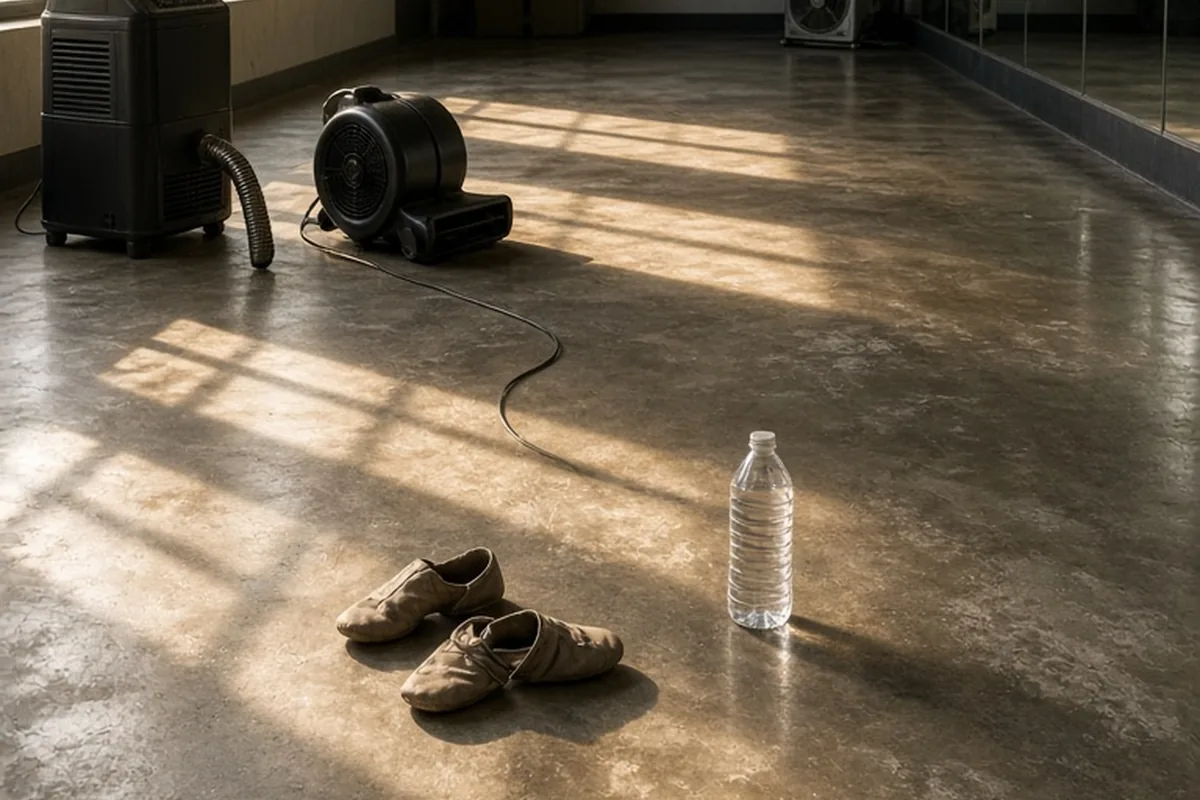
To pull moisture out of cement, run commercial refrigerant or desiccant dehumidifiers alongside high-velocity air movers to draw out deep capillary water. Seal the room against external humidity, maintain ambient temperatures between seventy and eighty degrees Fahrenheit, and monitor internal slab moisture with relative humidity probes before installing flooring or applying sealers.
Concrete functions like a rigid sponge, absorbing water from ground contact, ambient humidity, or the original mixing process. When you prepare a basement, garage, or slab-on-grade floor for finishes like vinyl, epoxy, or hardwood, trapped moisture can ruin adhesives, foster mold growth, and warp materials. Understanding how to properly extract this moisture requires a systematic approach to humidity management, airflow, and diagnostic testing.
Deploying Industrial Dehumidifiers to Extract Core Dampness
Standard residential dehumidifiers often lack the extraction capacity needed to draw water out of a dense concrete matrix. Low-grain refrigerant (LGR) dehumidifiers or desiccant units are specifically engineered to remove large volumes of water vapor from the air even at low relative humidity levels. By creating a substantial vapor pressure differential between the damp slab and the surrounding dry air, these machines continuously pull capillary moisture toward the surface where it evaporates.
To maximize efficiency, close all windows, doors, and exterior vents in the target space to establish a closed drying chamber. Position the dehumidifier in a central location, running continuous drain lines into a sump pit, floor drain, or dedicated container. In a typical damp basement measuring five hundred square feet, running an LGR unit continuously for several days can remove gallons of water vapor, significantly reducing ambient saturation and encouraging the concrete to release its bound moisture.
A key trade-off with continuous dehumidification is electrical consumption and operational heat generation. While desiccant units perform exceptionally well in cooler environments below sixty degrees Fahrenheit, they require dedicated ducting to exhaust moist air outside. Choosing the right machine depends on ambient room temperature and the overall volume of moisture present within the subfloor.
Accelerating Surface Evaporation with High-Velocity Air Movers
Moisture evaporating from concrete forms a thin, stagnant layer of high-humidity air directly above the slab, which slows down further evaporation. High-velocity axial or centrifugal air movers break up this boundary layer by driving rapid, turbulent airflow directly across the surface. This rapid displacement allows the dehumidifier to process the evaporated moisture much faster.
Set up multiple fans around the perimeter of the room, angling the airflow downward at a roughly forty-five-degree angle toward the concrete surface. For a standard two-car garage or equivalent basement area, placing three to four air movers in a continuous vortex pattern keeps air constantly circulating without dead zones. This method prevents uneven drying, which can cause localized surface cracking if one area loses moisture far faster than adjacent sections.
While air movement is vital, running fans without dehumidification merely circulates damp air throughout the structure. Air movers must always be paired with active moisture extraction equipment; otherwise, the dispersed humidity will simply condense on cooler walls, joists, or overhead pipes.
Optimizing Ambient Temperature for Faster Moisture Migration
Water molecules move more rapidly through the microscopic capillaries of concrete when the slab is warm. Raising the ambient room temperature to between seventy and eighty degrees Fahrenheit increases the vapor pressure within the slab, driving deep moisture upward toward the drier air. Portable electric or indirect-fired heaters work best for this purpose because they provide clean, dry heat without introducing combustion moisture.
Avoid using unvented propane or kerosene space heaters during the drying process. These combustion heaters release significant amounts of water vapor directly into the room as a byproduct of burning fuel, which works against your drying goals. For example, burning one gallon of propane introduces nearly one gallon of moisture into the surrounding air, substantially slowing down the slab drying process.
Take care not to heat newly poured or freshly repaired cement excessively during its initial twenty-eight-day curing phase. Forcing concrete to dry too quickly before it develops proper compressive strength can lead to weak, powdery surfaces and surface crazing. Heat should be applied gradually and evenly to manage moisture migration safely.
Stopping External Water Infiltration and Hydrostatic Pressure
Attempting to dry a concrete slab while exterior water actively seeps in from the surrounding soil is an endless cycle. Ground moisture pushed against foundation walls and slabs by hydrostatic pressure will continuously replace any water you extract from the surface. Addressing exterior drainage and foundation vulnerabilities is therefore an essential preliminary step.
Start by inspecting exterior downspouts and gutters to confirm that roof runoff discharges at least six to ten feet away from the foundation. Ensure the ground soil slopes away from the perimeter of the building by roughly one inch per foot over the first six feet. Indoors, inspect the concrete for visible active leaks, damp seams, or efflorescence—a powdery white mineral deposit left behind when migrating water evaporates.
If hydrostatic pressure remains high due to a elevated water table, mechanical drying alone will not provide a permanent solution. In such instances, installing an interior perimeter drain tile system paired with a sump pump may be necessary to relieve hydrostatic pressure beneath the slab before finish coatings can be applied.
Testing Slab Moisture Content with Reliable Methods
Concrete may feel dry to the touch while still harboring significant moisture deep inside its pores. Relying purely on visual inspection often leads to premature flooring installation and subsequent adhesive failure. Utilizing structured testing methods ensures you have an objective measurement of the slab's internal conditions before finishing the surface.
For a simple preliminary check, tape a two-foot by two-foot sheet of clear plastic tightly to the slab using heavy-duty duct tape, sealing all four edges completely. Leave it in place for twenty-four to forty-eight hours; condensation beneath the plastic or a darkened slab surface indicates high vapor transmission. For precise measurements, especially prior to installing resilient flooring or wood, in-situ relative humidity probes inserted into drilled holes provide standard, accurate data regarding deep moisture levels.
Surface pin meters and non-invasive impedance meters offer quick comparative scans across large areas to find moisture hotspots, but they only read the top half-inch of the slab. Always pair rapid scanning tools with depth-specific relative humidity tests when making major installation decisions.
Applying Penetrating Sealers and Topical Vapor Barriers
Once active moisture is brought down to an acceptable baseline, applying a chemical treatment helps lock remaining moisture out and prevent future dampness from rising. Penetrating silicate sealers react chemically with free lime and calcium hydroxide inside the concrete capillaries, forming an insoluble crystalline gel that densifies the slab and narrows the microscopic pores.
For areas intended for sensitive finished flooring, a two-part epoxy moisture mitigation barrier creates a robust impermeable membrane across the surface. These specialized coatings are formulated to withstand high levels of continuous moisture vapor emission from beneath while providing a clean, stable surface for adhesives, underlayments, or self-leveling compounds.
Note that topical sealers and vapor barriers cannot be applied to saturated concrete. The slab must be dried to the manufacturer's specified surface tolerance prior to application, or the sealer will fail to bond properly and may blister or peel over time.
Illustrative Scenarios
Illustrative Scenario: Resolving Chronic Garage Slab Dampness
A homeowner preparing a forty-year-old garage slab for an epoxy floor coating noticed persistent dark patches and high surface humidity after rainy periods. Rather than coating the slab immediately, the homeowner extended the exterior downspouts away from the foundation, sealed the garage doors with weatherstripping, and rented an LGR dehumidifier alongside two high-velocity air movers for five days. Ambient room temperature was maintained at seventy-five degrees using an electric space heater.
Key point: Addressing exterior water drainage first allowed the mechanical drying setup to pull deep residual moisture from the slab within days, resulting in steady relative humidity readings that met the epoxy manufacturer's installation guidelines.
Frequently asked questions
How long does it typically take to pull moisture out of a concrete slab?
Drying time depends on slab thickness, age, and initial moisture levels, but standard mechanical drying with dehumidifiers and air movers usually takes between three to fourteen days. New concrete slabs generally require roughly thirty days of drying time per inch of slab thickness under natural conditions.
Can I use household fans and open windows to dry out wet cement?
Opening windows only helps if the outdoor air has lower relative humidity than the indoor environment. In most cases, relying on standard household fans and open windows is ineffective, and closed-chamber drying with dedicated dehumidifiers produces much faster, more consistent results.
What happens if I install flooring over concrete that is still damp?
Trapped moisture creates vapor pressure that breaks down flooring glues, buckles hardwood planks, and causes vinyl tiles to bubble or lift. Additionally, the trapped moisture creates an ideal environment for mold and mildew growth beneath the floor covering.
Your next step
Inspect your exterior drainage to eliminate incoming water sources, set up closed-room dehumidification with focused airflow, and verify that internal slab moisture meets manufacturer specifications before applying sealers or floor coverings.