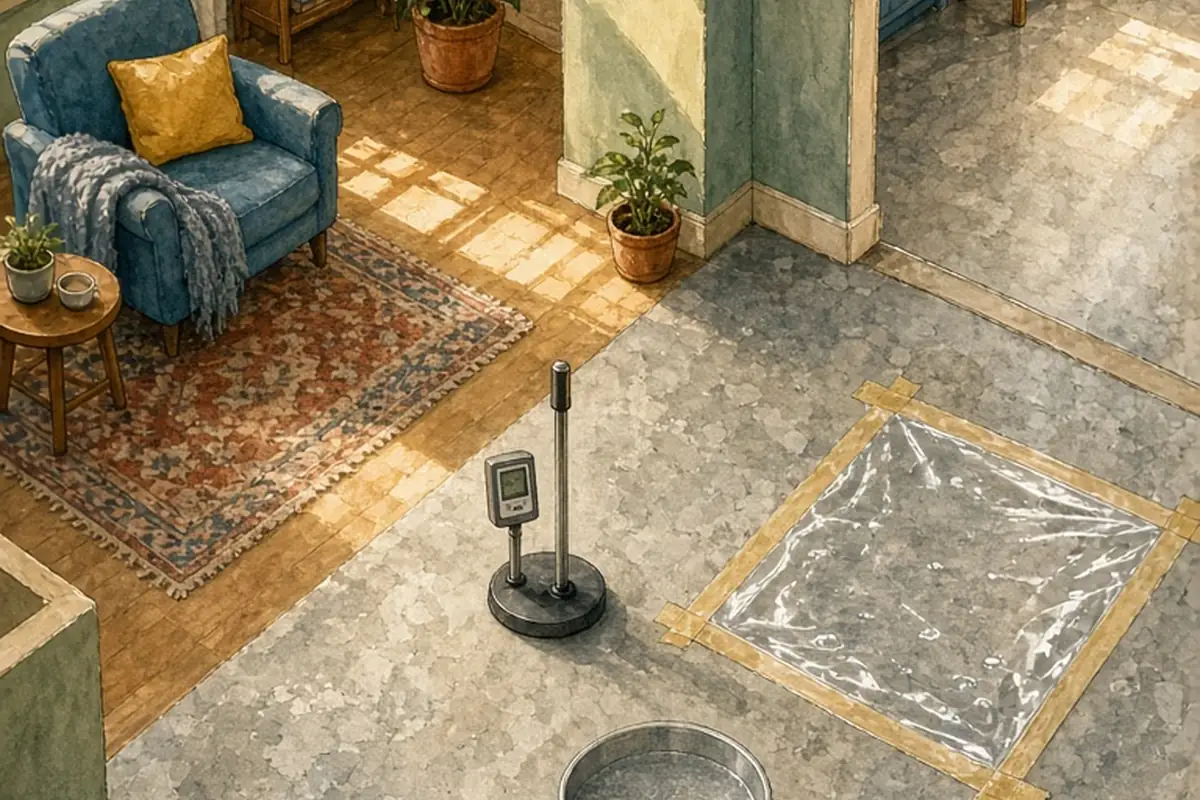
To test concrete moisture accurately, measure internal relative humidity using in-situ probes for modern flooring standards, or perform an anhydrous calcium chloride test to assess surface vapor emission rates. For a preliminary qualitative check, tape a clear plastic sheet to the slab for twenty-four hours. Always clean the slab surface, acclimate the room to operating temperature, and compare your test readings against the specific adhesive or flooring manufacturer limits before installation.
Pouring new flooring over an insufficiently cured or damp concrete slab often leads to adhesive breakdown, warped floorboards, bubbling resilient tiles, and hidden mold growth. Because concrete can appear pale and dry on the surface while still retaining substantial moisture deep within its crystalline matrix, reliable testing is an essential prerequisite before applying any floor covering, sealer, or adhesive.
Understanding Why Concrete Moisture Testing Matters
Concrete requires significant quantities of water during mixing to achieve workability and initiate the chemical hydration process that binds cement and aggregates together. However, a large percentage of that water remains unbonded free moisture within microscopic capillary pores. As the concrete cures and dries, this excess water gradually migrates toward the surface and evaporates into the surrounding air. When builders or homeowners install moisture-sensitive materials such as hardwood, luxury vinyl plank, laminate, or epoxy coatings directly on top of an unverified slab, they effectively seal the exit path for this evaporating vapor.
Trapped moisture creates hydrostatic and vapor pressure beneath non-porous floor coverings, which can emulsify water-based adhesives, cause vinyl seams to lift, or lead to wood cupping and structural buckling. In addition, moisture carrying alkaline salts toward the concrete surface can cause saponification of adhesives and foster mold colonization beneath underlayments. Performing standardized moisture testing provides quantifiable data about whether the slab has reached an equilibrium that can safely support your planned floor covering, helping you avoid costly structural remediation and warranty voids.
Choosing Between Relative Humidity and Calcium Chloride Methods
The two most common quantitative testing approaches in North America are in-situ relative humidity testing, governed by ASTM F2170, and anhydrous calcium chloride testing, governed by ASTM F1869. Relative humidity testing measures the moisture content within the body of the concrete slab by inserting calibrated electronic probes into pre-drilled holes at specific depths. Because moisture moves from the bottom of the slab upward, RH testing reflects the moisture that will eventually redistribute throughout the entire thickness once a non-breathable flooring material is installed.
Calcium chloride testing, on the other hand, measures the moisture vapor emission rate from the top half-inch of the concrete surface over a sixty to seventy-two hour period. While calcium chloride testing has a long historical precedent and remains widely referenced in older material specifications, it only captures surface vapor behavior and can be heavily skewed by brief ambient temperature swings or surface washing. Many modern resilient flooring and adhesive manufacturers now prioritize in-situ RH probe percentages as their primary specification criteria, though reviewing your specific material warranty will clarify which metric is mandatory.
Using the Plastic Sheet Method for Quick Preliminary Screening
The plastic sheet method, standardized under ASTM D4263, serves as an inexpensive qualitative screening tool to detect visible moisture condensation. To perform this test, cut an eighteen-by-eighteen-inch square of heavy-gauge clear polyethylene plastic sheeting, place it flat against a clean section of bare concrete, and seal all four perimeter edges tightly with moisture-resistant duct tape. Leave the sheet completely undisturbed for a minimum of sixteen to twenty-four hours under normal room temperature conditions before inspecting the underside of the plastic and the underlying slab.
When you remove the plastic, look for visible water droplets clinging to the underside of the film or a noticeable dark damp patch on the concrete surface beneath the test area. While the presence of condensation confirms that active moisture evaporation is occurring, the absence of visible droplets does not prove the slab is dry enough for sensitive flooring. The plastic sheet test cannot measure internal relative humidity or deep capillary water, meaning it should only be used as an initial screening check rather than a final confirmation for high-stakes installations.
Conducting In-Situ Relative Humidity Testing Step by Step
In-situ relative humidity testing provides the most reliable internal assessment of concrete moisture equilibrium. The procedure begins by determining the correct drilling depth based on slab drying conditions: drill holes to forty percent of the total slab thickness for slabs drying from one side, such as those on a vapor barrier or elevated metal deck, or twenty percent for slabs drying from both top and bottom. Use a rotary hammer drill with a carbide bit of the exact diameter specified by the probe manufacturer, ensuring the hole is clean and straight.
After drilling, thoroughly vacuum the hole using a narrow nozzle, brush the internal sidewalls with a wire cylinder brush to dislodge compacted concrete dust, and vacuum again to remove all debris. Insert the manufacturer-supplied plastic sleeve into the hole, seal the top flange to prevent ambient air infiltration, and install the protective cap. Allow the sleeve and internal air pocket to equilibrate for the manufacturer-specified period, traditionally twenty-four hours, before inserting the calibrated probe reader to record relative humidity and internal slab temperature.
- Verify the slab has been acclimated to operational building conditions for at least forty-eight hours before drilling.
- Drill three test holes for the first one thousand square feet and one additional hole for each additional one thousand square feet.
- Ensure the probe sensor is fully acclimated inside the test sleeve before taking final percentage readings.
- Record the ambient air temperature, slab temperature, and relative humidity simultaneously to confirm thermal stability.
Performing an Anhydrous Calcium Chloride Test
An anhydrous calcium chloride test quantifies the weight of moisture vapor emitted from a concrete surface over time, expressed as pounds of moisture per one thousand square feet per twenty-four hours. To conduct this test accurately, start by grinding a twenty-by-twenty-inch section of concrete down to clean, unsealed aggregate, removing all adhesives, curing compounds, paint, and contaminants. Allow the freshly ground concrete patch to acclimate uncovered for twenty-four hours so that the newly exposed surface reaches thermal and moisture balance with the surrounding room.
Next, carefully unseal the pre-weighed dish of anhydrous calcium chloride crystals, record the starting weight and time, set the dish on the prepared concrete, and immediately cover it with the transparent plastic dome kit. Seal the perimeter flange of the dome to the slab with airtight sealant tape so no ambient air can enter. After sixty to seventy-two hours, cut open the dome, immediately cap the calcium chloride dish to prevent absorbing room humidity, and weigh it on a precision gram scale. Use the standard mathematical formula provided with the test kit to convert weight gain and exposure duration into the final vapor emission rate.
Using Electronic Moisture Meters for Surface Mapping
Handheld electronic moisture meters provide rapid, non-destructive evaluations that are valuable for mapping large concrete floors to locate moisture concentration zones. Pinless impedance meters use electromagnetic sensor pads pressed firmly against the concrete surface to measure electrical impedance, which fluctuates in proportion to the water content near the surface. Pin-type meters use electrical resistance between two contact points pressed into the slab surface or inserted into shallow contact holes.
These meters deliver immediate comparative numbers rather than ASTM-recognized quantitative compliance values for flooring warranties. Their primary advantage lies in helping you scan an entire room or basement within minutes to identify cold spots, perimeter dampness, plumbing leaks, or uneven curing across different concrete pours. Once you identify the areas with the highest impedance or resistance readings, you can target those specific high-risk zones for full in-situ RH probe or calcium chloride testing.
Preparing the Slab and Interpreting Manufacturer Tolerances
Moisture test results are only meaningful when conducted in a controlled interior environment that mirrors the building's permanent operational temperature and relative humidity. Testing unheated concrete during winter construction or unventilated basements during humid summer weather will produce skewed readings that do not reflect long-term floor performance. Turn on the permanent heating, ventilation, and air conditioning system for at least forty-eight to seventy-two hours prior to testing, keeping room temperatures between sixty-five and seventy-five degrees Fahrenheit.
Once testing is complete, compare your recorded numbers against the installation guidelines published by your flooring, adhesive, and underlayment manufacturers. While thresholds vary, standard vinyl plank adhesives often require relative humidity levels below eighty to eighty-five percent or calcium chloride emissions under three to five pounds, whereas moisture-sensitive solid hardwoods demand even stricter limits. If test results exceed manufacturer tolerances, you must allow additional curing time, improve mechanical dehumidification, or install an approved topical epoxy moisture mitigation barrier before continuing installation.
Frequently asked questions
How long does new concrete take to dry before it can be tested for flooring?
A standard rule of thumb is approximately thirty days of drying time per inch of concrete slab thickness under moderate temperature and humidity conditions. However, ambient weather, concrete mix design, enclosed building conditions, and vapor retarders can extend this timeline significantly. Testing should only begin once the slab has cured for several weeks and the building interior is environmentally conditioned.
What is an acceptable moisture level for concrete before installing luxury vinyl plank?
Most luxury vinyl plank manufacturers specify an internal relative humidity of eighty-five percent or lower when using standard adhesives, or a moisture vapor emission rate below five pounds per one thousand square feet per twenty-four hours. Some high-moisture adhesive systems tolerate up to ninety-five or ninety-nine percent relative humidity, so you should always verify the exact threshold listed in your flooring warranty.
Can I install flooring if my concrete fails the moisture test?
Installing flooring over a slab that fails moisture testing risks adhesive failure, cupping, and mold development. If readings exceed manufacturer limits, you can either allow additional drying time with commercial dehumidifiers or apply a professional two-part epoxy moisture mitigation membrane to block vapor transmission before laying your floor.
Are pinless moisture meters accurate enough to validate a flooring warranty?
Pinless moisture meters are useful for initial mapping and comparative screening, but they are generally not recognized by flooring manufacturers as standalone proof of compliance. Flooring warranties almost universally require standardized testing documentation using ASTM F2170 in-situ relative humidity probes or ASTM F1869 calcium chloride kits.
Your next step
Obtain the precise moisture tolerance specifications from your flooring and adhesive manufacturers, ensure the room is fully conditioned to operating temperature, and place standardized in-situ RH test sleeves in the highest-risk areas of the slab.