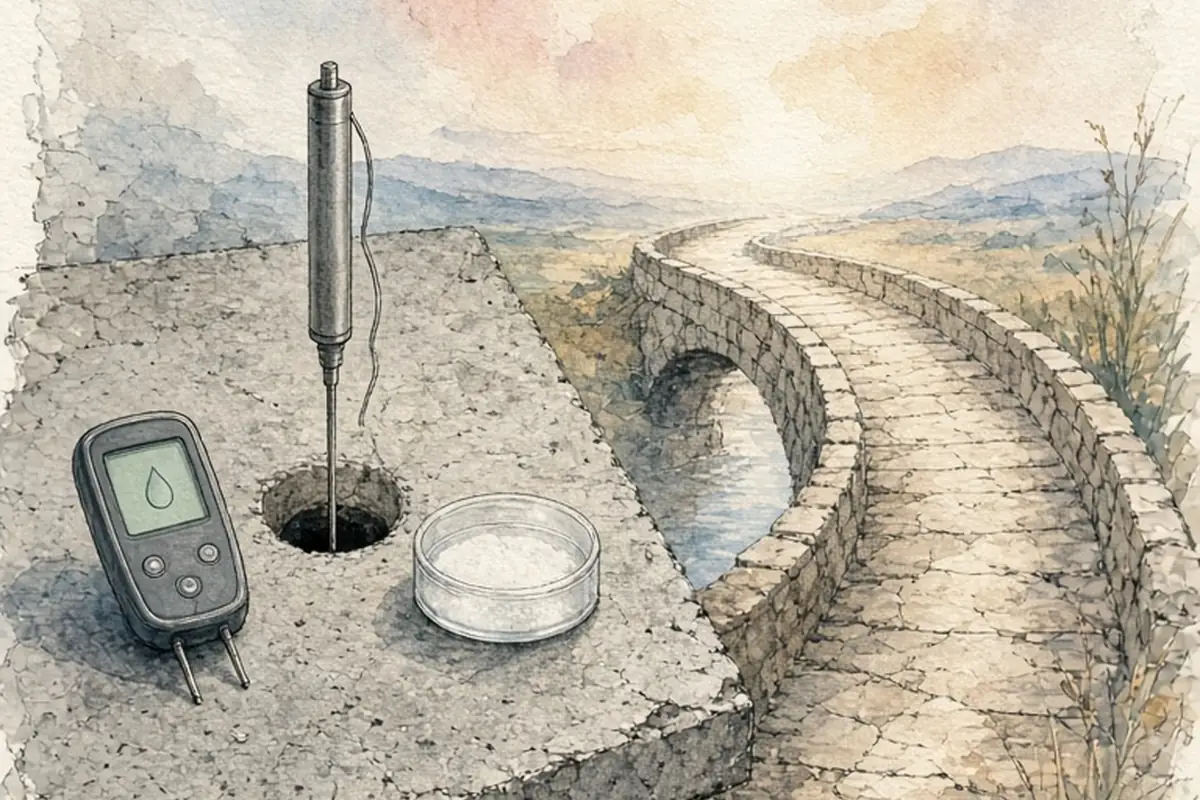
To test moisture in concrete, use an in-situ relative humidity probe for the most reliable internal reading, a calcium chloride test kit to measure surface vapor emission, or a non-destructive electronic moisture meter for fast spot screening. Drill test holes to the proper slab depth, let sensors equilibrate according to industry standards, and compare readings against your flooring manufacturer moisture limits before applying adhesives or underlayment.
Concrete slabs often appear completely dry on the surface within days of pouring, yet they can retain significant residual water within their deeper internal capillary structure for months.
Understanding How Moisture Moves Through Concrete Slabs
Fresh concrete requires water to hydrate cement particles and build compressive strength, but standard mixes contain far more water than necessary for hydration alone. This excess water must evaporate over time through tiny microscopic pores and capillary channels. As the surface dries, internal moisture migrates upward from the bottom of the slab toward the lower humidity of the open air. This drying process is rarely uniform, as ambient temperature, slab thickness, air movement, and relative humidity directly govern how quickly internal moisture dissipates.
A common point of failure occurs when homeowners or contractors confuse curing with drying. Curing refers strictly to chemical hydration, which locks in strength during the initial weeks after placement, whereas drying is the physical evaporation of remaining water, which can take anywhere from several months to more than a year. Furthermore, slabs poured directly on the ground without an intact vapor retarder can continuously draw ground moisture upward via capillary suction, creating an endless cycle of vapor transmission that easily damages finished flooring installations if left unaddressed.
Conducting In-Situ Relative Humidity Probe Testing
In-situ relative humidity probe testing, standardized under ASTM F2170, is widely considered the industry benchmark for evaluating the internal moisture state of concrete. Unlike surface tests that only register vapor leaving the top layer, embedded probes measure the actual equilibrium relative humidity deep inside the core. To perform this test, you drill holes into the concrete to a depth equal to forty percent of the slab thickness for slabs drying from one side, or twenty percent for elevated slabs drying from both top and bottom. After vacuuming and brushing the drilled holes to remove loose dust, you insert specialized plastic sleeves and seal them with airtight caps.
After allowing the lined holes to equilibrate for the manufacturer-recommended duration, which typically ranges from twenty-four hours to several days depending on the probe system, an electronic sensor is inserted into each sleeve to record the relative humidity percentage. For instance, testing a four-inch slab in a residential basement requires drilling to a depth of roughly one point six inches. If the resulting reading registers at ninety percent relative humidity, installing sensitive engineered wood or luxury vinyl with an eighty percent threshold will almost certainly lead to adhesive degradation or cupping. A practical limitation of this method is the requirement for specialized rotary hammer drills, calibration equipment, and minor surface patching once testing concludes.
Measuring Vapor Emissions with Calcium Chloride Kits
The anhydrous calcium chloride test, governed by ASTM F1869, measures the moisture vapor emission rate from the surface of a concrete slab over a defined timeframe. This method uses a pre-weighed dish of dry calcium chloride crystals placed beneath a transparent plastic dome that is hermetically sealed to the concrete with adhesive mastic. The dry crystals actively absorb moisture vapor emitting from a standard one-thousand-square-foot equivalent area over a period of sixty to seventy-two hours. Once retrieved, the dish is weighed again on an accurate gram scale to calculate how many pounds of water vapor emit per one thousand square feet every twenty-four hours.
Before setting the dome, the concrete surface must be mechanically ground to remove sealers, paint, adhesives, and carbonation that would otherwise block normal vapor transmission. For example, a homeowner testing an older slab after tearing out old carpet might record an emission rate of five pounds per one thousand square feet per day. While this value might be acceptable for breathable ceramic tile, it would exceed the typical three-pound limit recommended for non-breathable vinyl sheet goods. A notable limitation of calcium chloride testing is that it only reflects conditions within the top half-inch of the concrete at that specific moment, making it vulnerable to sudden changes in ambient temperature and room humidity.
Screening Surfaces with Electronic Moisture Meters
Electronic moisture meters provide immediate, non-destructive evaluations and serve as convenient tools for surveying large floor layouts prior to formal quantitative testing. These handheld instruments utilize electrical impedance or high-frequency radio waves transmitted through contact pads on the base of the unit to assess the dielectric properties of the slab surface. By pressing the meter firmly against clean concrete across a structured grid pattern, users can quickly identify damp patches, perimeter leaks, or cold spots where moisture concentrates.
Consider a large open-concept renovation where sixty individual points across a two-thousand-square-foot basement are surveyed in under thirty minutes. The meter may show uniformly low relative numbers across the main living area but high readings along the exterior foundation wall, pinpointing exactly where targeted in-situ probes or drainage investigations should focus. However, electronic meters cannot replace quantitative ASTM-standard tests because their readings are comparative rather than absolute, and they can be influenced by rebar proximity, slab density, and surface carbonation.
Establishing Proper Site Conditions for Reliable Data
Moisture testing produces reliable data only when the building interior matches its final intended operational conditions. Concrete acts as a dynamic hygroscopic sponge that continuously exchanges moisture with the surrounding air. If a building is unheated, open to outdoor weather, or lacking an active heating, ventilation, and air conditioning system, the concrete will adjust to external atmospheric swings, skewing moisture measurements and giving a false sense of security or unearned alarm.
To obtain actionable test results, the permanent heating and cooling system should run continuously for at least forty-eight hours before and throughout the testing window, maintaining temperatures between sixty-five and seventy-five degrees Fahrenheit alongside a relative humidity between forty and sixty percent. Testing a slab in an unconditioned winter construction zone might show an artificially low vapor emission rate simply because cold air suppresses evaporation, only for massive moisture release to occur months later once the home heating is turned on.
Comparing Test Data to Flooring Manufacturer Requirements
Every finished flooring product, from solid hardwood and engineered planks to luxury vinyl tile and epoxy coatings, has strict moisture tolerance thresholds set by its manufacturer. Exceeding these limits voids product warranties and frequently causes structural or cosmetic failures, such as adhesive emulsification, edge peaking, hollow spots, wood buckling, and persistent subfloor mold growth. Manufacturers typically publish maximum acceptable thresholds in both relative humidity percentage and vapor emission rates.
For instance, modern pressure-sensitive adhesives used with luxury vinyl flooring commonly allow a maximum in-situ relative humidity of eighty-five percent and a vapor emission rate of five pounds, while direct-glue solid hardwood might demand limits below seventy-five percent and three pounds. If your test data returns an internal relative humidity of eighty-eight percent, you face a clear choice: wait for additional natural drying, accelerate the process with industrial dehumidification, or budget for a dedicated surface-applied moisture mitigation epoxy.
Addressing High Moisture Readings and Remediation Paths
When testing confirms excessive moisture levels that exceed your chosen flooring specifications, you must determine whether the source is residual construction moisture or ongoing hydrostatic pressure from beneath the foundation. If the slab lacks an effective sub-slab polyethylene vapor retarder, external groundwater will continuously migrate upward regardless of how long the slab dries. In such circumstances, improving exterior grading, clearing gutters, and ensuring functional French drains are essential first steps to reduce surrounding soil saturation.
For residual construction water or unmitigated vapor migration, applying a two-part, one-hundred-percent solids epoxy moisture mitigation primer directly over mechanically prepared concrete provides a dependable barrier. This membrane seals the capillary pores and prevents water vapor from reaching sensitive adhesives. While mitigation coatings add initial expense to a project, attempting to install moisture-sensitive flooring over a wet slab without a barrier inevitably results in costly tear-outs, ruined materials, and extensive reinstallation labor.
Frequently asked questions
Can I test concrete moisture using a plastic sheet taped to the floor?
The plastic sheet method involves taping an airtight piece of plastic to the slab for sixteen to twenty-four hours to check for condensation underneath. While it serves as a basic visual indicator that moisture is present, it does not provide quantitative data and cannot verify whether a slab meets manufacturer warranty standards.
How many moisture tests should I perform on a concrete slab?
Industry guidelines generally recommend conducting three separate test locations for the first one thousand square feet of concrete space. For larger areas, add one additional test for each additional one thousand square feet to ensure adequate coverage across different sections of the slab.
How long does a new concrete slab take to dry completely?
A standard rule of thumb is approximately one month of drying time per inch of slab thickness under optimal ambient conditions of seventy degrees Fahrenheit and fifty percent relative humidity. However, high ambient humidity, poor ventilation, or thicker slab pours can extend this timeline to six months or longer.
What should I do if my concrete is too wet for flooring installation?
You can either allow the slab more time to dry with the building heating and dehumidification running, or apply an ASTM F3010 compliant epoxy moisture mitigation system. This barrier seals the concrete surface, allowing sensitive flooring adhesives to bond safely even over high-moisture slabs.
Your next step
Review your specific flooring manufacturer specifications for maximum allowed moisture levels, then rent or purchase an ASTM-compliant in-situ relative humidity probe kit to accurately measure your slab before purchasing materials.