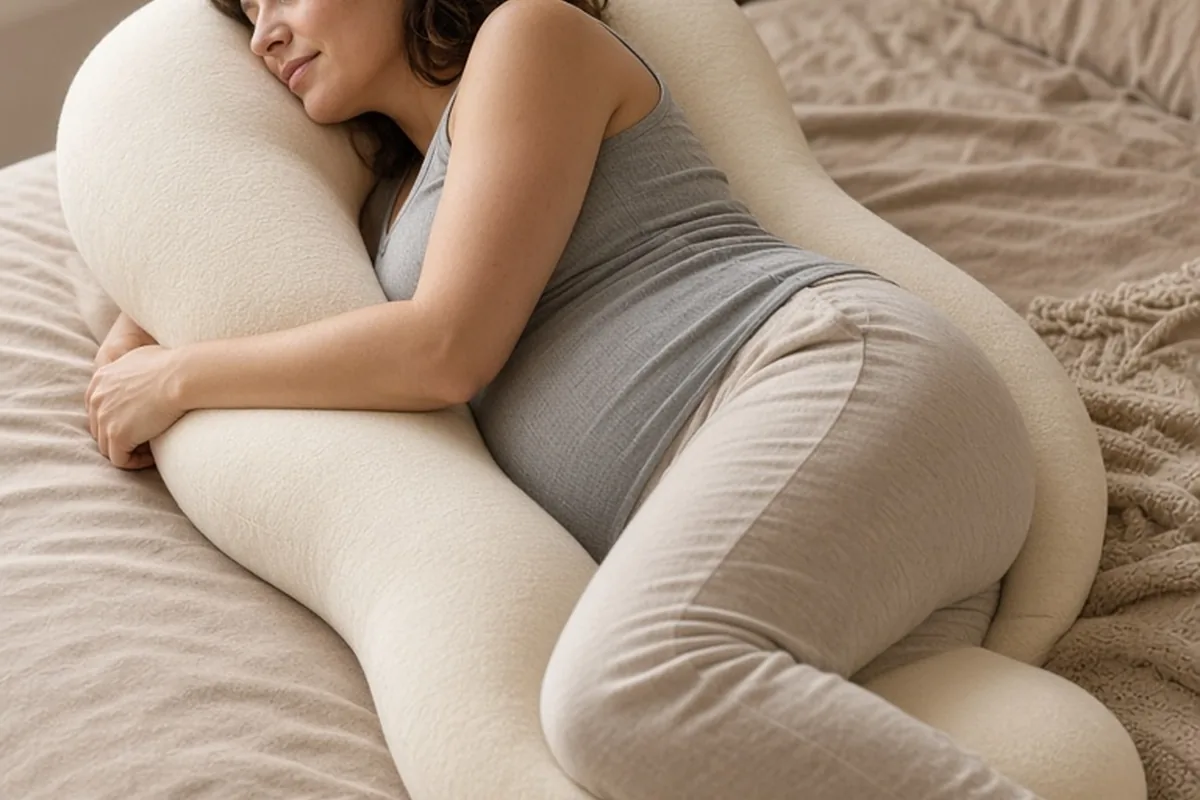
To use a pregnancy pillow for optimal sleep, position yourself on your side—preferably your left—and place the pillow contour between your knees and ankles to keep your hips, pelvis, and spine aligned. Tuck an arm or section under your head for neck support, and rest the front curve under your growing belly to relieve strain on abdominal ligaments. Depending on whether you have a U-shaped, C-shaped, or wedge pillow, you can also brace the back curve against your spine to prevent rolling flat onto your back.
Finding a comfortable sleeping posture becomes increasingly challenging as pregnancy progresses and shifting weight places new demands on your joints, lower back, and hips. A dedicated pregnancy pillow provides targeted physical support where ordinary bed pillows often slip or flatten, allowing your muscles to fully relax so you can get restorative rest.
Side Sleeping Support with Full-Body U-Shaped and C-Shaped Pillows
Full-body pregnancy pillows are designed primarily to facilitate and sustain comfortable side sleeping. When using a symmetrical U-shaped pillow, lie directly in the center channel between the two long arms with the curved top supporting your head and neck. Pull one long leg of the pillow forward along your chest and abdomen, resting your top arm over the cushion and threading the lower end between your knees. The opposing leg of the U-shape sits flush against your back, providing a firm tactile barrier that keeps you from rolling onto your spine during deep sleep. This setup is particularly convenient for people who shift from side to side throughout the night, as you can simply roll over within the center pocket without having to physically lift and reposition the entire pillow.
A C-shaped or contoured J-shaped pillow requires a slightly more intentional setup depending on whether you prioritize back bracing or frontal belly relief. If you need maximum lumbar support, place the long spine of the C against your back, rest your head on the top curve, and pull the bottom hook between your thighs so your lower leg and foot rest on the cushion. If you experience significant front-body pulling, abdominal heaviness, or pubic bone tenderness, flip the orientation so the open side faces your back and the main cushion supports your chest, bump, and knees. Make sure the pillow maintains enough firmness under your neck so your cervical spine stays parallel to the mattress rather than tilting sharply upward or sinking downward.
Targeting Hip and Pelvic Alignment Between the Knees and Ankles
One of the most frequent causes of sleep-disrupting hip ache during pregnancy is the downward pull of the top leg when lying on your side. When the top knee drops forward onto the mattress, it twists the pelvis and places continuous rotational stress on the sacroiliac joints and lower lumbar spine. Placing a pillow between your knees helps keep your thighs parallel, but standard placement often leaves the ankles dangling unsupported, which continues to torque the hip joint.
To achieve balanced pelvic alignment, ensure your pillow extends far enough down to cushion both your knees and your ankles simultaneously. Bend your knees at roughly a forty-five to ninety-degree angle, keeping your lower limbs stacked in a relaxed fetal posture. If you are using a contoured full-body pillow, tuck the bottom curl between your calves and feet so that the space between your ankles matches the natural width of your hips. For those using modular pads or smaller cushions, stacking a secondary cushion between the ankles eliminates knee strain, reduces pull on the piriformis muscles, and significantly decreases morning stiffness in the pelvic girdle.
Belly Propping and Lower Back Support Using Compact Wedges
Not every sleeping arrangement accommodates a massive full-body pillow, and many individuals find that localized support meets their needs with far less bulk. A triangular or semicircular pregnancy wedge is an adaptable tool specifically designed to slide into the narrow gaps where gravity pulls on your body. When side sleeping, gently slide the tapered edge of a wedge pillow just under the lower slope of your abdomen while lying down. The wedge should support the weight of your belly without lifting it uncomfortably high, neutralizing the downward pull on your abdominal wall and round ligaments.
A second wedge can simultaneously address lower back fatigue. Slide a firm wedge cushion directly behind your lumbar region so that it wedges snugly between your back and the mattress surface. This arrangement allows you to lean back slightly and offload tension from your hips without turning fully flat onto your back. If you prefer resting in a modified semi-side position, the rear wedge absorbs your torso weight while the front wedge prevents your bump from dragging your ribcage forward, creating a stable, nest-like cradle that requires very little bed space.
The Semi-Reclined and Elevated Torso Position for Reflux and Congestion
Hormonal shifts relax the lower esophageal sphincter during pregnancy, making nighttime acid reflux, heartburn, and nasal congestion common sleep disruptions. Lying completely flat on your side can sometimes exacerbate these symptoms, leading to frequent waking and discomfort. Creating a gentle, graduated incline from your hips up through your head allows gravity to help keep stomach acid down while easing breathing pathways without compressing your neck.
To build a supportive semi-reclined setup, fold the top curve of a U-shaped or C-shaped pillow over on itself, or rest the upper portion across standard bed pillows to create a steady ramp. Settle your shoulders and upper back onto the incline, ensuring that your entire torso rises gradually rather than just bending your neck sharply at the chin. You can still tuck the lower arms of the pillow under your thighs and knees to take pressure off your lower back and keep your body from sliding down the bed. This elevated side-leaning posture offers relief during periods of severe indigestion, shortness of breath, or upper respiratory congestion.
Adapting Pillow Configurations for Back and Shoulder Relief Across Trimesters
Your physical support requirements change markedly as your pregnancy progresses, and your pillow setup should evolve alongside your changing center of gravity. During the first trimester, systemic fatigue and tender breasts may make stomach sleeping uncomfortable before a visible bump appears. In this stage, hugging a straight body pillow along your front can cushion sensitive chest tissue and prevent you from rolling fully onto your stomach, providing comfortable tactile contact without requiring a heavy contour.
By the second and third trimesters, joint laxity increases due to pregnancy hormones, making the shoulders and mid-back vulnerable to strain when side sleeping. If your top shoulder collapses forward during the night, it tightens the pectoral muscles and strains the upper back. Hug the upper portion of your pregnancy pillow closely against your chest, resting your top forearm and wrist completely on top of the cushion at roughly heart level. This holds your chest open, keeps your shoulder blades neutral, and prevents numbness or tingling in your fingers caused by compressed nerves in the neck and shoulder area.
Transitioning Between Left-Side and Right-Side Rest Throughout the Night
Clinical guidance generally encourages side sleeping during the later stages of pregnancy, with the left side frequently highlighted because it promotes optimal blood flow through the inferior vena cava and eases blood circulation to the placenta. However, maintaining a single rigid posture for eight continuous hours is impractical and often leads to painful pressure points on the downward hip and shoulder. Switching between your left and right side is a completely normal way to maintain comfort and prevent localized soreness.
To make midnight turning seamless, adjust your pillow setup so you can rotate without fully waking up or untangling complex bedding. With a symmetrical U-pillow, you simply pivot your hips and shoulders in place; the back leg immediately becomes your new front-body hugger and knee spacer, while the front leg catches your back. If you use an asymmetrical C-pillow or wedge combination, take a moment to pull the core cushion with you as you roll. If lying on your right side begins to feel heavy or uncomfortable, resting for twenty minutes with a wedge propped behind your back in a quarter-turn tilt provides a restful middle ground that avoids flat-back compression while giving your left hip a break.
Selecting the Right Pillow Shape and Material for Your Body Frame and Bed Space
Finding an effective pillow configuration depends heavily on matching the pillow design to your height, mattress firmness, and room layout. Taller individuals often find standard C-shaped pillows too short to support both the head and ankles simultaneously, leaving the feet unsupported and reintroducing hip strain. For taller frames, long U-shaped models or straight, extra-long cylindrical body pillows paired with a separate head cushion offer greater flexibility. Conversely, in smaller beds or shared sleeping arrangements, massive full-body pillows can crowd your partner or push against headboards, making modular two-piece wedge sets or compact butterfly pillows much more practical.
Material filling and cover breathability are equally important for sustained sleep quality. High-density memory foam provides robust, non-sagging structure that works exceptionally well for pelvic stabilization and heavy abdominal support, though it can trap body heat if not paired with a breathable cotton or bamboo cover. Polyester fiberfill offers a softer, more moldable feel that is easy to fluff and reshape during the night, but it may compress faster over months of use. When selecting your pillow, test the firmness to ensure it does not completely flatten under the weight of your leg, as adequate thickness is essential to keeping your joints properly spaced.
Frequently asked questions
Can I sleep on my back if I use a pregnancy pillow to elevate my hips?
Lying completely flat on your back in the second and third trimesters can compress major blood vessels and cause dizziness or reduced circulation. If you prefer a back-sleeping sensation, use a pregnancy pillow or wedge to prop your upper body at an incline or tilt your torso slightly to one side so you are never resting entirely flat.
Why does my hip still hurt even when using a pregnancy pillow between my knees?
Hip pain often persists if the pillow only cushions your knees while leaving your ankles unseparated, which causes the hip joint to twist downward. Make sure the pillow extends all the way down between your ankles and feet to maintain a completely parallel alignment from your pelvis to your toes.
How do I keep from overheating while wrapped in a large full-body pregnancy pillow?
Full-body pillows can trap warmth, especially when made with synthetic fleece or unventilated foam. Choose pillows with removable covers made from natural fibers like cotton or bamboo, wear breathable lightweight sleepwear, and consider using separate compact wedges instead of a surrounding U-pillow if heat continues to disrupt your rest.
Can I continue using my pregnancy pillow after giving birth?
Yes, many people repurpose their pregnancy pillows during postpartum recovery. Full-body and C-shaped pillows work well as supportive nursing props to offload arm and back strain, while smaller wedges can provide comfortable back and pelvic support when sitting up in bed or on the sofa.
Your next step
Take five minutes tonight before going to bed to adjust your pillow spacing so that your knees, ankles, and bump are evenly supported before you settle in to sleep.