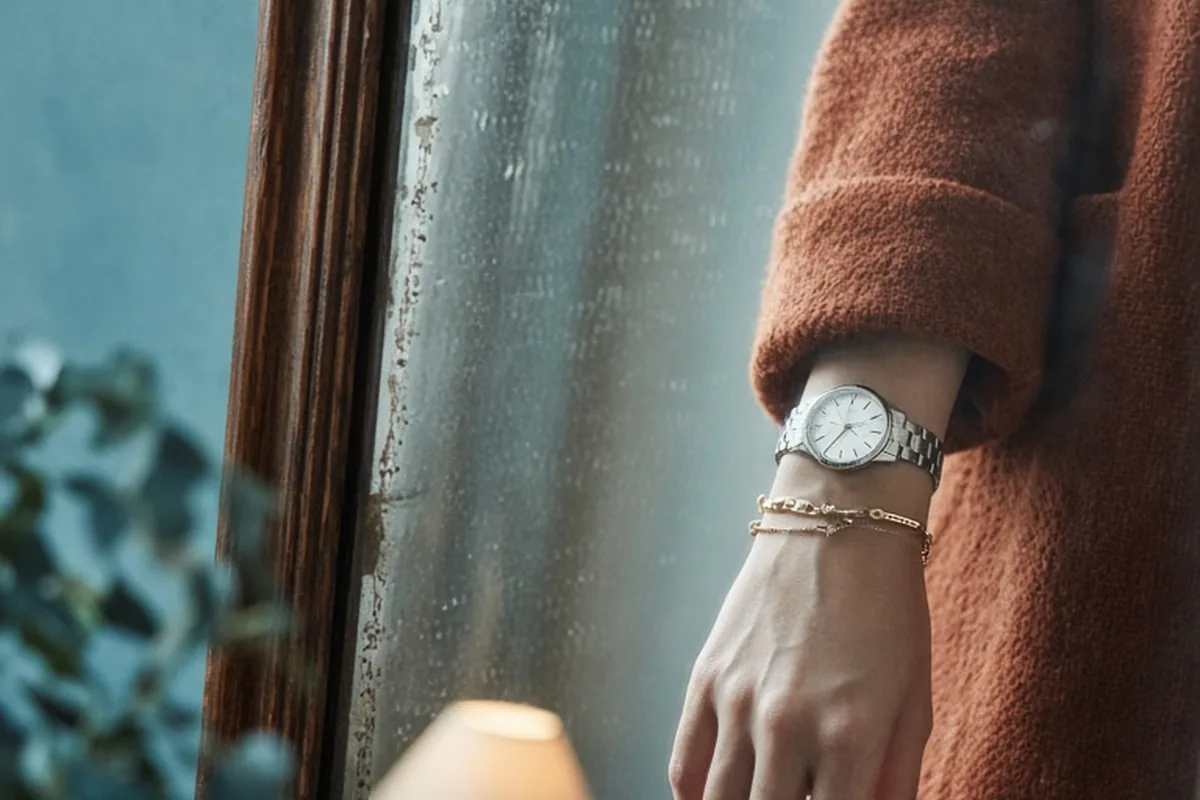
To wear a women's watch comfortably and stylishly, secure it just above your wrist bone on your non-dominant hand. Ensure the band is snug enough that the case stays centered on top of your wrist without pinching or sliding more than an inch. Match the case diameter to your wrist proportions, and coordinate strap materials and metal tones with your outfit and jewelry.
While traditional etiquette once dictated rigid rules for timepieces, modern watch styling emphasizes personal comfort, proportional balance, and intentional coordination with your everyday wardrobe.
Wrist Selection and Proper Anatomical Placement
The standard guideline for wearing any watch is to place it on your non-dominant wrist. If you are right-handed, you wear the watch on your left wrist; if you are left-handed, you wear it on your right. This convention developed for practical reasons: wearing the timepiece on the arm you use less frequently protects the crystal and case from accidental bumps, prevents the strap from dragging against surfaces while writing or typing, and allows you to check the time easily while your dominant hand remains occupied.
Anatomically, the watch case should rest just above the ulnar prominence, which is the small, rounded bone on the outside of your wrist. Positioning the case slightly higher toward your forearm rather than directly on or below the joint prevents the crown from pressing into the back of your hand whenever you bend your wrist. For example, when resting your hands on a keyboard or desk, a watch positioned behind the wrist bone stays flat and comfortable without impeding natural joint movement.
While non-dominant placement is standard, personal comfort always takes priority. If you have a physical condition, skin sensitivity, or simply a preference for wearing jewelry on a particular arm, you can comfortably wear your watch on your dominant wrist. The key consideration is ensuring the clasp and crown do not catch on clothing or interfere with your daily motor tasks.
Proportions and Case Sizing for Different Wrist Sizes
A well-fitted watch maintains visual harmony with the width and circumference of your wrist. Case diameter is measured in millimeters, and selecting the right size depends largely on wrist circumference. Smaller wrists measuring under 6 inches generally pair best with case diameters between 24mm and 30mm. Medium wrists between 6 and 7 inches comfortably accommodate cases ranging from 31mm to 36mm, while wrists over 7 inches can easily support larger statement dials from 38mm to 42mm.
Beyond dial diameter, the lug-to-lug distance—the measurement from the top strap attachment point to the bottom—determines whether a watch fits properly. The lugs should never extend beyond the natural edges of your wrist when viewed from above. If the lugs overhang, the watch will tend to pivot sideways, create gaps under the strap, and look disproportionately large. For instance, pairing a delicate 26mm cocktail watch with an evening dress provides a refined aesthetic, whereas an oversized 38mm chronograph creates a confident, modern accent when worn with a structured blazer.
A trade-off to consider with larger dials is physical weight and profile height. Thicker, oversized cases can feel top-heavy on smaller wrists and may struggle to slide smoothly beneath tailored shirt cuffs or narrow knitwear sleeves.
Selecting Strap Materials to Match Occasion and Utility
Watch straps define the overall tone of your timepiece and should align with both the environment and your activity level. Traditional materials each carry distinct functional advantages and aesthetic associations that influence how your watch integrates with your outfit.
Fine leather straps in black, tan, burgundy, or navy convey classic elegance and are well-suited for professional, formal, and business-casual settings. Metal bracelets, such as stainless steel, yellow gold, rose gold, or two-tone links, offer exceptional durability and transition seamlessly from daytime office wear to evening dinners. Mesh bands offer a sleeker, jewelry-like drape that contours closely to the wrist, while silicone, rubber, and woven nylon straps excel in athletic or casual settings due to their moisture resistance and ease of cleaning.
Climate and moisture exposure represent an essential practical factor. Natural leather absorbs perspiration and humidity, which can cause discoloration, odor, or premature wear over time. If you live in a warm climate or commute in high humidity, a breathable stainless steel mesh or water-resistant textile strap provides significantly greater longevity than untreated leather.
- Leather: Best for business attire, formal events, and tailored cold-weather clothing.
- Metal link bracelets: Versatile for daily professional wear, smart casual outings, and evening wear.
- Milanese mesh: Lightweight and jewelry-like, ideal for transitional day-to-night styling.
- Silicone and nylon: Functional choices for workouts, outdoor recreation, and casual weekends.
Stacking Watches with Bracelets and Jewelry
Stacking a watch with complementary bracelets is a popular styling approach, but it requires deliberate balance to prevent visual clutter and physical damage to your accessories. When building a wrist stack, let the watch remain the focal anchor, keeping surrounding pieces secondary in size and complexity.
To achieve a cohesive look, position thinner, lightweight bracelets above the watch—closer to your elbow—rather than below it near your hand. Placing bracelets above the case keeps them from sliding down over the dial or interfering with hand movement. For example, pairing a minimalist stainless steel watch with a slim silver bangle and a delicate beaded chain creates texture and depth without overwhelming the wrist. Limiting your stack to one or two complementary pieces preserves an intentional, polished aesthetic.
The primary risk when stacking is surface scratching caused by friction between metal components. Hard gemstones, textured chain links, and diamond-encrusted bands can abrade polished watch bezels and scratch sapphire or mineral crystals. To minimize wear, pair your watch with soft cord bracelets, smooth metal cuffs, or wear intricate stone jewelry on your opposite wrist.
Harmonizing Watch Metals with Rings and Accessories
Coordinating the hardware of your watch with your other accessories helps tie an entire outfit together. While traditional fashion rules once mandated matching all metals precisely, modern style permits thoughtful mixing as long as the combination appears deliberate.
If you prefer a cohesive, uniform appearance, match the watch case and buckle to the dominant metal of your rings, necklace, belt hardware, and handbag accents. A warm yellow gold watch pairs naturally with gold hoop earrings and warm-toned clothing, whereas silver and white gold deliver a crisp, contemporary contrast against cool tones like black, grey, and navy. Two-tone watches featuring both silver and gold elements serve as versatile bridge pieces, allowing you to wear mixed jewelry effortlessly without visual conflict.
When mixing metals intentionally, try to maintain consistency in finish rather than color alone. Pairing a high-polish silver watch with polished gold rings looks harmonious, whereas mixing a matte brushed titanium watch with ornate, antique-style brass jewelry can create an unintentional clash in texture and formality.
Fine-Tuning Band Fit and Tension for All-Day Comfort
Achieving the correct band tension is crucial for both physical comfort and the longevity of your timepiece. A watch that is too tight restricts blood flow, leaves skin indentations, and traps sweat, while a band that is too loose will spin around the wrist, causing the dial to strike hard surfaces.
A dependable guideline is the one-finger rule: you should be able to slide the tip of your index finger comfortably between your strap and the underside of your wrist. For leather and silicone straps, find the buckle hole that holds the case stable without compressing the skin. For metal link bracelets, sizing typically requires adding or removing individual links. Always ensure links are removed evenly from both sides of the folding clasp so the clasp mechanism remains centered on the underside of your wrist.
Keep in mind that wrists naturally expand and contract throughout the day due to temperature changes, hydration levels, and physical exertion. If your metal bracelet feels snug in the afternoon, consider using the micro-adjustment settings inside the clasp or opting for a strap with elastic or sliding adjustments during hotter seasons.
Adapting Timepieces Across Different Dress Codes
Selecting the right watch for specific occasions involves assessing the balance between formality, dial simplicity, and overall design complexity. Matching your watch style to the context demonstrates attention to detail and ensures your accessory enhances rather than distracts from your outfit.
For formal black-tie or cocktail events, opt for discreet, elegant designs such as a slim dress watch with a minimal dial, an understated leather band, or a fine jewelry-style bracelet. In professional and corporate environments, classic mid-sized watches with clean geometric cases, neutral dials, and leather or steel bands offer a polished, capable appearance. For weekend outings and travel, sportier chronographs, field watches, or durable digital pieces provide practical utility alongside casual charm.
Smartwatches require thoughtful consideration across dress codes. While highly functional, a bulky smartwatch with a brightly colored silicone strap can look out of place with formal evening wear. You can easily elevate a smartwatch for business or formal settings by switching to an analog watch face display and swapping the standard rubber strap for a tapered leather band or stainless steel mesh bracelet.
Illustrative Scenarios
Adjusting Watch Proportions for a Hybrid Work Routine
Elena worked in a hybrid role split between formal client presentations and active field visits. She initially wore an oversized 40mm fashion watch on a loose metal bracelet that constantly slid down to her hand, snagged on her jacket cuffs, and rattled against her laptop keyboard while typing. To improve everyday functionality while maintaining a professional appearance, she switched to a 32mm stainless steel watch on a tailored link bracelet with micro-adjustment holes. Sizing the bracelet allowed the case to rest securely just above her wrist bone.
Key point: Selecting a case size proportionate to your wrist and adjusting the band so it stays centered prevents daily irritation and ensures the watch slides smoothly beneath clothing across various settings.
Frequently asked questions
Should a woman wear her watch on the left or right wrist?
A woman should typically wear her watch on her non-dominant wrist to protect the case from impacts and keep it out of the way during daily tasks. However, wearing it on the dominant wrist is entirely acceptable if it feels more comfortable or natural for you.
How loose should a women's bracelet-style watch be?
A bracelet watch should have enough slack to move slightly along your forearm—no more than an inch up or down—without spinning completely around your wrist. You should be able to slide one fingertip easily beneath the band while the dial stays facing upward.
Can I wear a smartwatch with formal or evening attire?
Yes, you can wear a smartwatch to formal events by styling it appropriately. Replace sporty silicone bands with a sleek leather, Milanese mesh, or link bracelet, and select a minimalist, dark-themed analog display face to match the formal tone.
Your next step
Measure your wrist circumference, position the case just above your wrist bone on your non-dominant hand, and adjust the band to fit one fingertip underneath for balanced comfort and style.