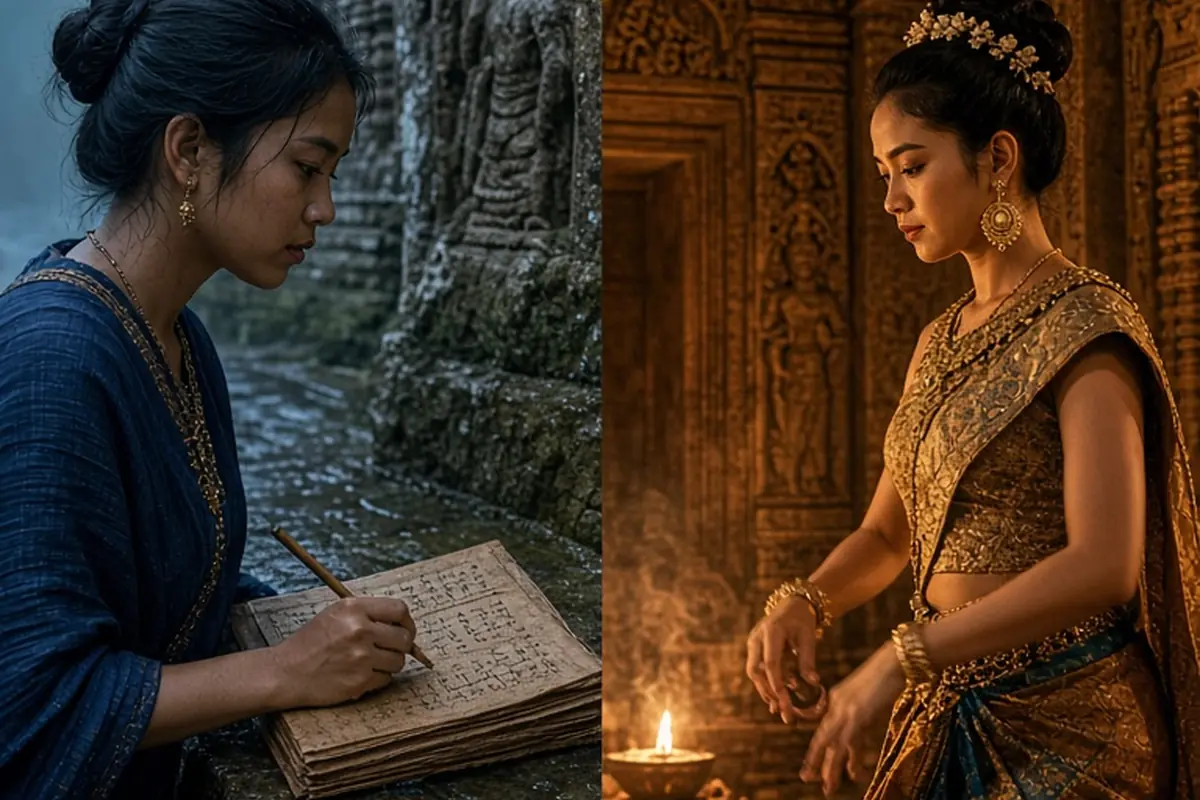
In the Angkorian Khmer Empire, women actively shaped culture and academics as royal scholars, Sanskrit poets, temple administrators, and spiritual teachers. High-status figures like Queen Indradevi established schools and composed masterworks of literature, while women across social strata directed market commerce, preserved oral and textile traditions, and maintained ritual dance practices that sustained the intellectual and cultural identity of ancient Cambodia.
Exploring historical gender roles often reveals unexpected depth, particularly in ancient Southeast Asia, where cultural influence and intellectual mastery were frequently shared across genders rather than restricted to men alone.
Epigraphic Evidence of Sanskrit Mastery and Royal Education
Stone epigraphy from the Angkorian period reveals that elite women achieved profound mastery in classical literature, linguistics, and philosophy. The most celebrated example comes from Queen Indradevi, the senior wife of King Jayavarman VII in the late twelfth century. Inscriptions describe her not merely as a royal consort, but as a brilliant intellectual whose understanding of Buddhist philosophy, grammar, and astronomy surpassed even veteran court scholars. She composed the Phimeanakas inscription, a remarkable Sanskrit poem renowned for its sophisticated meter, rich metaphorical imagery, and precise theological arguments.
Beyond her personal literary achievements, Indradevi used her institutional power to educate others, establishing a royal academy where she personally taught Buddhist doctrine, grammar, and literature to women from across the realm. This demonstrated a deliberate effort to institutionalize female academic achievement rather than treating it as an isolated court anomaly. At the same time, it is essential to acknowledge historical limits: while royal and aristocratic women had structured access to advanced Sanskrit literacy, everyday literacy among rural populations remained predominantly functional and oral, reflecting broader socioeconomic divisions common across the medieval world.
Spiritual Leadership and Philosophic Stewardship in Angkorian Faiths
Women during the Angkor period held prominent positions within both Shaivite Hinduism and Mahayana Buddhism, acting as philosophers, ritual specialists, and custodians of sacred spaces. Stone inscriptions document women founding spiritual hermitages, dedicating statues of deities, and endowing monasteries with land, livestock, and servants. Their religious contributions were not passive acts of piety; they actively shaped theological discourse and determined how religious principles were integrated into civic life.
For example, Queen Jayarajadevi, the first wife of Jayavarman VII and sister to Indradevi, was celebrated for her ascetic discipline, philanthropic foundations, and deep comprehension of Buddhist principles. When her husband was away on military campaigns, she guided the kingdom spiritually, establishing refuges for the vulnerable and sponsoring theatrical presentations of Buddhist stories to instruct the populace. These initiatives highlight how spiritual authority provided Angkorian women with a platform to influence societal ethics, public welfare, and community education on a national scale.
Economic Autonomy and Market Governance as Cultural Foundations
Cultural and intellectual pursuits require robust economic underpinnings, and in the Angkor Empire, commerce was overwhelmingly directed and managed by women. When the Chinese diplomat Zhou Daguan visited Angkor in 1296, he explicitly noted that women handled the day-to-day trade, held market stalls, managed household finances, and negotiated commercial transactions with foreign merchants. This financial independence granted women significant social authority and autonomy in both public and domestic spheres.
Because Angkorian society practiced bilateral kinship and matrilineal inheritance of land and property, women retained direct ownership over valuable family estates and resources. This economic sovereignty allowed women of various social classes to fund local artistic projects, commission stone carvings, and sponsor community religious festivals. Without the active entrepreneurial leadership of Angkorian women, the thriving urban markets and the patronage systems that sustained regional craftsmen, sculptors, and musicians would not have existed in their historical form.
Palace Administration, Judicial Counsel, and Political Influence
Inside the royal palace, female officials fulfilled critical administrative and governmental duties that extended far beyond ceremonial attendance. Contemporary accounts and relief carvings depict women serving as internal palace guards, record keepers, judicial arbitrators, and trusted diplomatic liaisons. Because the royal court served as the administrative core of the empire, women stationed within these inner circles had continuous access to state deliberations and exerted substantial influence over administrative decisions.
In legal and dispute resolution matters, women frequently served as arbiters for community and family conflicts, leveraging customary law and property records to deliver verdicts. While supreme imperial power was formally held by the monarch, the king's governance relied heavily on female counselors who understood court genealogy, tributary networks, and regional land titles. Recognizing this administrative presence counters the simplistic assumption that ancient statecraft was exclusively male, demonstrating instead that political stability depended on coordinated gender cooperation.
Living Arts: Temple Dance, Sacred Music, and Architectural Patronage
The iconic visual and performative culture of Angkor—immortalized in the thousands of Apsara and Devata figures carved across Angkor Wat and the Bayon—was deeply rooted in the real-world artistic contributions of female performers and patrons. Sacred temple dancers were not mere entertainers; they were respected religious functionaries who served as living conduits between the human world and the divine. They underwent rigorous training in complex physical choreographies, musical theory, and epic storytelling, preserving the foundational mythology of the Khmer civilization across generations.
Furthermore, female aristocrats were active patrons of monument construction, funding temple enclosures, public water reservoirs, and stone libraries that housed palm-leaf manuscripts. These physical structures served as the academic repositories of their day, preserving treatises on medicine, astronomy, and religion. By underwriting both the tangible architecture and the intangible performance traditions of the empire, women acted as the primary guardians of Angkorian aesthetic and educational identity.
Contemporary Insights: Applying Bilateral Respect to Modern Partnerships
Examining the balanced partnership models of the Angkor era offers valuable perspective for modern interpersonal dynamics, particularly around shared decision-making, mutual respect, and intellectual collaboration. Modern relationships thrive when partners abandon rigid assumptions about who should lead discussions, manage finances, or pursue intellectual development. Just as Angkorian culture drew strength from recognizing the competence of women in commerce, governance, and scholarship, healthy modern relationships rely on equal voice and shared stewardship.
When couples face disagreements regarding career goals, financial responsibilities, or household leadership, looking to collaborative historical models reminds us that mutual capability is not a recent invention. Practicing active listening, supporting each other's educational ambitions, and sharing logistical control builds authentic trust and self-respect. True confidence in a partnership comes from valuing your partner's intellect and autonomy rather than attempting to maintain unilateral control or falling back on outdated stereotypes.
Illustrative Scenarios
Re-evaluating Historical Narratives in Academic Research
Marcus, a university history student, was preparing a thesis proposal on state formation in medieval Southeast Asia. He initially assumed that ancient administrative and philosophical institutions were entirely dominated by men, mirroring classical European models. While reviewing translated Khmer epigraphy, he encountered the writings of Queen Indradevi and records of female market leadership. Confused by how to reconcile this with his preconceptions, he considered omitting the female-led academic networks to simplify his thesis. Instead, he chose to restructure his framework around bilateral governance, highlighting how Indradevi's educational institutions influenced imperial statecraft.
Key point: Examining historical evidence with an open mind allows us to replace rigid assumptions with accurate, nuanced understanding.
Navigating Balanced Decision-Making in Daily Life
Elena and David were struggling to balance financial planning and household project management. David felt pressure to make final decisions alone to demonstrate leadership, which left Elena feeling sidelined and David overwhelmed. After reading about the complementary roles in Angkorian commerce and estate management, they recognized that true partnership relies on shared autonomy. They agreed to divide responsibilities based on individual strengths and deliberate major choices collaboratively, eliminating unilateral decision-making.
Key point: Shared responsibility and mutual respect relieve unnecessary pressure and create stronger, more balanced partnerships.
Frequently asked questions
Who was the most prominent female academic in the Angkor Empire?
Queen Indradevi is widely recognized as the foremost female intellectual of the Angkor era. She was a celebrated Sanskrit poet, a master of Buddhist philosophy and grammar, and the founder of a royal academy dedicated to educating women.
Did everyday women have educational opportunities in ancient Cambodia?
While formal Sanskrit scholarship was largely concentrated among the nobility, non-royal women received extensive practical education in trade, textile production, oral traditions, and religious customs. Their economic autonomy in running markets gave them substantial practical knowledge and social authority.
How do modern historians know about women in the Angkor era?
Historians rely on surviving Sanskrit and Old Khmer stone inscriptions, temple relief carvings, and foreign diplomatic accounts, most notably the detailed thirteenth-century travelogue written by Chinese envoy Zhou Daguan.
Your next step
Take twenty minutes this week to study an authentic primary source translation or visit a museum exhibit on ancient Southeast Asian heritage to broaden your perspective on historical female leadership.