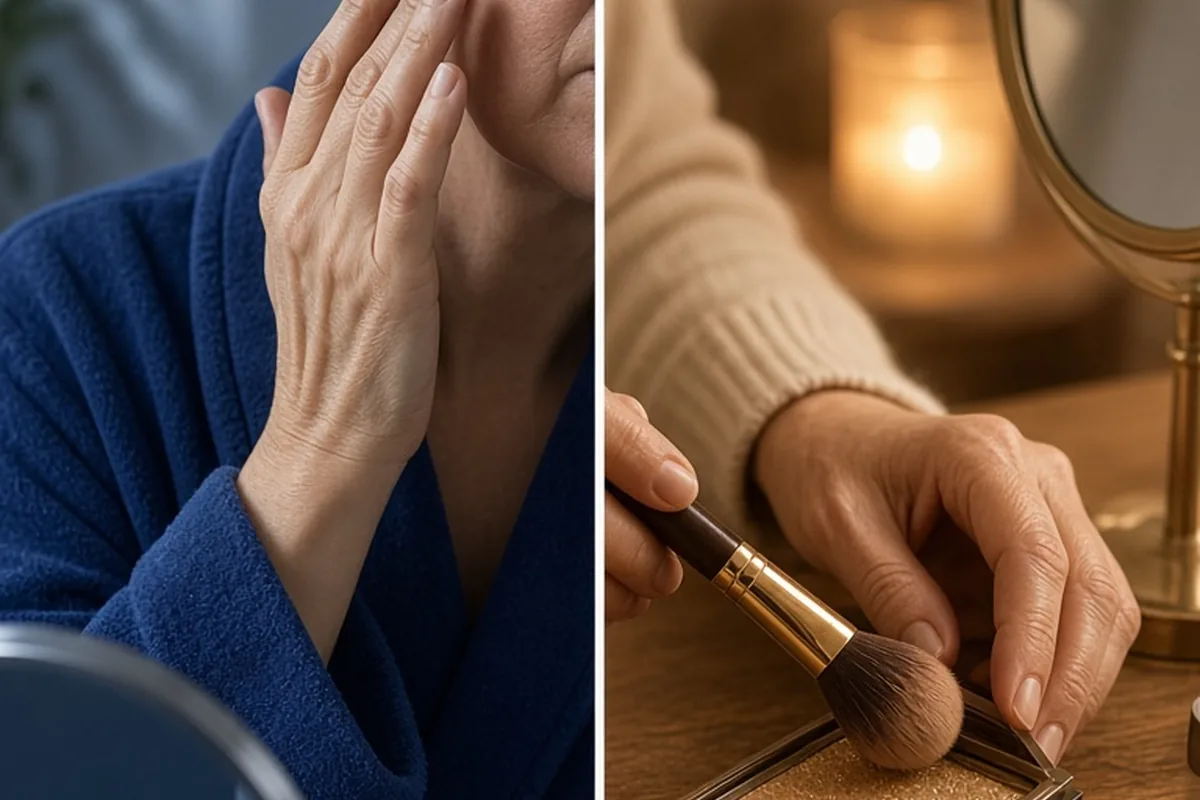
Laura Geller makeup is generally well-suited for mature skin because its signature baked powder formulas start as liquid creams, creating a weightless finish that resists settling into fine lines. Products like the Baked Balance-n-Brighten Foundation provide buildable, semi-matte to luminous coverage without the heavy, drying effect common to traditional powders. However, individuals with severely dry or flaky patches will still need thorough moisturizing preparation beforehand to ensure an even, smooth application.
Finding cosmetics that flatter shifting skin textures, loss of elasticity, and fine lines often requires moving away from heavy liquid bases and chalky setting powders.
The Science of Baked Formulas and Aging Complexions
Mature skin naturally undergoes structural changes, including a gradual reduction in sebum production, decreased epidermal thickness, and uneven surface texture. Traditional pressed powders are typically formulated with dry pigments and binding agents that can absorb surface oils, accentuating crepey areas and settling into dynamic expression lines. Laura Geller products, particularly the signature baked line, rely on an artisan manufacturing process where multi-colored liquid pigments are baked on terracotta tiles for an extended period. This baking process retains a creamy consistency within a dry format, allowing the pigment to meld with the skin rather than sitting as a dusty film on top of it.
When applied to the face, the warmth of the skin activates these micro-milled pigments. Instead of forming a rigid layer that cracks when smiling or speaking, the formula flexes across textural variations. For instance, someone experiencing loss of firmness around the jawline or cross-hatching around the eyes will find that baked pigments diffuse ambient light across the plane of the face. This optical dispersion softens the appearance of depth in wrinkles without requiring a thick layer of cosmetic paste that risks migrating into creases as the day progresses.
Despite these advantages, the physical nature of baked powder means it still relies on a baseline level of surface hydration. If the stratum corneum is dehydrated, the baked particles can cling to dead skin cells around the nose or chin. While it avoids the suffocating weight of heavy full-coverage liquids, it cannot replace the hydrating functions of a dedicated topical skincare routine.
Coverage, Tone Correction, and Color Blending
Hyperpigmentation, sun spots, broken capillaries, and diffuse redness are common concerns for mature skin. Liquid foundations that offer full coverage often rely on high concentrations of titanium dioxide or iron oxides, which can create a flat, mask-like appearance that drains natural vitality from the complexion. Laura Geller Baked Balance-n-Brighten addresses this through marbleized swirls of multiple complementary color ribbons. These ribbons blend together on the brush to provide self-correcting coverage that adapts to natural variations in facial skin tones rather than painting over them uniformly.
For example, a swirl containing soft yellow, rose, and beige pigments helps neutralize localized redness around the cheeks while balancing sallowness across the forehead. This multi-tonal approach creates dimensional coverage that mimics youthful skin clarity. Because the coverage is medium and buildable, you can swirl additional product onto areas requiring extra correction without building visible thickness across the rest of the face.
However, there are coverage boundaries to keep in mind. For pronounced melasma, deep post-inflammatory erythema, or dark under-eye hollows, baked powder foundation alone may not provide complete opacity. Relying solely on layering powder over dark spots can eventually lead to dryness in targeted areas. In these cases, pairing the powder with a lightweight, fluid pinpoint concealer produces a more natural finish than trying to build the powder to maximum density.
Essential Skin Preparation for Baked Cosmetics
The performance of baked cosmetics on mature skin is heavily dictated by the canvas beneath it. Because powder formulas adhere to whatever surface moisture is present, applying them directly onto unmoisturized, parched skin will yield an uneven, patchy finish. Conversely, applying baked powder directly over fresh, unabsorbed facial oil or sticky sunscreen can cause the powder to grab aggressively in one spot, resulting in dark streaks that are difficult to blend out.
An effective preparation routine begins with a hydrating serum containing humectants like glycerin or hyaluronic acid, followed by a nourishing moisturizer matched to your skin type. Allow these skincare layers to absorb for three to five minutes until the surface feels supple but dry to the touch. If you use a primer, choose one with hydrating or smoothing properties rather than a heavy, pore-filling silicone that can ball up under brush friction. Laura Geller Spackle primers, for instance, are water-rich formulations designed to create a uniform, slip-resistant base that holds baked pigments in place all day.
A practical test is to lightly touch the back of your hand to your cheek before reaching for your brush. If your skin feels tacky or wet, wait an additional minute. If your skin feels tight or rough, press two drops of a lightweight facial oil or an extra layer of light moisturizer into the skin first. Taking this extra minute ensures the baked minerals glide across the skin rather than catching on dehydrated areas.
Tool Selection and Application Mechanics
How you apply baked makeup is just as important as the formula itself. Traditional sponges or overly stiff, flat foundation brushes can deposit too much concentrated product onto mature skin, leading to a heavy application that exaggerates pores. The ideal tool is a dense, dome-shaped kabuki brush with soft synthetic bristles. The density of the brush allows you to pick up the baked pigment evenly across the bristle tips, while the domed shape prevents sharp edges from depositing harsh lines.
To apply, swirl the brush gently across the baked compact, tap off the excess powder from the ferrule, and buff the product into the skin using light, circular motions. Starting from the center of the face—where redness and uneven tone are typically most concentrated—work outward toward the hairline and jawline. For delicate areas like the under-eye or upper lip where fine lines are prominent, avoid aggressive swirling; instead, use a smaller, fluffy blending brush and gently press or roll the product onto the skin to avoid disturbing the skin barrier or creating micro-creasing.
A useful technique for mature complexions is the post-application setting mist. Once your baked foundation, blush, and bronzer are applied, lightly mist your face with a hydrating, alcohol-free facial spray. The fine mist melts the outer layer of the baked powder particles into the skin, instantly eliminating any powdery residue and creating a natural, dewy finish that lasts throughout the day.
Evaluating Blushes, Bronzers, and Highlighters in the Range
Mature skin often benefits from the warmth and structure that blushes and bronzers provide, but powder color products frequently contain large mica particles or chunky glitter that magnify fine lines on the high points of the cheeks. Laura Geller Baked Blush-n-Brighten and Baked Bronze-n-Brighten formulations utilize the same micro-milled baking process as the foundations, incorporating ultra-fine, luminous veins rather than overt shimmer flakes.
When applied to the cheekbones, these blushes deliver a wash of color with a subtle sheen that mimics the natural moisture reflection of healthy skin. For example, shades with a mix of peach, coral, and gold undertones can instantly revive a dull complexion without emphasizing enlarged pores near the apples of the cheeks. The bronzers offer balanced, neutral undertones that allow for soft perimeter framing without the muddy, orange cast that can age the face.
The trade-off lies in pigment intensity. Because these baked cheek products are richly pigmented, dipping a dense brush directly into the pan and sweeping it across the cheek can deposit more color than desired. Mature skin looks best with soft, diffused edges, so it is advisable to use a looser, angled blush brush and apply the color with a feather-light touch, gradually building the intensity.
Potential Drawbacks and When to Consider Alternatives
While Laura Geller makeup offers distinct benefits for mature skin, it is not a universally ideal solution for every skin profile. Individuals with active flaking, such as those undergoing intense retinoid treatments or dealing with severe eczema or rosacea flares, may find that any powder-based format catches on raised flakes. In such circumstances, a nourishing cream foundation, tinted balm, or serum foundation will provide greater surface emollience and soothing comfort.
Another consideration is shade matching across extreme ends of the skin tone spectrum. While the marbleized swirl technology accommodates a range of undertones within each shade bracket, people with very deep rich complexions or very fair cool undertones may find that the self-adjusting ribbons pull slightly too warm or lack sufficient depth. Testing shades in natural lighting is essential to verify that the baked balance does not oxidize or appear ashen.
Finally, individuals seeking absolute full coverage for deep scarring or severe discoloration may find the sheer-to-medium nature of baked products insufficient on its own. Attempting to build a baked powder to maximum opacity by layering multiple heavy coats will eventually negate its weightless benefits, leading to the exact caked appearance that mature skin seeks to avoid.
Frequently asked questions
Does Laura Geller foundation settle into deep wrinkles?
When applied lightly over properly hydrated skin, the baked formula is designed to float over textural changes rather than pool inside creases. However, applying too much powder or skipping moisturizer can cause particles to gather in dynamic expression lines over the course of the day.
Can Laura Geller baked products be used on oily mature skin?
Yes, the baked formula works well on mature skin that produces excess oil because it absorbs minor surface sebum without turning cakey. It provides a semi-matte finish that controls shine while preserving a natural, healthy luminosity.
Is a primer necessary when using Laura Geller makeup?
A primer is not strictly required if your skin is well-moisturized, but a hydrating primer can significantly improve blendability and longevity. It creates a smooth surface barrier that prevents the baked pigments from clinging unevenly to dry patches.
How do you choose between liquid foundation and baked powder for mature skin?
Choose baked powder if you prefer lightweight, breathable coverage that resists settling into lines and takes less time to apply. Choose liquid or serum foundations if your skin is severely dry, actively flaking, or if you prefer an intensely dewy, high-gloss finish.
Your next step
Assess your skin's daily hydration levels and start by testing a single baked foundation with a dense kabuki brush over a well-moisturized base to see how the finish performs on your unique texture.