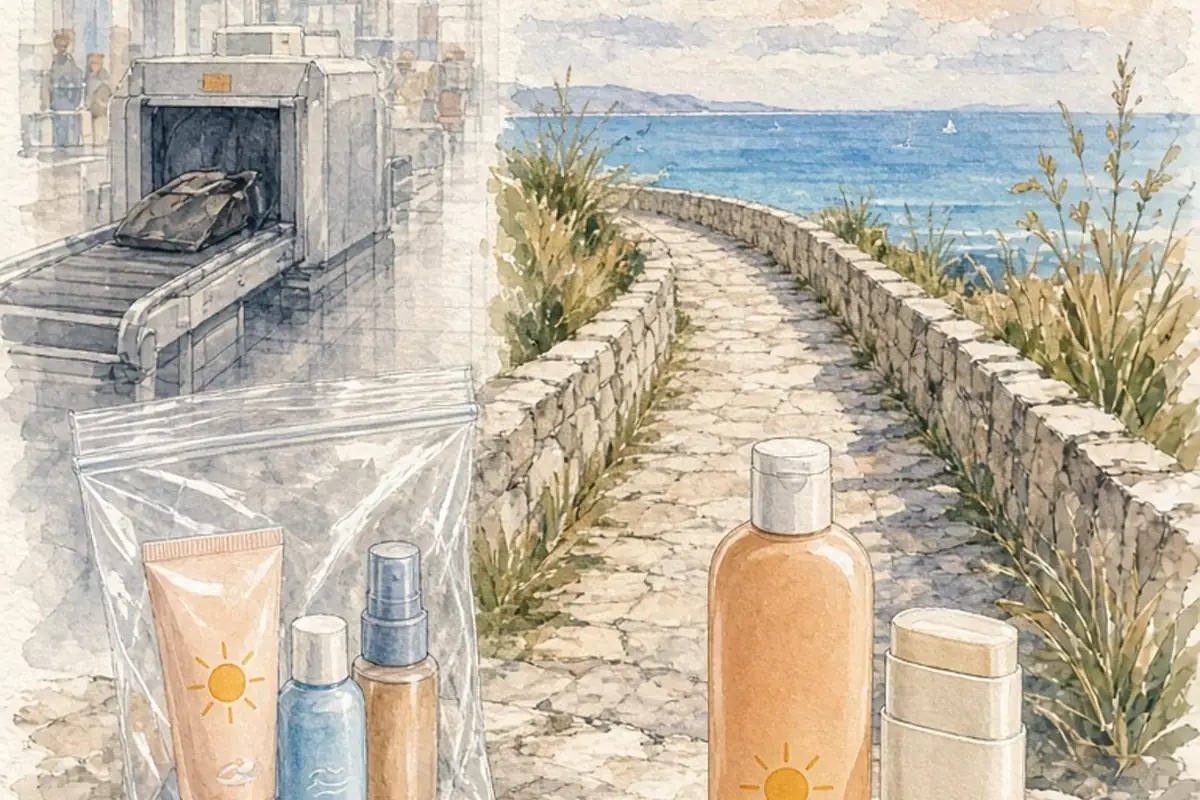
Yes, sunscreen is allowed on airplanes in both carry-on bags and checked luggage, but strict size limits apply to carry-ons. In your carry-on, liquid, lotion, cream, and aerosol sunscreens must be in containers of 3.4 ounces (100 milliliters) or smaller and fit into a single quart-sized bag. In checked baggage, you can bring standard full-size bottles, provided aerosol nozzles are protected against accidental discharge.
Navigating airport security with skincare requires knowing how security officers classify different product textures and formulations. Because daily sun protection is important whether you are traveling for a tropical vacation or flying cross-country for work, planning how you pack your sunscreens prevents frustrating hold-ups or confiscated bottles at the screening checkpoint.
Understanding the Carry-On Liquid Rules for Sunscreen
The Transportation Security Administration treats all lotions, gels, fluids, and liquid-cream emulsions as liquids under the standard 3-1-1 checkpoint rule. This guideline mandates that any liquid product carried into the passenger cabin must be packaged in a bottle or tube with a manufacturer-stamped capacity of 3.4 ounces (100 milliliters) or less. Security agents evaluate the marked maximum volume of the packaging rather than how much fluid remains inside. If you carry a six-ounce bottle that only contains an ounce of leftover lotion, checkpoint officers will still reject it because security regulations evaluate maximum container capacity rather than remaining liquid levels.
All of your travel-sized personal care liquids, including sunscreen, must fit comfortably inside one clear, resealable quart-sized plastic bag. If your cosmetic bag cannot close completely or requires forceful jamming to seal, screening personnel may ask you to leave items behind. For travelers who prefer not to buy disposable miniature bottles, decanting your favorite formula into a reusable silicone or plastic travel container is an economical alternative. When transferring chemical sunscreens, choose opaque or tinted containers to prevent sunlight exposure from degrading the active UV filters during transit.
Solid Sunscreen Sticks and Powder Formulations
If you want to conserve valuable real estate inside your clear liquid pouch, solid sunscreen sticks and mineral powder sunscreens offer a convenient travel strategy. Security guidelines classify completely solid stick products as non-liquids, meaning they do not count toward your single quart-sized bag limit and can remain freely accessible in your carry-on tote, backpack, or personal item. Similarly, dry mineral powder formulations with built-in brush dispensers are considered dry cosmetics and bypass standard liquid volume caps.
While solid sticks and powder formulas simplify the security screening process, they present distinct application trade-offs. Sunscreen sticks provide targeted coverage that works exceptionally well for facial contours, ears, the neck, and the tops of your hands, but coating larger areas like arms and legs with a stick can feel slow or sticky. Powder sunscreens are ideal for reapplication over makeup and removing mid-flight shine without smudging cosmetics, but dermatologists generally advise against relying solely on brush-on powders as your primary protective shield because achieving adequate, even density across exposed skin is difficult.
Navigating Aerosol and Continuous Spray Sunscreens
Aerosol and continuous spray sunscreens are permitted on commercial flights, but they face scrutiny because pressurized canisters involve flammability and pressure-safety considerations. In carry-on luggage, aerosol sprays must adhere to the same 3.4-ounce limit as liquids, and the bottle must slide into your quart-sized bag. Many outdoor and sports sunscreens are sold in miniature 3-ounce aerosol canisters specifically manufactured for airport checkpoints, giving travelers a misting option that conforms to federal regulations.
Safety regulations require that any aerosol brought onto an aircraft must have a protective cap or an integrated twist-lock mechanism that prevents the nozzle from depressing accidentally during handling or turbulence. Beyond regulatory compliance, practicing courteous cabin etiquette is essential. Spraying an aerosol sunscreen inside an airport waiting area or aboard an aircraft releases fine airborne droplets and alcohol vapors into recirculated air, which can irritate fellow passengers and trigger respiratory discomfort. If you must reapply an aerosol while traveling, spray the mist directly into your palm in a restroom before smoothing it onto your skin.
Packing Full-Sized Sunscreens in Checked Luggage
If you are planning an extended beach trip that requires multiple full-sized bottles of body lotion, packing your sunscreen in checked baggage is the most practical choice. Checked luggage does not impose the 3.4-ounce restriction on standard creams and lotions, allowing you to transport eight-ounce, twelve-ounce, or family-sized pump bottles without issue. For aerosol sprays in checked bags, the Federal Aviation Administration sets an aggregate limit for medicinal and toiletry articles: each passenger is typically restricted to a total of 70 fluid ounces across all aerosol products, with no single container exceeding 18 ounces.
Cargo holds experience dramatic shifts in air pressure and ambient temperature during flight, which can cause flexible plastic bottles to expand and pop their lids. To prevent messy leaks that could ruin clothing and electronics, open each bottle before packing, gently squeeze out a small pocket of excess air, and screw the cap back on firmly. Securing flip-top lids with a small piece of removable tape and sealing each container inside an individual waterproof zip-top bag provides reliable insurance against altitude-induced spills.
In-Flight Sun Protection and Cabin Atmosphere Realities
Many travelers assume they do not need sun protection while sitting inside an airplane cabin, but high-altitude flight introduces concentrated ultraviolet exposure. Standard commercial passenger windows are made of layered polycarbonate or tempered glass that effectively blocks UVB rays, the wavelengths primarily responsible for sunburn. However, these windows permit a substantial amount of UVA radiation to penetrate the cabin, and UVA rays penetrate deep into the skin, contributing to premature aging, cellular breakdown, and hyperpigmentation.
Because UV radiation intensity increases significantly with altitude, sitting beside an unshaded window during a daytime flight exposes your face and hands to elevated levels of UVA light. Furthermore, cabin air conditioning systems maintain relative humidity levels between ten and twenty percent, which rapidly leaches moisture from the skin barrier. Packing a travel-sized, hydrating sunscreen with ceramides, hyaluronic acid, or glycerin allows you to shield your complexion from indirect window exposure while counteracting the drying atmosphere of the aircraft cabin.
International Checkpoint Variations and Regional Bans
While the 100-milliliter standard is widely recognized across the globe, international screening facilities enforce packaging nuances differently than domestic checkpoints. In many European, British, and Asian airports, screening agents strictly require that all liquids fit into a specific plastic bag provided directly at the security line rather than personal cosmetic pouches, even if your pouch is clear and under one quart in volume. Knowing these regional differences helps you avoid unexpected delays during international transfers or return flights.
Additionally, several popular coastal destinations have enacted legal prohibitions against specific chemical UV filters to protect fragile marine ecosystems and coral reefs. Locations such as Hawaii, the U.S. Virgin Islands, Palau, and parts of the Mexican Caribbean prohibit or discourage the sale and use of sunscreens containing ingredients like oxybenzone and octinoxate. If your itinerary involves swimming or snorkeling in sensitive marine environments, reviewing the local ingredient regulations before flying ensures your products will not be confiscated or banned upon entry.
Frequently asked questions
Can I bring a large bottle of sunscreen through security if it is mostly empty?
No, security screeners assess the total printed capacity of the bottle rather than the amount of sunscreen left inside. A six-ounce tube with only two ounces of remaining lotion will still be confiscated at the checkpoint. Always transfer leftover sunscreen into a container clearly marked as 3.4 ounces (100 milliliters) or less.
Can sunscreen qualify for a medical liquids exemption at airport security?
Over-the-counter sunscreen is almost always classified as a cosmetic toiletry and must comply with standard liquid limits. If you have an authentic medical condition requiring prescription-strength topical photoprotection, carry a doctor's formal prescription and declare it to officers before screening begins. Approval remains at the discretion of the security supervisor.
Does luggage x-ray screening ruin the active ingredients in sunscreen?
Standard airport luggage scanners and carry-on x-ray machines do not harm the chemical or mineral active ingredients in sunscreen. The radiation levels used in airport security equipment are far too low to break down UV-blocking compounds or diminish the product's protective shelf life. Extreme heat left in a parked car is much more likely to spoil sunscreen than an airport x-ray.
Are facial mist sunscreens allowed in carry-on bags?
Yes, facial mist sunscreens are permitted in your carry-on provided the container is 3.4 ounces (100 milliliters) or smaller and fits within your single clear quart bag. Non-aerosol pump mists and miniature aerosol sprays are treated under the same volume rules as traditional lotions.
Your next step
Check the printed volume on every sunscreen container you plan to carry into the cabin to confirm it does not exceed 3.4 ounces (100 milliliters), pack any full-sized bottles securely in sealed bags inside your checked luggage, and consider packing a solid sunscreen stick to save space in your carry-on liquid pouch.