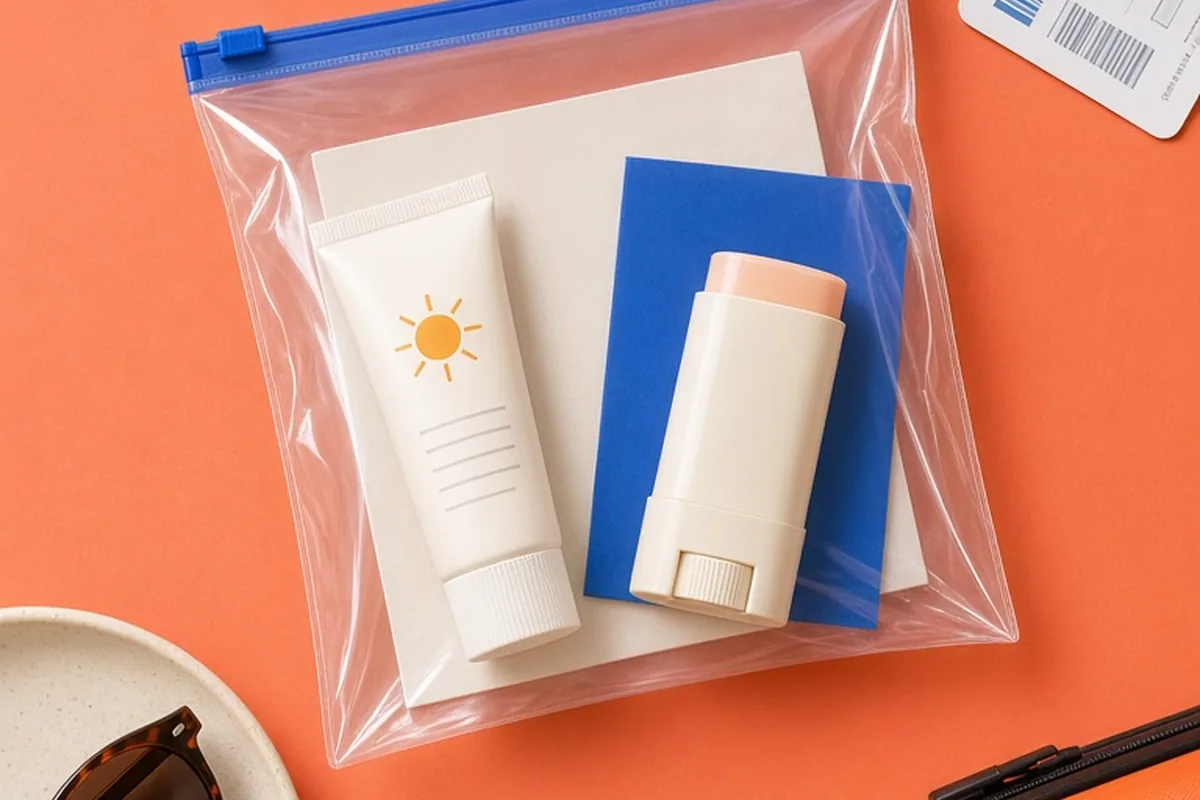
Yes, sunscreen is allowed on planes in both carry-on and checked bags. In carry-on luggage, liquid, lotion, gel, and aerosol sunscreens must be in containers of 3.4 ounces (100 milliliters) or less and fit within a single quart-sized clear bag. If you need a full-sized bottle, you can safely pack it in your checked luggage without volume limits, provided aerosol cans have secure caps.
Preparing skincare products for travel often raises practical questions at airport security checkpoints. Understanding specific transportation rules for different sunscreen formulas ensures you stay protected under your destination's sun without losing expensive products at the screening belt.
Carry-On Liquids Rule: How the 3-1-1 Guidelines Apply to Sunscreen
Transportation security agencies classify creams, lotions, gels, and sprays under the general umbrella of liquids, aerosols, and gels. Under the Transportation Security Administration (TSA) 3-1-1 rule for carry-on luggage, every liquid sunscreen container must measure 3.4 fluid ounces (100 milliliters) or less. Security officers base compliance on container capacity rather than remaining volume. This means a half-empty six-ounce tube of sunscreen will be confiscated at the checkpoint, regardless of how little product remains inside.
To travel efficiently with carry-on luggage only, transfer your favorite facial or body formulas into clearly marked, reusable travel containers that meet the 3.4-ounce limit. Alternatively, you can purchase travel-sized retail versions from skincare brands. All your carry-on liquids, including moisturizers, cleansers, serums, and sunscreen tubes, must fit comfortably inside a single clear, resealable one-quart plastic bag. Presenting this bag separately during screening when requested helps avoid bag checks and keeps lines moving smoothly.
- Maximum container volume: 3.4 fluid ounces (100 milliliters) per bottle.
- Total allotment: All liquid items must fit inside one clear, quart-sized resealable bag.
- Capacity measurement: TSA assesses the printed bottle size, not the amount of fluid remaining.
Formulas Compared: Sticks, Liquids, Sprays, and Powders
Different sunscreen formulations fall under different categories at airport security checkpoints. Solid stick sunscreens are classified as solid toiletries rather than liquids, meaning they do not count toward your single quart-sized bag allowance. You can pack multiple full-sized solid sunscreen sticks in your carry-on or personal item without restriction, making them an excellent choice for travelers relying solely on overhead luggage.
Aerosol and continuous pump sprays are treated as liquids and must adhere strictly to the 3.4-ounce volume rule in carry-on bags. Furthermore, aerosol containers must have tightly fitted caps or locking mechanisms to prevent accidental discharge from baggage shifting. Powder mineral sunscreens are categorized as loose powders. In carry-on bags, TSA permits powders over 12 ounces (350 milliliters), but screening officers may require secondary manual inspection, so keeping powder brushes and containers accessible is recommended.
Packing Full-Sized Sunscreen in Checked Luggage Safely
When traveling for extended vacations or beach holidays, standard travel-sized bottles rarely provide sufficient product for full-body daily application. Packing full-sized bottles in your checked baggage is permissible and eliminates concerns regarding the standard liquid volume restrictions. According to Federal Aviation Administration (FAA) hazardous materials regulations, medicinal and toilet aerosols and liquids—including spray sunscreens—are permitted in checked luggage, provided total aggregate quantities per passenger do not exceed 70 fluid ounces (2 kilograms), with individual containers restricted to 18 fluid ounces (500 milliliters).
Aircraft cargo holds experience significant fluctuations in temperature and atmospheric pressure, which can cause flexible plastic bottles to expand and push liquid past loose flip-top lids. To prevent messy spills on your clothing, unscrew the cap of your sunscreen bottle, place a small square of plastic cling wrap over the opening, and screw the cap back on tightly. As an added precaution, seal each sunscreen bottle inside an individual leak-proof zip-top storage bag before packing it securely between soft garments in the center of your suitcase.
Navigating International Airport Security Variations
While the 100-milliliter (3.4-ounce) rule is widely adopted across the European Union, the United Kingdom, Canada, Australia, and many other global hubs, specific screening enforcement can differ noticeably from US domestic checkpoints. Some international airports strictly mandate that all liquids fit inside proprietary transparent bags provided directly at the entrance of the security queue, while others utilize advanced computed tomography (CT) scanners that permit passengers to leave liquids inside their carry-on luggage.
If your itinerary includes connecting international flights, remember that you may need to re-clear security during transit. Purchasing a full-sized sunscreen in an airport duty-free shop at your departure city can result in confiscation at your intermediate layover checkpoint unless the item is packaged in an officially sealed, tamper-evident bag accompanied by a same-day receipt. When in doubt, pack essential sunscreen in compliant travel containers before departing home to avoid mid-journey transit complications.
Sun Protection During the Flight: Cabin UV Exposure
Many travelers wonder whether they need to apply sunscreen while seated inside an airplane cabin. Standard commercial airplane windows are manufactured from thick polycarbonate or multi-layered glass, which effectively blocks nearly all ultraviolet B (UVB) rays, the primary cause of sunburns. However, these windows do not fully filter ultraviolet A (UVA) rays, which penetrate deeply into skin tissue and contribute to premature aging and cellular damage.
At cruising altitudes between 30,000 and 40,000 feet, atmospheric protection is significantly thinner, increasing ambient ultraviolet radiation intensity. If you have a window seat on a daytime flight, applying a broad-spectrum facial sunscreen with an SPF rating of 30 or higher prior to boarding helps safeguard your skin. Packing a hydrating facial sunscreen stick or a small cream tube in your personal item allows for easy, mess-free touch-ups without disturbing seatmates or triggering liquid screening issues.
Practical Packing Checklists and Destination Buying Strategies
Deciding whether to pack your sun protection or purchase it upon arrival depends on your destination, skin sensitivity, and luggage capacity. Resort areas and island destinations frequently mark up sunscreen prices significantly at hotel gift shops and convenience stores. Conversely, bringing multiple large bottles from home can add unnecessary weight to your luggage or consume all available space in your carry-on liquids pouch.
A balanced approach involves bringing your specialized daily facial sunscreen and sensitive-skin products in compliant travel containers within your carry-on, while purchasing standard, high-volume body sunscreen at a local supermarket or pharmacy once you arrive. If you rely on specific active ingredients, such as non-nano zinc oxide or European chemical UV filters, verify availability at your destination beforehand, as local cosmetic regulations and retail selections vary across borders.
- Pack in carry-on: Specialized facial sunscreens, sensitive-skin formulas, and solid SPF lip balms.
- Pack in checked bag: Full-sized spray bottles, large family lotions, and after-sun gels.
- Buy upon arrival: Basic full-body broad-spectrum lotions for high-volume beach days when traveling light.
Illustrative Scenarios
Packing Sun Protection for a Week-Long Carry-On Trip
A traveler planning a seven-day tropical trip with only a carry-on backpack needed enough sunscreen for daily outdoor excursions without exceeding the TSA liquids allotment. Instead of trying to fit several bulky lotion bottles into a single one-quart bag, she packed two solid mineral SPF sticks for daytime facial touch-ups, one 3.4-ounce tube of water-resistant facial lotion in her liquids pouch, and purchased a standard 8-ounce bottle of body sunscreen at a local market near her accommodations.
Key point: Pairing solid stick formulas in personal luggage with locally purchased body lotions preserves limited carry-on liquid space while maintaining reliable skin protection throughout a trip.
Frequently asked questions
Can I bring full-sized aerosol sunscreen in checked luggage?
Yes, full-sized aerosol sunscreens are permitted in checked luggage under FAA regulations for personal care items. Each container must not exceed 18 fluid ounces (500 milliliters), and the nozzle must have a secure cap to prevent accidental discharge during flight.
Does solid stick sunscreen count toward the TSA 3-1-1 liquid limit?
No, solid stick sunscreens are classified as solid personal care items rather than liquids or gels. You can pack solid SPF sticks in your carry-on bag outside of the clear quart-sized liquids bag without volume limits.
Can I bring medical or prescription sunscreen through security in larger sizes?
Medically necessary liquids, including prescription dermatological sunscreens, are exempt from the 3.4-ounce limit at US checkpoints. You must declare these items to the screening officer at the start of security screening for separate inspection.
Should I wear sunscreen while sitting next to an airplane window?
Yes, wearing broad-spectrum sunscreen is helpful on daytime flights because airplane windows block UVB rays but let through significant amounts of UVA radiation. Applying SPF 30 or higher before boarding protects skin from elevated high-altitude UV exposure.
Your next step
Review your sunscreen formulations before packing, placing solid sticks and powders directly in your carry-on while decanting favorite lotions into 3.4-ounce bottles or packing full-sized containers securely in checked luggage.