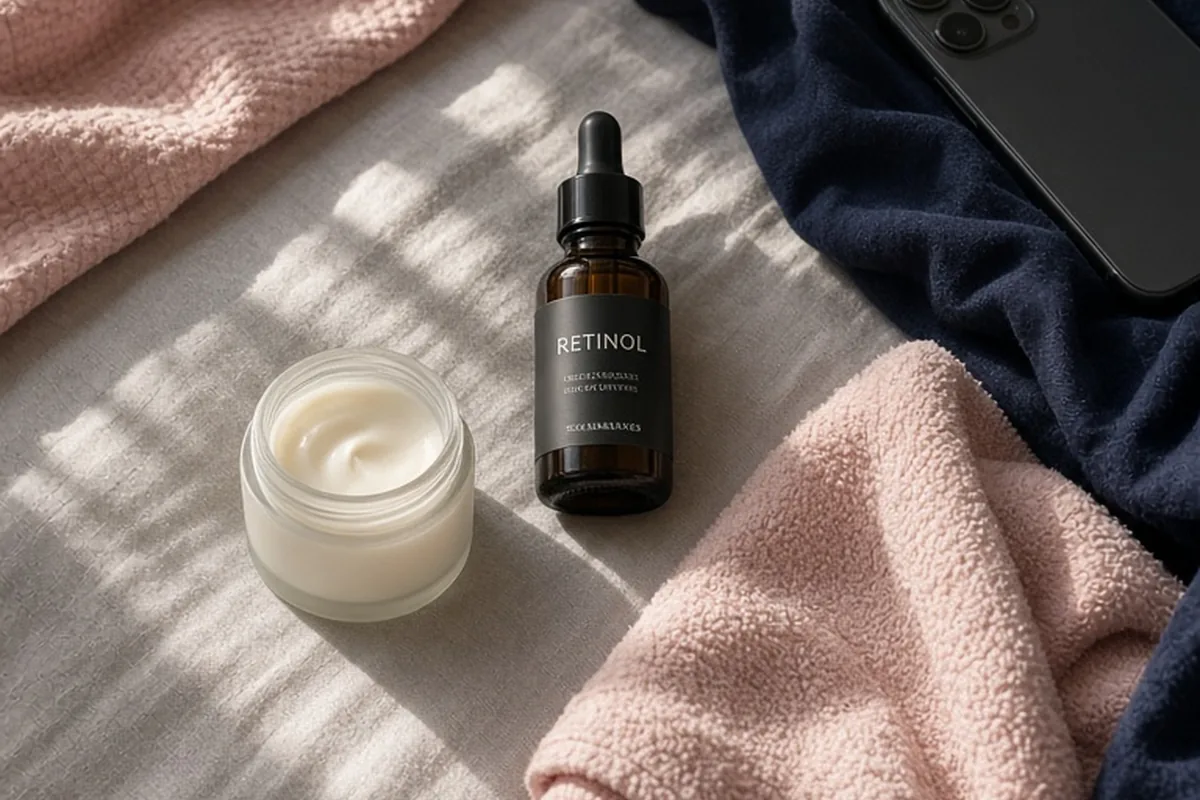
You can apply retinol either before or after moisturizer depending on your skin sensitivity. Applying retinol directly to clean, dry skin before moisturizer maximizes absorption and potency for experienced users. If you experience redness, peeling, or stinging, applying moisturizer before retinol—or sandwiching retinol between two light layers of moisturizer—creates a protective buffer that reduces irritation while still delivering the active ingredient effectively.
Establishing a stable evening skincare routine often comes down to the order in which you layer active treatments and barrier-supporting creams. Retinol remains one of the most widely used ingredients for addressing fine lines, texture, and blemish-prone skin, but its potency requires deliberate handling to avoid unnecessary irritation.
Applying Retinol Before Moisturizer for Maximum Potency
Applying retinol directly to clean, dry skin before any moisturizing cream allows the active molecule to make unhindered contact with your skin barrier. In this conventional layering sequence, the vehicle carrying the retinol—whether a lightweight serum, emulsion, or liquid suspension—penetrates without having to pass through occlusive lipids, waxes, or heavy emollients. This approach is generally best suited for individuals whose skin is already acclimated to retinoids, or those with naturally resilient, oily, or combination skin types that do not easily succumb to flaking or barrier disruption.
To use this method successfully, cleanse your face thoroughly with a mild, non-stripping cleanser and pat your skin completely dry with a clean towel. It is critical to wait approximately ten to fifteen minutes until all surface moisture has evaporated, as applying retinoids to damp skin accelerates absorption and significantly increases the likelihood of stinging and irritation. Once your skin is dry, smooth a single pea-sized amount evenly across your entire face, avoiding the immediate eye contours and the corners of the mouth. Allow the treatment to settle for two to five minutes before following with a nourishing moisturizer to seal in hydration and support lipid barrier repair overnight.
The primary trade-off of applying retinol first is the elevated risk of retinoid dermatitis, characterized by tightness, burning, and visible redness. If you notice persistent flaking around your nose or chin after several days of direct application, your skin is signaling that the penetration rate is outpacing its natural tolerance threshold. In that scenario, stepping back to a buffered application sequence provides relief without forcing you to abandon the active ingredient entirely.
Applying Retinol After Moisturizer to Buffer Sensitive Skin
Applying moisturizer before retinol is a dermatologist-supported technique commonly known as buffering. When you apply a layer of moisturizer first, its humectants and emollients dilute the concentration gradient and slow the rate at which the retinoid diffuses into the stratum corneum. This deliberate delay blunts the initial spike in cellular turnover that causes uncomfortable side effects, making it an ideal strategy for beginners, individuals with reactive skin, or those introducing a higher-strength formula.
A common misconception is that putting moisturizer first completely neutralizes the efficacy of retinol. In practice, lipid-soluble retinoid molecules gradually penetrate through standard moisturizing lotions and creams, ensuring your skin still receives the long-term cell-renewing benefits without the intense shock to your moisture barrier. To execute this technique, apply a thin, hydrating cream or lotion after cleansing, let it absorb until it feels set to the touch, and then distribute your pea-sized portion of retinol across the face.
While buffering dramatically improves comfort, it does have a minor limitation: heavy, petroleum-based ointments or thick balms containing high concentrations of petrolatum, mineral oil, or beeswax can create an impenetrable physical seal. If your preparatory moisturizer is too thick, it may block the retinol from reaching the skin entirely. For buffering to work as intended, select a lightweight lotion rich in ceramides, glycerin, or hyaluronic acid rather than an occlusive healing ointment.
The Retinol Sandwich Method for Dry and Reactive Skin
The sandwich method takes buffering one step further by placing the retinol between two distinct layers of moisturizer. This technique is especially helpful during cold, dry winter months when environmental humidity drops, or for anyone navigating the initial four to six weeks of retinization. By encasing the active treatment within two hydrating layers, you provide immediate barrier reinforcement both underneath and on top of the active ingredient.
To perform the sandwich method, begin by washing your face and applying a light layer of moisturizer while your skin is slightly damp from cleansing to lock in hydration. Next, allow that initial layer to dry completely for roughly ten minutes. Once dry, smooth your pea-sized amount of retinol across the face. Finally, finish the routine by applying a second layer of moisturizer—which can be the same product or a slightly richer night cream—over the entire area. This top layer minimizes transepidermal water loss and keeps the skin comfortable throughout the night.
The main drawback of the sandwich method is the potential for product pilling or heaviness, especially if your products contain incompatible silicones or heavy polymers that do not layer smoothly. To avoid this, keep your application amounts modest and give each layer sufficient time to settle before applying the next.
How Formulation and Skin Type Dictate Your Routine
Your skin type and the specific vehicle formulation of your retinol product play a major role in determining whether before or after makes the most sense. Liquid and gel-based retinols tend to dry quickly and are formulated for direct application on oily or congested skin that tolerates actives well. Conversely, cream-based retinols and encapsulated formulas already contain emollient bases designed to release the active slowly, making them naturally gentler even when applied before a separate moisturizer.
Understanding your personal skin profile helps clarify your approach:
If you have naturally oily or acne-prone skin, applying a lightweight retinol serum directly after cleansing allows the formula to absorb cleanly without leaving an overly greasy residue, followed by an oil-free gel moisturizer.
If you have dry, mature, or naturally sensitive skin, applying your moisturizer first or utilizing the sandwich technique prevents moisture depletion and preserves the integrity of your lipid mantle.
If you have combination skin, you can customize your application by buffering your drier cheek areas with moisturizer first while applying the retinol directly onto your oilier T-zone.
Always evaluate how your skin feels in the morning. Waking up to soft, calm skin indicates that your current layering sequence matches your barrier capacity, whereas waking up to taut, shiny, or irritated skin suggests that you should shift toward post-moisturizer buffering.
- Oily or acne-prone skin: Apply retinol serum directly after cleansing, then follow with an oil-free gel moisturizer.
- Dry or sensitive skin: Apply a hydrating lotion first or use the sandwich method to preserve lipid integrity.
- Combination skin: Buffer dry zones like the cheeks first, while applying directly to resilient areas like the forehead and chin.
Application Timing and Practical Rules to Avoid Irritation
Regardless of whether you choose to place retinol before or after your cream, consistent application mechanics are vital for preventing irritation. The single most important rule is the quantity you use. A standard pea-sized dot is sufficient for the entire face; applying larger quantities does not accelerate skin improvements, but it dramatically increases the risk of redness, burning, and flaking.
Dot the single pea-sized drop onto your forehead, cheeks, and chin before gently spreading it outward. Take care to avoid the immediate perimeter of your eyes, the outer creases of your nostrils, and the lip border, where the skin is thinner and far more susceptible to barrier damage. If you wish to treat the neck and upper chest, introduce that area separately with a buffered application, as the neck contains fewer sebaceous glands and is notoriously prone to retinoid reactions.
Frequency is just as critical as product order. Beginners should start by applying retinol only two nights per week for the first two weeks, spacing applications several days apart. If no dryness or irritation occurs, you can gradually increase frequency to every other night, and eventually to nightly use if your skin remains balanced and comfortable.
Structuring Your Morning and Evening Skincare Routine
Retinol degrades when exposed to direct sunlight and increases your skin's susceptibility to UV radiation, which is why it should only ever be used during your evening routine. Your daytime regimen should focus on protection, hydration, and environmental defense, creating a balanced cycle that supports nightly skin renewal.
In the morning, rinse your face with lukewarm water or a gentle cleanser, apply a hydrating serum or moisturizer, and complete the routine with a broad-spectrum sunscreen of SPF 30 or higher. Wearing daily sunscreen is non-negotiable when using retinoids, as the accelerated turnover of surface cells leaves new skin vulnerable to photoaging and sun damage.
In the evening, keep your routine simple on retinol nights. Avoid using chemical exfoliants such as glycolic, lactic, or salicylic acids, as well as benzoyl peroxide or high-concentration vitamin C treatments in the same session. Combining multiple potent actives in one evening overwhelms the skin barrier. Pair your retinol exclusively with soothing, supportive ingredients such as ceramides, squalane, panthenol, and niacinamide to keep the skin calm.
How to Handle the Adjustment Period and Barrier Setbacks
During the first several weeks of using a retinoid, your skin undergoes an adjustment period known as retinization. It is common to experience mild dryness, minor peeling, or a temporary increase in blemishes known as purging, which occurs as cellular turnover accelerates and brings existing microcomedones to the surface faster.
Distinguishing between a normal adjustment phase and a damaged moisture barrier is essential for maintaining skin health. Normal retinization feels like slight tightness or fine flaking that resolves easily with moisturizer. A damaged barrier, by contrast, feels hot to the touch, stings when you apply even gentle, non-active moisturizers, and produces widespread redness or rough patches.
If you encounter signs of a compromised barrier, pause retinol use completely for three to seven days. Focus exclusively on gentle cleansing, barrier-repairing creams with ceramides, and daily sun protection. Once your skin feels completely calm and comfortable, you can reintroduce retinol using the buffered or sandwich method at a lower weekly frequency.
Illustrative Scenarios
Illustrative Scenario: Transitioning from Buffering to Direct Application
A skincare user with combination skin started using an over-the-counter 0.3% retinol product. During the first two weeks, direct application to bare skin caused mild flaking and stinging around the jawline. The user adjusted the routine by applying a lightweight ceramide lotion first, waiting ten minutes, and applying the retinol over the moisturizer three nights per week. After six weeks of consistent use without irritation, the user transitioned back to applying retinol directly onto dry skin before moisturizer.
Key point: Buffering provides a temporary bridge that allows your skin to build retinoid tolerance comfortably before progressing to direct application.
Frequently asked questions
Does applying moisturizer before retinol make it completely ineffective?
No, applying moisturizer first does not stop retinol from working. Retinol molecules are lipophilic and gradually pass through standard hydrating lotions to reach the skin, delivering long-term benefits with significantly less irritation.
How long should I wait between applying retinol and moisturizer?
If you apply retinol first, waiting two to five minutes allows the product to settle evenly before you follow with moisturizer. If you apply moisturizer first, wait roughly five to ten minutes to ensure your skin is completely dry before smoothing on your retinol.
Can I mix my retinol and moisturizer together in my palm before applying?
While mixing them in your palm dilutes the formula to reduce irritation, it can lead to uneven distribution of the active ingredient across your face. Layering one product smoothly over the other ensures a more consistent, predictable application.
Should I apply eye cream before or after retinol?
Apply a gentle eye cream before your retinol to act as a protective barrier around the delicate orbital area. This simple buffer prevents the retinol from migrating into the thin skin around your eyes where irritation occurs most frequently.
Your next step
Assess your current skin comfort level tonight: start by applying a lightweight moisturizer before your pea-sized dose of retinol if you are new or sensitive, and only move to applying retinol first once your skin demonstrates consistent tolerance.