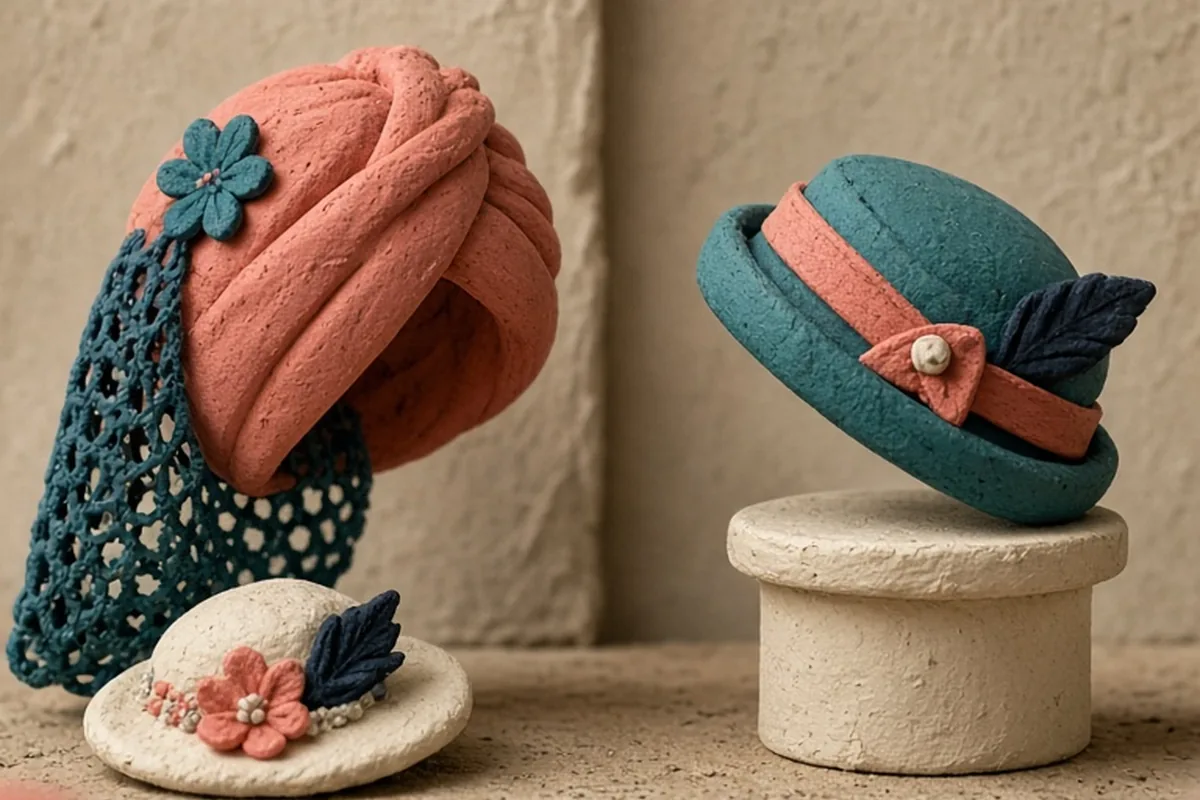
In the 1940s, women wore an inventive variety of hats including structured fedoras, compact pillboxes, dramatic tilt toppers, fabric turbans, snoods, and miniature doll hats. Because millinery was largely exempt from wartime fabric rationing in the United States and Britain, hats became the primary way women brought color, individuality, and personal glamour to utilitarian, rationed wardrobe staples.
While strict clothing rationing during the Second World War limited yardage, pocket details, and fabric varieties for dresses and suits, headwear remained a liberated canvas for personal expression and daily morale.
The Defining Hat Silhouettes of the Early to Mid-1940s
The early 1940s introduced headwear silhouettes designed to balance the severe, military-influenced tailoring of wartime suits. With women wearing tailored jackets featuring padded, squared shoulders and knee-length skirts, headwear shifted upward and forward to create visual harmony. Popular daytime styles included structured felt fedoras, angled berets, compact homburgs, and jaunty overseas caps modeled directly on service uniforms. These structured silhouettes projected confidence and capability while maintaining a polished, intentional appearance suitable for both office work and social gatherings.
A hallmark of mid-1940s styling was asymmetry. Rather than sitting squarely on the crown of the head, hats were intentionally perched at steep angles, tilted far over the right eyebrow, or worn pushed back toward the crown to showcase intricate pompadour rolls and victory rolls. Milliners added shallow brims, dipped fronts, and scooped crowns that framed the face without obscuring the wearer's line of sight. For special occasions, wide-brimmed cartwheel hats and shallow saucer styles provided high drama, though their size made them less practical for crowded public transit or windy commutes.
Turbans and Snoods: The Intersection of Safety and Style
As millions of women entered factory floors, munitions plants, and mechanical workshops, loose hair presented a severe industrial safety hazard. The response was a cultural explosion of functional headcoverings, most notably the turban and the crocheted snood. Rather than settling for plain work caps, women turned fabric wraps and knotted scarves into vibrant fashion statements. Silk, rayon, printed cotton, and jersey fabrics were twisted, pleated, and pinned around the head, completely enclosing long hair while keeping the wearer looking neat and stylish throughout long shifts.
Snoods—mesh or yarn hairnets that cupped the hair at the nape of the neck—offered another versatile alternative. Often fastened to a small velvet bow, a felt headband, or a miniature forward cap, snoods allowed women to maintain elaborate curled hairstyles without spending hours restyling them each morning. The trade-off was largely one of formality: while turbans and snoods transitioned effortlessly from assembly lines to casual evening outings, traditional social settings still called for formal, structured millinery crafted from wool felt or straw.
Miniature Doll Hats and Tilt Pillboxes
Among the most recognizable fashion innovations of the 1940s was the miniature topper, commonly referred to as the 'doll hat' or postage-stamp hat. Measuring only a fraction of standard head sizes, these petite creations were designed to sit precariously above curled updos. They came in diverse geometries, ranging from tiny boater shapes and thimble-sized pillboxes to angled discs adorned with delicate birdcage veiling. Because they required minimal raw yardage, doll hats were affordable to produce and purchase even during peak material shortages.
Wearing a doll hat required specialized fastening techniques. Because the hat did not cup the skull, it relied on hidden millinery elastic bands stretched behind the nape, internal hair combs, or long decorative hatpins driven through the hair rolls. While visually striking and delightfully whimsical, doll hats could feel unstable in active environments, requiring wearers to master secure pinning methods to prevent the piece from shifting during movement.
Materials, Trimmings, and Make-Do-and-Mend Millinery
Wartime supply chains disrupted the availability of imported fine straws, French ribbons, and metal findings. Milliners and home sewers adapted by working with available domestic materials such as wool felt, braided straw alternatives, heavy cottons, rayon brocades, and repurposed household textiles. In many households, older 1930s wide-brimmed hats were unpicked, blocked over wooden bowls or kitchen molds, and recut into modern, compact wartime shapes, exemplifying the widespread 'Make Do and Mend' ethos.
Trimmings played an outsized role in refreshing a woman's wardrobe season after season. A single neutral felt base could be transformed repeatedly with fresh additions of spotted netting, dyed rooster feathers, velvet ribbon rosettes, fabric flowers, or glass hatpins. Veils made of fine rayon tulle or Russian netting were particularly popular; draped softly over the eyes or tied beneath the chin, they added an air of mystery and elevated even the simplest rationed wool suit into a formal ensemble.
Post-War Transitions and Christian Dior's New Look
The end of the war in 1945 and the debut of Christian Dior’s revolutionary 'New Look' in 1947 dramatically shifted women's millinery once again. As fabric rationing ended and feminine silhouettes expanded to feature nipped waists and full, calf-length skirts, headwear expanded in proportion. The compact, utilitarian shapes and jaunty miniature hats of the war years gradually gave way to wide-brimmed picture hats, dramatic mushroom brims, and architectural cloches designed to anchor expansive silhouettes.
Post-war millinery prioritized luxury, balanced proportions, and fine finishes. Velvet, crisp straw, duchess satin, and lush floral trims replaced wartime salvage materials. While working women continued to rely on practical berets and simple pillboxes for daily convenience, formal millinery celebrated the return of abundance and leisure, establishing the broad, elegant silhouettes that would dominate early 1950s high fashion.
How to Identify and Style 1940s Hats Today
When sourcing authentic 1940s hats in vintage markets, examine the construction details carefully. Genuine period pieces typically feature interior grosgrain ribbon sweatbands sewn by hand or early machine stitching, labels from union millinery guilds, and built-in metal hair combs or elastic cord channels. Wool felt should feel dense and sturdy, while veiling from the era often shows slight fragility and requires gentle handling. Be cautious of dry rot in vintage netting and brittle straw bases that cannot be reshaped without specialized steaming.
To incorporate authentic or reproduction 1940s hats into a contemporary wardrobe, focus on proportion and placement. Pair a structured fedora or angled beret with modern tailored separates like high-waisted trousers, crisp button-downs, or minimalist trench coats. If wearing a dramatic tilt hat or veiled pillbox, anchor your hair in a clean chignon, low twist, or soft side sweep so the piece has a firm base to rest upon. Keeping the rest of the outfit clean and structured allows the character of the hat to shine without looking like a costume.
Illustrative Scenarios
Restyling an Heirloom Tilt Hat for an Evening Event
Rachel inherited a 1944 black wool felt tilt hat with a spotted veil from her grandmother but struggled to wear it to an evening gala. At first, she placed it flat on the top of her head over loose, straightened hair; the hat continually slipped off and looked unbalanced against her modern slip dress. Recognizing the issue, Rachel pinned her hair into a secure, low textured bun to give the piece an anchor. She tilted the hat forward over her right temple, securing its hidden comb into the hair base and pairing it with a tailored black tuxedo jacket. The resulting silhouette looked cohesive, modern, and poised.
Key point: Period hats require deliberate angular placement and a structured hair base to achieve both physical stability and balanced proportions.
Balancing Historical Accuracy with Practical Visuals
Julian was designing costumes for a regional theatre production set in 1943 and initially equipped all female characters with identical wide-brimmed straw hats for outdoor scenes. During rehearsals, the oversized brims cast deep shadows across actors' faces under stage lighting and looked historically inaccurate for working-class characters subject to wartime material limits. Julian re-evaluated the script's social context and swapped the wide brims for fitted rayon turbans, crocheted snoods, and compact wool berets. The change immediately improved lighting visibility while capturing the authentic resourceful spirit of home-front fashion.
Key point: Choosing context-appropriate millinery shapes like turbans and compact berets conveys authentic period character far better than generic historical tropes.
Frequently asked questions
Why were women's hats exempt from rationing during World War II?
Governments in both the United States and Britain exempted millinery from rationing to maintain public morale and support small craft businesses. Because hats could be constructed from small offcuts, scraps, and unconventional non-rationed materials, they offered citizens an accessible way to refresh their appearance without draining critical wartime textile reserves.
How did women keep tiny 1940s doll hats from falling off?
Doll hats were secured using a combination of hidden millinery elastic cords stretched beneath the hair at the back of the head, internal metal hair combs sewn to the lining, and decorative steel hatpins. Setting the hair in structured rolls or pincurls provided a solid foundation for pins and combs to grip firmly.
What is the key difference between 1930s and 1940s women's hats?
While 1930s hats often featured soft, slouchy brims, feminine cloche evolutions, and deep crowns, 1940s hats were notably more structured, architectural, and compact. The 1940s favored sharp angles, military accents, forward tilts, and utility wraps designed to complement broader padded shoulders and practical wartime lifestyles.
Your next step
To build an authentic 1940s look or evaluate a vintage piece, secure your hair into a firm base and position the hat at an intentional forward or side angle.