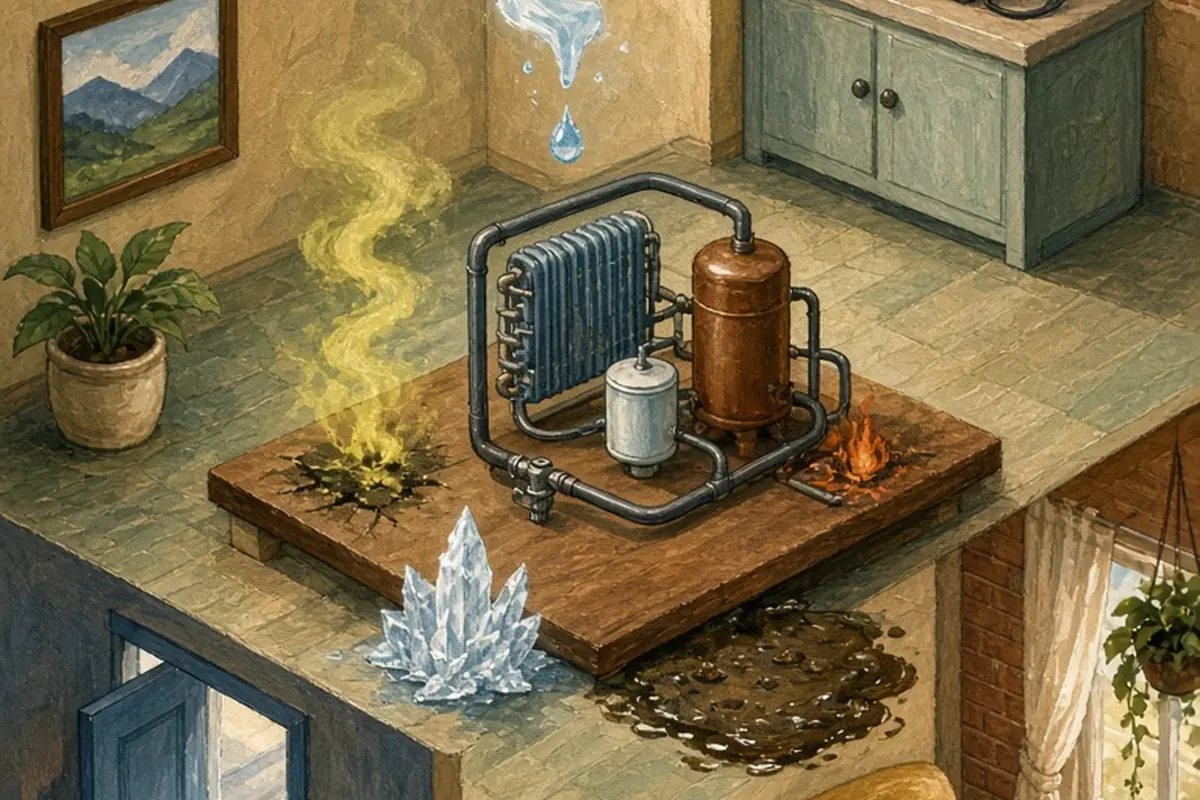
Moisture inside a refrigeration system causes severe mechanical and chemical damage. When water mixes with refrigerant and oil under high operating temperatures, it forms corrosive acids that eat away at components and degrade lubrication. In low-temperature sections, entrained water freezes into ice crystals that clog expansion valves and capillary tubes, choking refrigerant flow, reducing cooling capacity, and ultimately causing compressor overheating or catastrophic mechanical failure.
A sealed refrigeration circuit relies on a chemically stable, dehydrated environment to move heat reliably. Introducing even small amounts of liquid water or atmospheric humidity quickly upsets this balance, transforming an efficient closed loop into an acidic, high-wear environment that risks premature equipment breakdown.
Physical Blockages and Metering Device Freeze-Ups
The most immediate operational symptom of free moisture in a refrigeration circuit is physical freezing at the metering device. As liquid refrigerant travels from the high-pressure condenser toward the evaporator, it passes through a narrow restriction, such as a thermostatic expansion valve, electronic expansion valve, or capillary tube. The rapid pressure drop across this orifice causes immediate temperature drops, often well below the freezing point of water.
Because water possesses extremely low solubility in non-polar refrigerants, any moisture that exceeds saturation separates out as free liquid. As this free water reaches the freezing temperatures of the expansion orifice, it crystallizes into ice. This ice accumulates rapidly, restricting or completely stopping the flow of refrigerant into the evaporator coil. When refrigerant flow drops, suction pressure falls, the evaporator starves, and cooling capacity plummets.
A classic sign of an ice blockage is cyclical cooling failure. When the system shuts down or the expansion valve warms during an off-cycle, the ice melt clears the blockage, allowing the system to run normally for a brief window until freezing temperatures re-form the obstruction. Operating under these surging conditions subjects compressor motors to irregular thermal stress and prevents steady temperature control.
Chemical Breakdown and Acid Formation
Beyond immediate physical ice formation, moisture creates long-term chemical destruction throughout the system. Refrigeration systems generate significant heat inside compressor discharge chambers, where temperatures can exceed two hundred degrees Fahrenheit. When water encounters halogenated refrigerants and synthetic or mineral lubricants under these high temperatures, chemical hydrolysis begins.
Hydrolysis splits refrigerant and lubricant molecules into aggressive compounds, most notably hydrofluoric acid, hydrochloric acid, and organic fatty acids. Modern polyolester, or POE, synthetic oils used with hydrofluorocarbon and hydrofluoroolefin refrigerants are especially vulnerable. POE oils are hygroscopic, meaning they aggressively absorb moisture from ambient air. When water reacts with POE oil, the chemical reaction reverses the manufacturing process, breaking the oil down into residual acids and basic alcohols.
These acids continuously circulate with the refrigerant charge, attacking internal metallic components including copper lines, brass fittings, aluminum evaporator fins, and steel valve plates. Over time, acid etching thins pipe walls, corrodes delicate valve reeds, and creates fine metallic particulates that contaminate the entire closed loop.
Sludge Generation and Oil Lubrication Failure
As moisture-driven acids react with system metals and chemical additives, they produce a thick, sticky residue commonly referred to as chemical sludge. This sludge consists of decomposed oil, metal salts, and carbonized contaminants. As sludge circulates, it coats internal heat exchanger surfaces, acting as a thermal insulator that impairs heat transfer in both the condenser and evaporator coils.
Sludge also poses a severe mechanical threat to the compressor. Compressors rely on a clean, uniform film of oil to lubricate fast-moving internal parts such as pistons, wrist pins, scroll sets, and bearings. When moisture breaks down the oil viscosity and produces sludge, lubricating film strength collapses, causing metal-to-metal contact, accelerated mechanical friction, and excessive operating heat.
Over time, sludge accumulates in narrow passages, oil pickup tubes, and oil return ports. Starved of adequate lubrication, compressor bearings overheat, scuff, and eventually seize, resulting in complete mechanical failure that requires costly component replacement.
Copper Plating on Hot Compressor Components
A subtle but destructive consequence of acidic moisture contamination is the phenomenon of copper plating. Acidic chemical solutions dissolve microscopic amounts of copper from tubing, evaporator coils, and condenser circuits. This dissolved copper stays suspended in the circulating oil and refrigerant mixture until it reaches the hottest areas of the system.
The highest thermal loads occur at the compressor discharge valves, piston walls, connecting rod bearings, and shaft seals. When the copper-laden oil mixture contacts these high-temperature steel surfaces, the copper chemically precipitates out and plates onto the steel. This creates a thin, uneven metallic layer across critical friction points.
While a thin layer of copper might sound harmless, it reduces designed mechanical clearances between tight-tolerance moving parts. Copper plating on valve seats prevents reed valves from closing completely, leading to gas leakage and lost compression efficiency. On bearings and cylinder walls, the plated copper increases friction, promotes galling, and eventually causes severe mechanical lockup.
Electrical Insulation Breakdown and Motor Burnout
In hermetic and semi-hermetic refrigeration systems, the electric drive motor is housed inside the same housing as the compressor mechanism, where it is continuously bathed in circulating suction gas and lubricant. Because pure refrigerants and dry oils possess high dielectric strength, they serve as effective electrical insulators. Introducing moisture severely compromises these insulating properties.
Water has high electrical conductivity relative to synthetic oil and refrigerant. When water circulates across the electric motor windings, it degrades the dielectric resistance of the protective varnish coating the copper wires. Acidic moisture actively eats away at this organic varnish coating, causing microscopic pinholes and brittle spots in the winding insulation.
Once insulation degrades sufficiently, electrical current bridges between winding turns or arcs directly to the grounded steel compressor shell. This causes an electrical short circuit known as a motor burnout. A severe motor burnout releases intense localized heat, instantly vaporizing surrounding oil and refrigerant into highly concentrated, toxic acid mixtures that contaminate the entire piping network.
Primary Entry Pathways for System Moisture
Understanding how water enters a closed refrigeration system is essential for preventing damage. Because systems are designed to operate under pressure, moisture cannot enter a sound, pressurized line under normal conditions. Instead, contamination almost always occurs during manufacturing, installation, field servicing, or following a low-pressure breach.
The most frequent entry point occurs during service procedures when technicians open the circuit to atmosphere without adequate precautions. Exposing hygroscopic POE oil containers to humid air, using wet manifold gauges, or failing to purge charging hoses introduces ambient moisture directly into the system. Similarly, operating a system with a low-side leak where suction pressure drops below atmospheric pressure pulls humid air straight into the loop.
Moisture also enters when technicians fail to perform adequate vacuum dehydration before charging virgin refrigerant. Simply venting or briefly pumping down a line set leaves behind ambient humidity trapped on internal pipe walls and within component pores.
Methods for Detecting and Removing Moisture
Detecting moisture early minimizes costly repairs. The most common diagnostic tool is a liquid-line sight glass equipped with a chemical moisture indicator. The indicator element changes color—typically shifting from green when dry to yellow when wet—based on the parts-per-million moisture concentration in the liquid line. Regular visual inspections provide a fast, non-invasive check of internal dehydration levels.
To remove moisture during installation or after opening a system, technicians perform deep vacuum dehydration. Using a calibrated digital micron gauge and a dual-stage vacuum pump, the system pressure must be pulled down below five hundred microns and hold steady during an isolation test. Lowering pressure drops the boiling point of water below ambient room temperature, allowing trapped moisture to boil off into vapor and exit through the vacuum pump exhaust.
For operating systems, moisture is captured and held chemically by inline filter driers. These sealed canisters contain desiccant cores made of molecular sieves and activated alumina that trap moisture and neutralize circulating acids. Replacing liquid-line filter driers during routine service or following any atmospheric exposure ensures the system remains dry throughout its service life.
Frequently asked questions
How much moisture does it take to damage a refrigeration system?
Even a few drops of water can cause significant damage in standard refrigeration circuits. Moisture levels as low as fifty to one hundred parts per million can trigger oil hydrolysis, acid generation, and ice blockages at the expansion valve.
Can a liquid-line filter drier remove all moisture from a wet system?
A standard filter drier is designed to hold trace amounts of residual moisture and protect the system during normal operation. If a system has suffered major water ingress, the desiccant core will quickly saturate, requiring deep vacuum dehydration, oil replacement, and multiple drier changes.
Why is POE oil more susceptible to moisture than mineral oil?
Polyolester oil is chemically hygroscopic, meaning its molecular structure readily attracts and bonds with water molecules from ambient air. Mineral oil absorbs far less water and does not chemically hydrolyze back into organic acids as readily as ester-based synthetic oils.
What is the best way to ensure a refrigeration system is free of moisture before charging?
The standard method is performing a deep vacuum evacuation using a dual-stage pump and digital micron gauge until the system drops below five hundred microns. Performing a vacuum decay test confirms that no liquid moisture remains boiling inside the sealed tubing.
Your next step
Inspect your system sight glass for moisture discoloration, and ensure any service work includes thorough vacuum evacuation below five hundred microns and fresh filter drier installation.