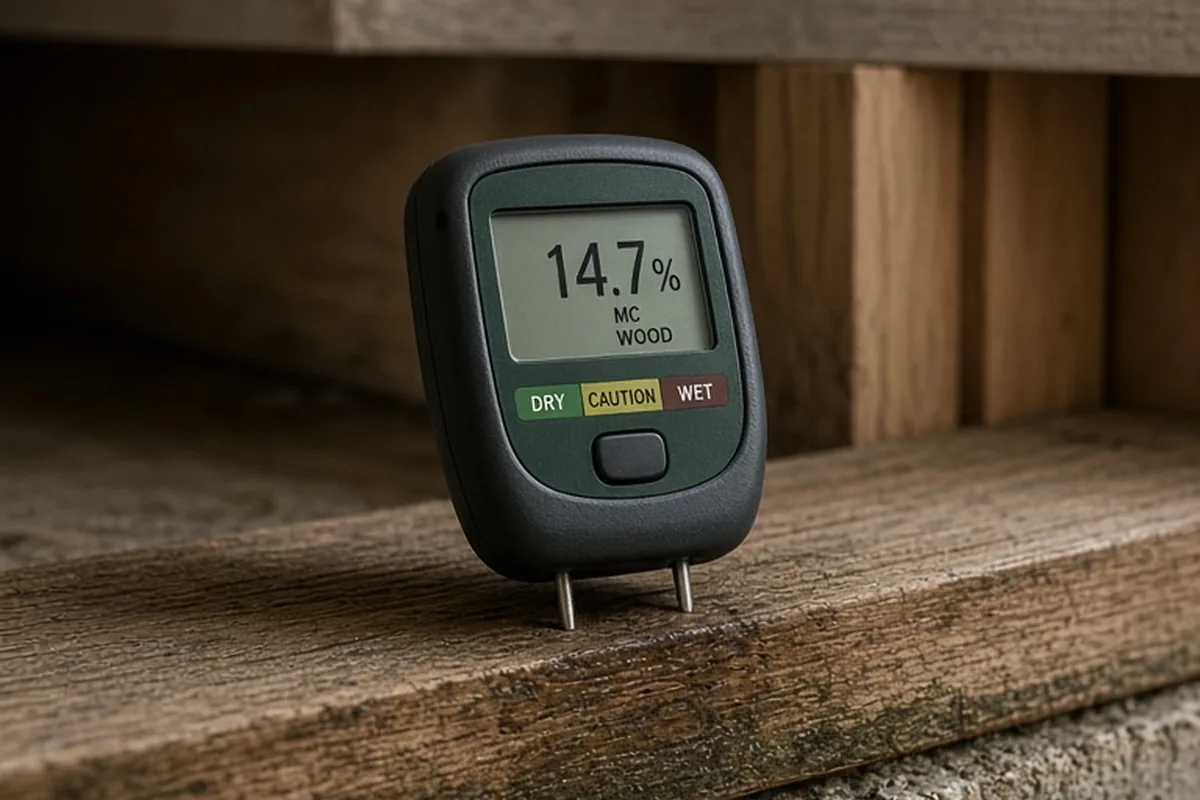
A moisture meter reading at a wooden sill plate should ideally stay below 15 percent moisture content. Readings between 16 and 19 percent indicate borderline dampness that warrants close monitoring and better ventilation. Any reading of 20 percent or higher creates an immediate risk for wood-decay fungi, mold colonization, and long-term structural failure, requiring prompt investigation into ground drainage, foundation capillary action, or indoor relative humidity.
The sill plate serves as the critical structural bridge connecting your home framing to its concrete foundation, making it one of the most vulnerable assemblies in the entire building envelope. Measuring the moisture content of this lumber with a reliable meter allows homeowners and inspectors to spot hidden water intrusion long before visible rot, drywall cracking, or sagging floor joists reveal severe structural damage.
Standard Moisture Content Benchmarks for Structural Lumber
Moisture meters evaluate wood by measuring the electrical resistance or capacitance across the material, reporting the result as a percentage of moisture content relative to oven-dry wood weight. In most climate zones, seasoned framing lumber naturally stabilizes between 8 and 14 percent moisture content during normal indoor atmospheric conditions. Because the sill plate sits directly adjacent to cold concrete and exposed exterior perimeter soil, it frequently absorbs ambient dampness, which can nudge acceptable readings slightly higher than interior partition studs without causing distress.
The critical threshold begins at 16 percent moisture content, which reflects elevated interstitial dampness. While rot does not immediately germinate at 17 or 18 percent, wood fibers are increasingly loaded with moisture, creating a welcoming habitat for wood-boring insects like subterranean termites and carpenter ants. When the reading crosses 20 percent, free water begins accumulating inside the lumber cell cavities. At 20 to 28 percent, commonly referred to as the fiber saturation point, wood-rotting organisms such as Serpula lacrymans and brown rot fungi activate, steadily degrading the structural lignin and cellulose that support your home.
- Below 12 percent: Completely dry, ideal baseline for air-conditioned or heated structural framing.
- 12 to 15 percent: Typical acceptable range for basements, unvented crawlspaces, and exterior foundation plates.
- 16 to 19 percent: Elevated caution zone; requires drying strategies, air movement, and seasonal tracking.
- 20 to 28 percent: Severe hazard zone; active fungal growth, surface mold, and progressive structural rot occur.
- Above 28 percent: Complete fiber saturation; wood is waterlogged, signaling continuous liquid water contact.
Why Sill Plates Accumulate Disproportionate Amounts of Moisture
Sill plates occupy an architectural transition zone subject to intense hydrothermal pressures from three distinct pathways: the concrete foundation wall, exterior bulk water, and interior ambient vapor. Concrete is naturally porous and acts like a rigid hard-sponge, drawing ground dampness upward through micro-capillary pores in a process known as capillary action or wicking. In older construction, or in homes where modern closed-cell foam sill gaskets or physical capillary breaks were omitted, the wooden plate rests directly upon raw concrete, pulling water straight into its grain year-round.
External and internal atmospheric dynamics amplify this wicking effect. Outside, roof runoff from misaligned gutters, landscape sprinklers, and soil banked too close to the siding continuously saturate the exterior masonry rim. Inside unconditioned crawlspaces or damp basements, elevated relative humidity above 65 percent causes ambient water vapor to condense against the cooler foundation wood. Because the sill plate is tucked beneath heavy wall loads and insulation batts, trapped moisture cannot easily evaporate, creating a chronic microclimate of decay that escapes casual visual inspection.
Choosing and Operating Pin Versus Pinless Moisture Meters
Selecting the proper moisture meter technology dictates the accuracy of your sill plate evaluation. Pin-type meters utilize two sharp electrical probes inserted directly into the wood fiber to measure electrical resistance, which drops proportionally as water content increases. Pinless meters, by contrast, use electromagnetic wave capacitance to scan the surface without puncturing the lumber. While pinless tools work rapidly for scanning large flat drywall panels or hardwood flooring, they frequently produce distorted readings on sill plates because their electromagnetic field penetrates deeply enough to inadvertently read the dense concrete foundation wall directly beneath the wood.
For an accurate diagnostic assessment, an insulated pin-type meter is the superior choice. Insulated pins allow you to bypass superficial surface condensation and read the moisture content at varying penetration depths, such as a quarter-inch, half-inch, or core level. To take an accurate measurement, drive the pins parallel to the wood grain rather than across it, as electrical conductivity moves along the grain orientation. Take multiple measurements along the bottom edge nearest the concrete, the mid-face of the board, and the upper edge meeting the rim joist to establish whether dampness is migrating upward from the masonry or trickling down from exterior wall flashing.
Recognizing False Highs and Interpreting Reading Anomalies
Not every high reading on a moisture meter represents liquid rot, and misinterpreting the numbers can lead to costly, unnecessary demolitions. The most common source of artificial high readings in sill plates is the chemical treatment found in modern framing. Modern residential codes mandate pressure-treated lumber for plates contacting concrete, typically treated with alkaline copper quaternary or copper azole compounds. Because these chemical formulations contain heavy metal salts, they drastically increase the electrical conductivity of the lumber, causing standard resistance meters calibrated for plain Douglas fir or spruce-pine-fir to read between 3 and 7 percentage points higher than actual conditions.
Temperature also exerts a significant physical influence on meter output. Colder lumber conducts less electrical current, causing a moisture meter to underestimate dampness in a winter crawlspace unless your device features an automatic or manual temperature compensation dial. Furthermore, if you are testing lumber within an inch of metal framing anchors, anchor bolts, seismic tie-downs, or steel rebar protruding through the concrete, the meter may pick up metal conductivity, yielding off-the-scale readings. Always verify questionable spikes by testing adjacent untreated sections and double-checking that the meter's species setting matches the actual wood type installed.
Tracing the Underlying Sources of Unwanted Water Intrusion
When your meter repeatedly logs verified readings above 16 percent, you must look beyond the lumber to identify the root path of water ingress. Begin outdoors by inspecting the grade and drainage slopes around the foundation perimeter. The ground surface should slope away from the exterior wall at a minimum drop of six inches over the first ten feet to ensure rainwater flows rapidly away from the masonry. Look closely at downspout extensions; discharge pipes dropping water within three feet of the foundation wall saturate the backfill soil, driving a hydrostatic wave of water straight through the foundation cap into the sill plate.
If exterior grading is satisfactory, turn your inspection to crawlspace or basement air dynamics and thermal bridging. In humid summer months, warm exterior air entering unsealed crawlspace vents meets cool, foundation-level lumber, instantly driving relative humidity past the dew point and causing heavy condensation. In winter, missing or poorly detailed rim joist insulation allows cold outside air to chill the sill plate, encouraging indoor moisture from living spaces to condense on the back of the plate. Check also for subtle plumbing leaks directly overhead, such as leaking hose bibbs, ice-maker supply lines, or tub drains resting within adjacent floor cavities.
Remediation Techniques for Wet or Borderline Sill Plates
Remediating high moisture readings requires an orderly combination of immediate mechanical drying and permanent site corrections. If your readings hover between 16 and 22 percent but the wood remains structurally sound without soft, spongy rot pockets, install high-volume air movers and a commercial-grade low-grain refrigerant dehumidifier in the immediate space. Pull back any damp fiberglass batt insulation, which acts as a wet compress against the timber, and expose the plate to steady airflow until meter readings fall stably below 14 percent.
Once baseline drying is achieved, address the physical boundary between the wood and masonry. If the home was built without a sill gasket and capillary wicking persists, professional contractors can sometimes carefully drive temporary hydraulic shims in short segments to slip in non-compressible poly barrier strips, though this is labor-intensive. More commonly, sealing the exterior foundation wall with a breathable silane-siloxane water repellent and installing an internal perimeter vapor barrier sealed up to the top of the foundation stops the moisture cycle. If testing discovers soft timber where an awl easily penetrates more than a quarter-inch, drying alone is insufficient; the compromised framing sections must be temporarily shored, cut out, and replaced with sound, pressure-treated lumber.
Establishing an Annual Foundation Monitoring Schedule
Moisture levels in structural framing fluctuate continuously with weather patterns, making single-point assessments occasionally deceptive. A sill plate that reads a safe 13 percent in freezing mid-winter conditions may climb to an alarming 19 percent during humid late-spring rains or autumn soil saturation. To maintain foundation integrity, establish an ongoing inspection protocol that captures environmental extremes across the calendar year.
Choose three to four representative testing locations around the home perimeter, ensuring you include the lowest topographical corner of the lot and areas beneath plumbing penetrations. Mark these specific test locations lightly with a pencil so you can return to the exact same spots for comparative data. Record the date, the outdoor weather conditions, basement relative humidity, and the corresponding pin-meter readings in a dedicated home maintenance log. This recorded historical baseline allows you to distinguish normal seasonal variations from emerging drainage problems or failing flashing long before structural damage occurs.
Illustrative Scenarios
Diagnosing Seasonal Condensation Versus Capillary Wicking
During a routine inspection of an unvented crawlspace, a homeowner recorded moisture meter readings of 22 percent along the north-facing sill plate using a pinless meter. A subsequent deep-pin test showed that moisture was high on the exposed wood surface (21 percent) but dropped to an acceptable 13 percent inside the core of the timber. Further evaluation revealed that outdoor summer air entering through an unsealed foundation vent was condensing on the cold wood surfaces, rather than groundwater rising through the concrete footing.
Key point: Surface moisture readings can mimic serious foundation leaks; using insulated pin probes to measure the core prevents unnecessary structural excavation when the real remedy is humidity control and vent sealing.
Frequently asked questions
Can I use an inexpensive pinless moisture meter on a sill plate?
Pinless meters are generally unsuited for sill plates because their scanning depth penetrates two to three-quarters of an inch, meaning the concrete or steel fasteners directly beneath the plate can distort the electrical signal. A pin-type meter with insulated probes provides the necessary precision to isolate the actual wood moisture from surrounding building materials.
Does pressure-treated wood give a false high reading on a moisture meter?
Yes, pressure-treated wood contains metallic chemical preservatives such as copper compounds that conduct electricity more easily than raw wood. These salts often elevate resistance-based pin meter readings by 3 to 7 percentage points, so an indicated reading of 18 percent on a treated plate may actually represent a safe 12 to 14 percent wood moisture content.
At what moisture meter percentage will mold begin growing on a sill plate?
Most common household mold spores can germinate when wood moisture content consistently exceeds 16 to 18 percent in the presence of warm temperatures and stagnant air. Full-scale active wood-decay rot requires sustained moisture levels of 20 percent or greater, which is why keeping the plate under 15 percent is standard practice.
What is the fastest way to dry out a damp sill plate?
The fastest approach involves removing any wet fiberglass insulation surrounding the rim joist, aiming a dedicated fan directly at the timber, and operating a heavy-duty dehumidifier set to 45 percent relative humidity. Once the surface dries, you must still identify and resolve the exterior grading or wicking source to prevent the moisture from returning.
Your next step
Take baseline pin-meter readings at three spaced locations along your sill plate this week to identify your current moisture range, and prioritize exterior downspout extensions or crawlspace dehumidification if readings measure 16 percent or above.