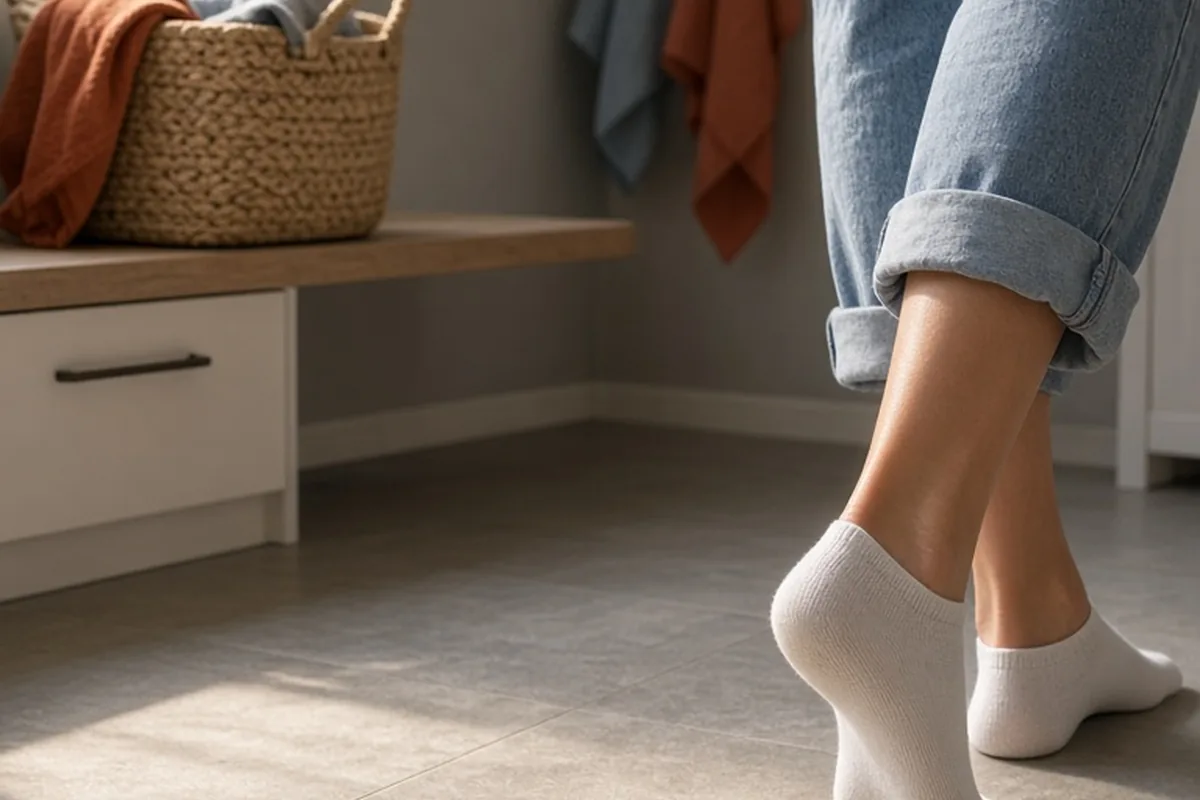
Women and fragrance enthusiasts apply perfume to their ankles because warmth naturally rises, allowing scent molecules to travel upward throughout the day. Lower-body application creates a subtle, evolving scent trail as you walk, prevents immediate nose blindness, and keeps strong top notes from overwhelming personal space or irritating sensitive skin on the neck and chest.
While traditional advice focuses on spraying fragrance directly onto the wrists or throat, seasoned perfume wearers often target the lower half of the body. Understanding the logic behind ankle application helps anyone make fragrance feel effortless, understated, and longer-lasting.
The Physics of Scent: How Rising Warmth Carries Fragrance
The primary reason people apply fragrance to their ankles comes down to thermodynamics and air currents. Scent molecules evaporate in response to body heat and ambient air movement. Because warm air naturally ascends, perfume applied to the lowest points of the body gently travels upward past the legs, waist, and torso over several hours. When you spray fragrance solely around your collarbone or chin, the highest concentration sits directly under your nose and rises away from you quickly, concentrating the entire scent profile in one tight radius.
Spraying the ankles shifts that trajectory entirely. As your skin warms the base notes of a fragrance, the scent diffuses across your full height rather than remaining trapped around your neckline. This dynamic creates a balanced aura rather than a localized blast of perfume. For instance, heavier formulas containing amber, sandalwood, patchouli, or vanilla perform exceptionally well from the lower body because their dense molecules require consistent ambient warmth to lift smoothly into the surrounding air.
The trade-off with this method is that lighter, fleeting fragrances like delicate citrus colognes or airy aquatic mists may dissipate before they ever reach nose level. Lower-body placement works best with eau de parfum concentrations, perfume oils, or robust eau de toilettes that have enough molecular weight to sustain an upward journey throughout the day.
Avoiding Olfactory Fatigue and Nose Blindness
A frequent frustration among daily fragrance wearers is olfactory fatigue, commonly known as nose blindness. When sensory receptors in the nasal cavity are continually exposed to the same strong aroma, the brain filters it out to remain alert to new environmental smells. Spraying perfume directly on the neck, behind the ears, or across the chest places aromatic compounds inches away from the nose, causing the wearer to stop smelling their own fragrance within fifteen to thirty minutes. This often leads to accidental over-application, as the wearer assumes the scent has completely vanished.
Applying fragrance to the ankles puts substantial physical distance between the application zone and the olfactory receptors. Because the scent reaches your nose in intermittent waves rather than a continuous stream, your brain does not habituate to it as quickly. You get to enjoy pleasant, unexpected wafts of your own fragrance when you stand up, cross your legs, or walk across a room, without ever feeling suffocated by your own choice of scent.
This distance also provides a safety buffer in professional or close-contact settings. If a fragrance turns out to be sharper or stronger than anticipated, having it situated at the feet keeps it from invading a colleague's desk space or overpowering a companion sitting across a small dinner table.
Creating a Distinct Scent Trail Through Natural Movement
In perfumery, the term sillage describes the lingering trail or wake left behind by a person as they move. Ankle application excels at maximizing sillage while keeping personal projection polite. When you walk, the natural swinging motion of your feet and the hemline of your trousers or skirt acts like a subtle bellows, pushing air past the skin and releasing micro-bursts of fragrance into your wake.
Consider the difference between standing still in an elevator and strolling through an outdoor patio or hallway. A neck spray projects outward horizontally, creating a cloud around your personal space. An ankle spray projects backward and upward with kinetic energy, leaving an impression in the space you just occupied rather than forcing itself on the people directly in front of you. This makes it an ideal strategy for social gatherings, warm-weather events, and open-air dates where you want your presence to feel intriguing rather than announced.
The main limitation occurs in cold winter conditions when heavy boots, thick wool socks, and insulated leggings create an impermeable barrier. Ankle application requires exposed skin, light hosiery, or breathable fabrics to allow the aroma to escape into the air stream.
Protecting Sensitive Skin, Fine Jewelry, and Delicate Clothing
Fragrance formulations rely on high concentrations of cosmetic alcohol and concentrated aromatic oils. Applying these mixtures repeatedly to delicate skin areas, such as the throat, décolletage, or the inner wrists, can lead to dryness, contact dermatitis, or sun-induced hyperpigmentation when exposed to direct ultraviolet rays. The skin around the ankles and lower legs is generally thicker and significantly less vulnerable to irritation from alcohol-based mists.
Furthermore, spraying perfume on the upper body frequently puts fine fabrics and precious metals at risk. Alcohol and natural resinous oils can tarnish silver, dull the luster of pearls, and permanently stain silk blouses, cashmere knits, or crisp white collars. Placing your fragrance on the ankles eliminates the hazard of accidentally ruining an expensive shirt or heirloom necklace while getting dressed.
To get the cleanest application without staining footwear or socks, mist the bare ankle from six to eight inches away right after drying off from a shower. Allow the alcohol thirty seconds to evaporate fully before pulling on shoes, ensuring that the oil bonds directly to the skin surface.
Lower-Body Pulse Points: Ankles Versus Behind the Knees
Pulse points are spots on the body where arterial blood vessels run closest to the skin's surface, generating slightly higher local temperatures that activate perfume. While the wrists and carotid arteries are the most famous pulse points, the lower body possesses equally effective thermal zones, notably the hollow behind the ankle bone (the posterior tibial region) and the soft crease behind the knees.
Choosing between the ankles and the back of the knees depends largely on your outfit, footwear, and the ambient temperature of your environment. Both areas provide gentle warmth, but each serves a distinct practical purpose depending on how your clothing moves throughout the day.
Use these practical guidelines to decide which lower-body pulse point best fits your routine:
- Choose the ankles when wearing cropped pants, sandals, loafers, or low sneakers where airflow around the lower leg is unobstructed.
- Target behind the knees when wearing knee-length dresses, skirts, or shorts, as the friction and warmth of bending your legs activates the scent smoothly.
- Combine an ankle mist with a single wrist dab if you want a complete vertical profile that balances personal enjoyment with an ambient trail.
- Skip lower pulse points entirely when wearing tall leather boots, thick athletic socks, or heavy snow gear that traps all evaporation inside the footwear.
Practical Layering: How to Apply Lower-Body Scents Smoothly
Applying fragrance to your ankles does not mean you have to abandon upper-body placement altogether. Instead, it invites a more deliberate layering approach that balances different fragrance families and intensities. A common mistake is using full-strength sprays on the neck, wrists, and ankles simultaneously, which compounds the total volume of perfume and overwhelms everyone nearby.
A refined technique involves using your heavier, richer scent on the lower body and a lighter, fresher note on your upper pulse points. For example, applying a warm base oil with notes of amber or cedarwood to the ankles provides grounding depth as it warms, while a crisp citrus or green floral misted lightly on the wrists delivers immediate freshness without competing for dominance.
Another effective routine is applying an unscented body lotion or lightweight body oil to the ankles immediately before spraying. Dry skin absorbs aromatic oils rapidly, causing the fragrance to fade prematurely. Hydrating the skin creates an emollient barrier that traps perfume molecules on the surface, extending projection and longevity throughout a long day on your feet.
The Social and Dating Dynamics of Low-Key Fragrance
In dating and interpersonal settings, scent plays a powerful yet delicate role. A common social misstep is projecting an intense cloud of cologne or perfume in hopes of making a strong impression, only to trigger headaches, allergies, or an impression of trying too hard. When fragrance precedes a person into a room or lingers long after they leave a small dining table, it creates sensory friction rather than comfort.
Ankle application shifts the dynamic from an overt announcement to an inviting discovery. Because the scent disperses gradually upward and is stirred by movement, it reveals itself primarily when you lean in, shift your posture, or walk together outdoors. This subtle delivery respects personal boundaries while rewarding proximity, signaling thoughtful self-care and quiet confidence rather than a demand for attention.
Whether preparing for an evening date, a professional interview, or a crowded dinner party, keeping the focal point of your fragrance low ensures that your scent complements your presence rather than competing with your conversation.
Illustrative Scenarios
Adjusting Fragrance for Close-Contact Workspaces
Elena loved wearing a rich, woody perfume, but after transitioning from remote work to a shared corporate office, she noticed coworkers coughing and cracking windows whenever she sat at the communal conference table. Her first reaction was to stop wearing fragrance entirely, feeling frustrated that her favorite signature scent seemed too offensive for professional life. Instead of abandoning it, Elena switched from two neck sprays to a single mist applied behind each ankle before putting on her trousers. The lower placement allowed the scent to rise gently in her wake without clouding the immediate airspace around her desk.
Key point: Lower-body application lets you enjoy potent, complex fragrances in close quarters without overwhelming shared spaces or violating office etiquette.
Managing Scent Intensity on a First Date
Marcus was preparing for a dinner date at an intimate, crowded bistro. In the past, he had applied four sprays of a bold eau de parfum across his chest and neck, only to notice his date leaning back and struggling to enjoy the meal over his heavy sillage. For this date, Marcus decided to spray his ankles and the back of his knees, adding just a single light dab to one wrist. When they met, the scent remained subtle during dinner and only became noticeable when they stood up to walk along the sidewalk afterward.
Key point: Subtle, motion-driven projection rewards closeness and respects dining atmospheres far better than heavy upper-body spraying.
Frequently asked questions
Does perfume on the ankles actually last all day?
Yes, fragrances often last longer on the ankles because the skin there is less exposed to constant handwashing and facial oil turnover. Applying an unscented lotion first locks in the aromatic compounds for steady, slow diffusion.
Can men apply cologne to their ankles too?
Absolutely. The physics of rising heat and movement-driven sillage apply equally to all genders and all fragrance profiles. It is particularly helpful for men who wear strong leather, tobacco, or oud colognes that can easily overpower a room when sprayed on the chest.
What type of fragrance works best on the lower body?
Heavier concentrations like eau de parfum, pure parfum, and body oils perform best on the ankles because their dense base notes need heat to project. Very light citrus mists or body splashes may evaporate before their scent rises to noticeable levels.
Will spraying perfume on my ankles stain my shoes or socks?
Directly spraying leather, suede, or light-colored fabrics can leave oil marks or alcohol rings. To avoid damage, spray bare skin immediately after showering and wait thirty seconds for the liquid to dry completely before dressing.
Your next step
Try spraying your favorite bold fragrance once on each bare ankle tomorrow morning after applying moisturizer to experience how rising warmth and natural movement create a softer, more enduring scent trail.