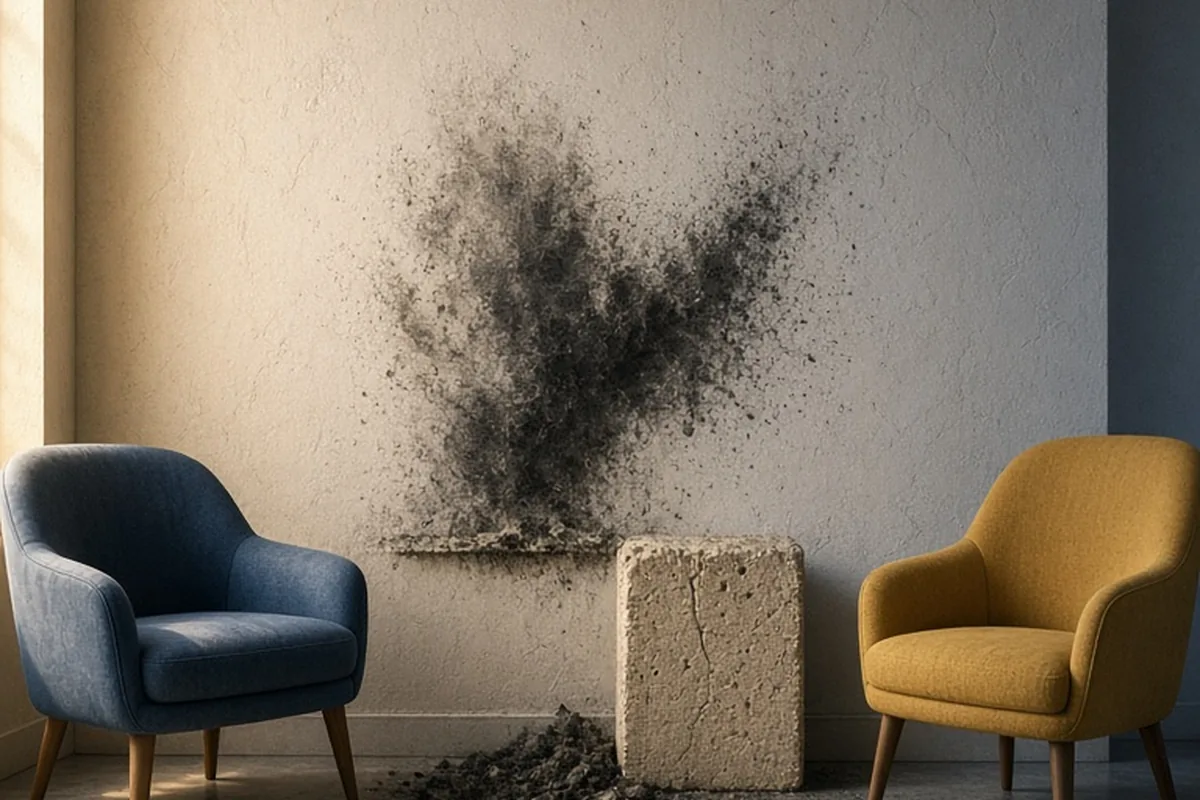
Mold will not continue to grow without moisture. Fungi require water to metabolize organic matter, expand their colonies, and produce new spores. However, eliminating moisture does not kill existing mold. Instead, the colony enters a dormant state where dehydrated spores survive for months or years. The moment relative humidity rises or water returns, these dormant spores reactivate and resume active spreading within twenty-four to forty-eight hours.
Discovering a patch of dark, powdery discoloration on a drywall panel, baseboard, or bathroom ceiling often leads to an immediate search for active leaks. When the surrounding building material feels completely dry to the touch, property owners often assume the fungal colony has died on its own and no longer poses any risk. Understanding how fungi react to dehydration clarifies why dry mold cannot simply be ignored or covered over.
Active Growth Versus Dormancy: How Fungi React to Dryness
Fungi are fundamentally dependent on ambient water to sustain life. In an active colony, microscopic thread-like structures called hyphae release digestive enzymes directly into organic substrates like wood, drywall paper, or fabric backing. These enzymes break down complex carbohydrates into simple nutrients that the fungus absorbs. This entire metabolic process requires liquid water or sustained high humidity. When the environment completely dries out, this biological mechanism stops immediately. The colony halts cellular division, stops expanding along the surface, and ceases producing new reproductive structures.
Halting active growth, however, is not the same as dying. Most household mold species, including Cladosporium, Penicillium, Aspergillus, and Stachybotrys, possess robust survival adaptations designed to withstand prolonged droughts. As moisture evaporates, the vegetative mycelium desiccates, but the fungal spores enter a protective state known as dormancy. Spores have durable, thick outer cell walls that shield their genetic material from extreme temperatures and dry air. In this suspended state, spores can remain viable on building materials for months or even years, behaving much like plant seeds waiting for rain.
Why Dried Mold Remains a Health and Structural Concern
Many people believe that once a water source is shut off and an affected wall dries out, the mold ceases to be harmful. Unfortunately, dormant and dead mold particles retain their structural proteins, cell wall components like beta-glucans, and secondary metabolites called mycotoxins. When a person inhales these desiccated fungal fragments, their immune system reacts in the exact same manner as it would to living organisms. Dormant colonies can trigger persistent nasal congestion, itchy eyes, skin rashes, and severe bronchospasms in individuals with asthma or seasonal allergies.
Dry mold also poses a heightened risk of airborne dispersion. When mold is wet and active, it tends to be slimy or sticky, which keeps many of the spores adhered to the substrate. As the colony dries into a powdery residue, the slightest disturbance—such as a draft from an open door, footsteps vibrating across a floor, or the airflow from a vacuum cleaner—can launch millions of microscopic particles into the indoor airstream. Furthermore, while the mold is inactive, any structural weakening of organic framing, subflooring, or drywall that occurred during the original moist phase remains intact and compromised.
Moisture Thresholds and Indoor Microclimates That Trigger Regrowth
To understand when dormant mold will wake up, you must look at relative humidity and equilibrium moisture content. Indoor mold typically requires a sustained relative humidity of fifty-five to sixty percent or higher to resume active germination. If the relative humidity surpasses seventy percent for an extended window of twenty-four to forty-eight hours, dormant spores absorb ambient water vapor, rehydrate their cellular enzymes, and push out new germ tubes to resume colonization.
A common trap for homeowners is relying on a central thermostat reading to gauge moisture. While the center of a living room might register a comfortable forty-five percent relative humidity, hidden microclimates can easily reach the saturation point. Exterior-facing walls behind heavy dressers, uninsulated baseboards beneath windows, and floorboards over unconditioned crawlspaces frequently stay significantly colder than the room air. When warm indoor air meets these cool boundaries, the local relative humidity climbs toward the dew point, creating localized condensation that wakes dormant mold even without a pipe burst.
How to Clean Inactive Mold Without Cross-Contaminating Your Home
Cleaning dry mold requires specific precautions to prevent turning a localized patch into an airborne indoor air quality problem. The most critical mistake is dry brushing, sweeping, or dry scrubbing an inactive colony. Instead, you must gently mist the area with water or a mild cleaning solution prior to physical disturbance. Light dampening weighs down the loose spores, binding them together so they cannot float into adjacent living areas while you work.
Equally important is personal protection and containment. Anyone handling dry fungal deposits should wear a properly fitted N95 or P100 respirator, unvented safety goggles, and disposable nitrile gloves. Hard, non-porous surfaces like glazed tile, laminate, or metal can be thoroughly scrubbed using warm water and a basic household detergent or dedicated surfactant, followed by thorough drying. Because standard household vacuum cleaners exhaust microscopic spores back into the room air, any vacuuming must be done exclusively with a sealed HEPA-rated appliance.
Evaluating Porous Materials: When to Clean and When to Discard
Not all household surfaces can be saved once mold has taken hold, even if the material has completely dried out. The deciding factor is the porosity of the underlying item. Non-porous materials do not allow fungal roots to penetrate beneath the exterior surface, meaning a thorough surface wipe will remove both dormant spores and allergenic debris. Semi-porous surfaces, such as solid structural lumber, can often be sanded, wire-brushed, or treated with specialized fungicidal sealants once dried to safe moisture content levels.
In contrast, fully porous items present a much steeper challenge. Materials such as drywall, acoustic ceiling tiles, fiberglass insulation, and carpet padding act like sponges. The fungal hyphae weave deep into the internal fibrous matrix. Even if you clean the visible surface and dry the room, the internal fungal roots remain trapped inside. When humid air inevitably returns, the growth returns from the inside out. For these materials, the most reliable and long-lasting approach is carefully cutting out the affected section, sealing it in plastic bags, and replacing it with clean materials.
Long-Term Moisture Control: Keeping Spores Permanently Inactive
Because fungal spores exist naturally in outdoor air and inevitably drift inside every home, absolute indoor sterility is impossible. The only durable defense against ongoing mold problems is strict, consistent moisture control. If building materials remain consistently dry, spores settle onto surfaces without ever germinating, posing minimal risk and getting removed during standard dusting and cleaning routines.
Achieving consistent dryness requires addressing both bulk water intrusions and ambient vapor levels across the home. Practical preventative measures include:
Running dedicated bathroom exhaust fans for at least twenty minutes after showering to clear localized vapor.
Operating a standalone or whole-house dehumidifier in basements to keep relative humidity below fifty percent year-round.
Inspecting crawlspaces to confirm that heavy-gauge plastic vapor barriers fully cover exposed soil surfaces.
Grading outdoor landscape soil so rainwater slopes naturally away from the foundation perimeter.
Checking under-sink plumbing slip joints and appliance supply hoses twice a year for subtle seepage.
- Running dedicated bathroom exhaust fans for at least twenty minutes after showering to clear localized vapor.
- Operating a standalone or whole-house dehumidifier in basements to keep relative humidity below fifty percent year-round.
- Inspecting crawlspaces to confirm that heavy-gauge plastic vapor barriers fully cover exposed soil surfaces.
- Grading outdoor landscape soil so rainwater slopes naturally away from the foundation perimeter.
- Checking under-sink plumbing slip joints and appliance supply hoses twice a year for subtle seepage.
Deciding Between DIY Cleanup and Professional Remediation
Determining whether to tackle mold cleanup yourself or hire a certified remediation professional depends primarily on the total surface area involved and the accessibility of the growth. A widely accepted guideline from environmental and public health agencies suggests that non-porous or semi-porous patches smaller than ten square feet—roughly equivalent to a three-foot by three-foot square—can generally be addressed by a homeowner using basic containment and proper protective gear.
Professional intervention becomes necessary when the contamination spans larger areas, when water damage originated from contaminated category two or three sources like sewage backups, or when mold has infiltrated central heating and cooling ductwork. Professional teams possess negative air machines, industrial containment barriers, and specialized air scrubbers that prevent spores from migrating into unaffected zones of the home during demolition. While hiring professionals represents a greater initial expense, it prevents the recurring structural repairs and health issues caused by incomplete amateur remediation.
Frequently asked questions
Can dormant mold spores survive indefinitely without moisture?
While spores do not survive forever, many common household species can remain viable in a dry state for several years. Once relative humidity rises above sixty percent or direct water returns, these dormant spores can quickly rehydrate and begin colonizing the surface within twenty-four to forty-eight hours.
Is it safe to paint over mold once the surface has dried completely?
No, painting over dry mold is not an effective remediation method. The powdery fungal residue prevents paint from forming a durable bond with the wall, causing eventual peeling, and any moisture that later gets trapped behind the paint film will trigger renewed fungal expansion.
Does running a dehumidifier kill existing mold colonies?
A dehumidifier lowers indoor relative humidity, which halts active fungal growth and stops spores from germinating. However, dry air does not kill the existing mold; the physical colony and its allergenic fragments remain in place until they are actively wiped down or excised.
How can I tell if a dry discolored spot is mold or just dirt?
You can perform a simple preliminary check by dabbing a drop of diluted household bleach onto the discolored spot with a cotton swab. If the discoloration lightens or disappears within a couple of minutes, it is likely organic mold, whereas standard dirt or mineral staining typically remains unaffected.
Your next step
Use a digital hygrometer to confirm the ambient humidity near the dry patch stays below fifty percent, then mist and physically clean the surface with a damp detergent cloth rather than leaving dormant spores on the wall.