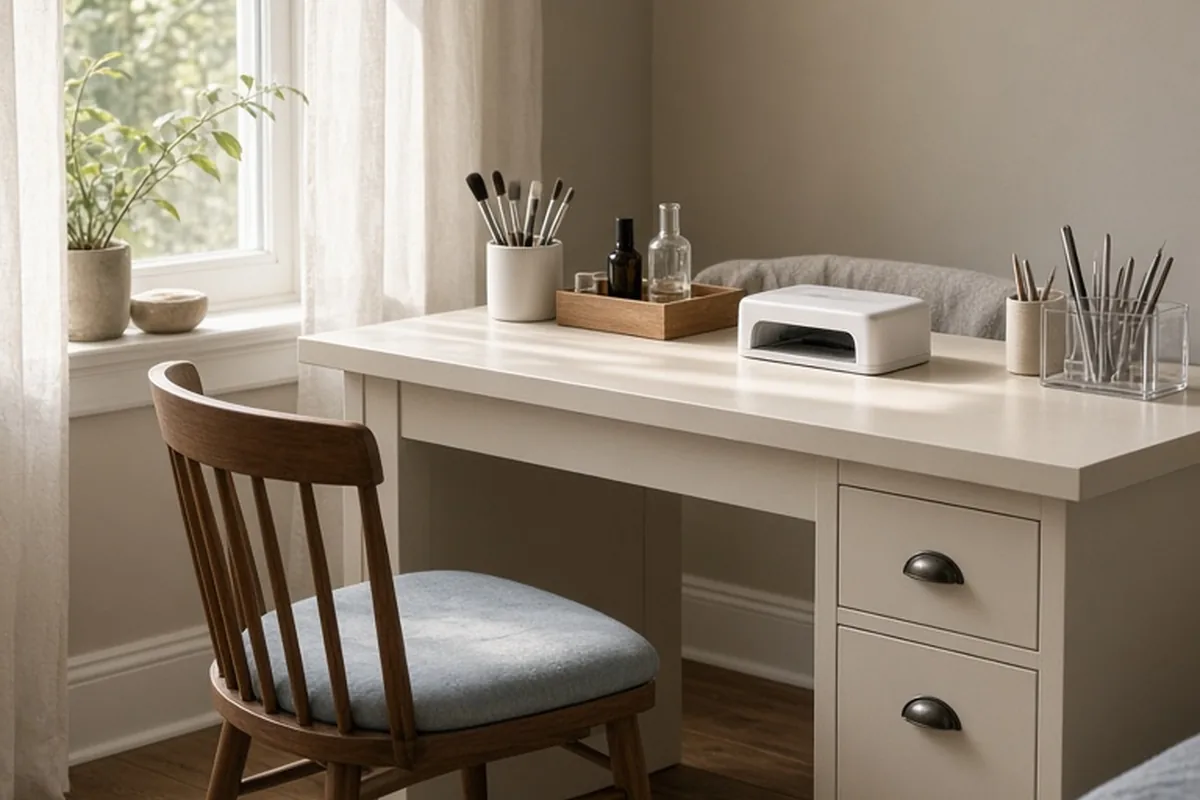
The average length for a standard manicure table ranges between 36 and 44 inches (91 to 112 cm). Compact or portable tables measure around 30 to 36 inches, while luxury or multi-drawer stations extend from 48 to 60 inches. Selecting the proper length depends on your equipment footprint, drawer requirements, and the physical room layout needed for safe client and technician circulation.
Setting up an efficient nail station requires balancing desktop surface area with ergonomic reach and overall salon traffic flow. Knowing standard dimensions prevents investing in furniture that cramps your room or strains your posture during long appointments.
Standard Manicure Table Lengths by Category
In the professional beauty industry, manicure tables are categorized broadly into portable, standard salon, and expanded luxury stations. Compact and folding tables generally measure between 30 and 36 inches in length. These units are engineered for mobile technicians, suite renters with severe square-footage limits, or temporary setup areas. While they save considerable floor space, they offer minimal room for secondary equipment or built-in storage columns.
Standard standalone manicure stations commonly measure between 38 and 44 inches in length, with 40 to 42 inches representing the industry sweet spot. This medium sizing accommodates a dedicated drawer stack on one side while preserving a central seating opening wide enough for comfortable legroom. Stations measuring 48 to 60 inches or longer are typically multi-technician double tables, custom-built cabinetry, or luxury units designed to house dual storage pedestals, integrated ventilation shafts, and extensive display racks.
When planning purchases, remember that published length specifications measure the outermost edges of the tabletop. If a table includes protruding side pockets, towel bars, or external bottle holders, the physical footprint may extend two to four inches beyond the listed tabletop length.
- Compact or Portable Stations: 30 to 36 inches (76 to 91 cm)
- Standard Single-Technician Tables: 38 to 44 inches (96 to 112 cm)
- Extended Single Stations with Dual Storage: 46 to 52 inches (117 to 132 cm)
- Double-Technician Workstations: 60 to 74 inches (152 to 188 cm)
The Ergonomic Relationship Between Length and Arm Reach
Table length directly dictates how far a nail technician must reach across lateral space during a service. The human body works most efficiently within a primary work zone, defined as the area reached by sweeping the forearm in an arc while keeping the elbow near the torso. For most individuals, this comfortable horizontal zone spans roughly 24 to 28 inches directly in front of the body.
When a table is excessively long without organized storage, technicians frequently place frequently used items, such as electric files, sanitizer bottles, and curing lamps, at the far edges. Repeatedly extending the arm beyond the natural reach radius places cumulative strain on the rotator cuff, upper back, and neck muscles. Choosing a 40- to 42-inch table allows core tools to remain within the primary zone while providing peripheral space for passive items like business cards or retail displays.
Why Depth Matters Just as Much as Table Length
A common mistake when evaluating manicure table sizing is focusing solely on length while ignoring depth. Standard manicure tables are intentionally narrow, typically measuring 16 to 20 inches from technician edge to client edge. This shallow profile ensures that the technician can hold the client's hand over the center of the desk without either party leaning forward excessively.
Standard office desks and dining tables often have depths of 24 to 30 inches. If an artist attempts to use an office desk because its 48-inch length fits the wall space, the extra depth forces the artist to bend at the waist or overextend the arms throughout a two-hour service. Maintaining a 16- to 18-inch depth paired with a 38- to 44-inch length provides the ideal functional rectangle for close-contact hand care.
Allocating Tabletop Length for Tools and Equipment
To select the correct table length, calculate the static footprint of the equipment you use on every client. A standard professional setup includes an armrest (12 to 16 inches wide), a main LED or UV curing lamp (8 to 10 inches wide), an electric file control box (4 to 6 inches wide), and a task lamp base (4 to 6 inches). If your table is only 32 inches long, these items will consume nearly the entire surface, leaving no room for a monomer dappen dish, brush stand, or prep solutions.
A 42-inch table provides ample length to create three distinct zones: a central working channel of approximately 18 inches for the client's hands and dust extraction, a dominant-hand tool zone of 12 inches for files and e-files, and an off-hand zone of 12 inches for the curing light and sanitation supplies. If you intend to run two curing lights so clients can cure both hands simultaneously without shifting, you will generally need a table length of at least 44 to 48 inches.
Salon Floor Plan and Clearance Guidelines
Table length directly influences how many stations can safely fit into a salon floor plan while maintaining fire egress and accessibility standards. Beyond the furniture dimensions, each station requires clear floor area surrounding it. A technician needs approximately 24 to 30 inches of space behind the table for stool movement, while the client side requires at least 30 to 36 inches to pull out seating comfortably without blocking pedestrian corridors.
When placing multiple manicure tables side by side in a continuous line, leave a minimum clearance of 36 to 48 inches between the ends of adjacent tables. This pathway allows clients, technicians, and sanitation carts to navigate the room without knocking into active work surfaces or disturbing resting arms. In smaller private suites, angling a 40-inch table diagonally in a corner can maximize floor space while preserving these necessary safety buffer zones.
Storage Configurations and Their Impact on Footprint
The internal configuration of drawers and columns significantly affects how usable a table's length feels. Single-pedestal tables feature drawers on either the left or right side, leaving the remaining section open underneath for technician and client legs. On a 40-inch table, a single drawer stack typically occupies 12 to 14 inches of width, leaving a 26- to 28-inch knee well, which provides adequate room for two seated adults.
Double-pedestal tables incorporate drawer columns on both sides, which demands a total table length of at least 48 to 54 inches. Attempting to fit dual drawer stacks into a 40-inch table narrows the central knee space to under 16 inches, forcing both the technician and the client to sit at awkward angles with their knees touching the cabinet walls. If you have limited wall space but require significant storage, choosing a 40-inch single-pedestal table paired with a separate rolling utility cart is far more functional than forcing a double-drawer unit into a small footprint.
Adapting or Custom Building a Manicure Workstation
Technicians who choose to custom-build cabinetry or modify existing furniture must adhere closely to professional proportions. If you are ordering custom stone, solid wood, or laminate tops, aim for a length between 42 and 46 inches, a depth between 17 and 19 inches, and a finished height of 29 to 31 inches from the floor to the top working plane.
Ensure that any custom tabletop material can withstand regular chemical exposure. Acetone, alcohol, and resin removers will quickly ruin unsealed wood or low-grade plastics. Integrating recessed flush-mount dust extractors into the tabletop helps preserve functional surface length, as it eliminates the bulky elevated housing associated with portable tabletop fans.
Frequently asked questions
Can I use a standard writing desk as a manicure table?
Writing desks are generally too deep, often measuring 24 to 30 inches across, which forces excessive leaning. They also lack acetone-resistant finishes and cable grommets designed for nail apparatus.
What is the best table length for mobile nail technicians?
Mobile technicians generally benefit most from foldable tables measuring 30 to 36 inches in length. This size is lightweight enough to transport in a vehicle trunk while providing sufficient room for a lamp and armrest.
How high should a manicure table be relative to its length?
Regardless of table length, the industry standard height is 29 to 31 inches (74 to 79 cm). This height allows both the technician and client to sit flat-footed with thighs parallel to the ground while using adjustable chairs.
Your next step
Measure your available floor area and map your equipment footprint before buying, aiming for a 38- to 44-inch table length to achieve the best balance of storage, legroom, and reach.