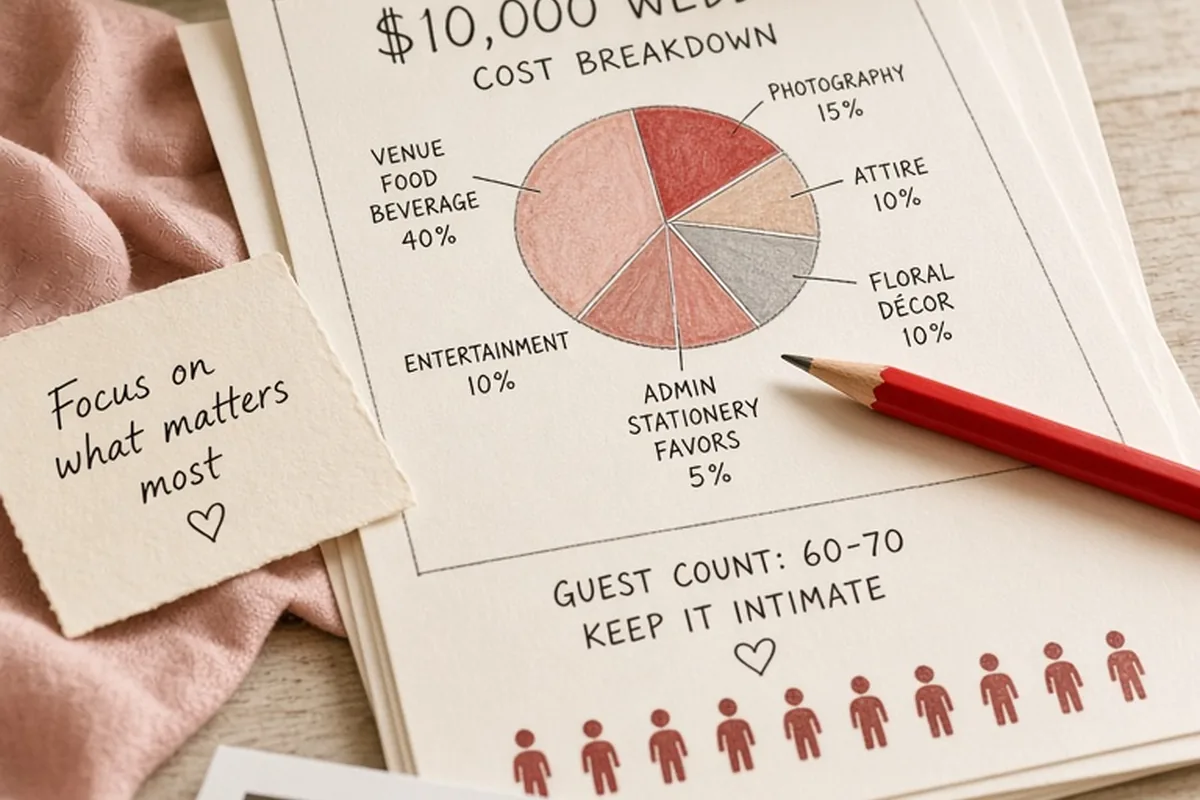
A ten-thousand-dollar wedding budget requires dividing your total funds across essential categories while keeping guest count modest. The largest share goes toward the venue, catering, and beverages, followed by photography, wedding attire, floral arrangements, entertainment, and administrative costs. Prioritizing three non-negotiable elements, choosing an off-peak date or municipal venue, and obtaining all-inclusive written vendor quotes ensure your celebration stays within your exact financial boundary without accumulating debt.
Organizing a memorable wedding on a defined budget demands deliberate planning, clear trade-offs, and disciplined expense tracking from your first venue tour to your final vendor gratuity.
Establishing Category Priorities Within a Fixed Wedding Budget
Every successful wedding plan begins with a structured framework for categorizing expenses. When working with a set financial ceiling, couples divide their overall pool into primary, secondary, and tertiary obligations. Primary obligations include the gathering space, food, and drinks, which together represent the core guest experience. Secondary expenses cover documentation and personal presentation, such as the photographer, officiant, rings, and wedding day clothing. Tertiary expenses encompass paper goods, decorative accents, transportation, and small party favors. Structuring your ledger around these functional tiers ensures that critical contractual obligations receive funding before you commit resources to purely decorative details.
To manage this division effectively, start by listing every required vendor category in a centralized spreadsheet before signing agreements. Assign an estimated allocation ceiling to each line item based on your personal values as a couple. For instance, if capturing heirloom portraits matters more to you than elaborate table centerpieces, your documentation line item will take precedence over floral design. Maintaining this clear hierarchy prevents the common pitfall of overspending on early vendor hires and leaving inadequate funds for reception necessities later in the planning timeline.
Managing Venue, Food, and Beverage Service Expenses
The reception meal and event space invariably consume the largest portion of any wedding budget. Traditional event halls often mandate in-house catering, high food-and-beverage minimums, and separate facility rental fees that can quickly exhaust available resources. To preserve your bottom line, consider alternative spaces such as public parks, historic civic buildings, botanical garden pavilions, community clubhouses, or private restaurant dining rooms. Restaurants are especially advantageous because they supply tables, chairs, linens, dinnerware, and dedicated service staff without requiring separate equipment rental fees.
When evaluating catering models, compare traditional plated multi-course meals against family-style platters, casual buffets, drop-off barbecue, food trucks, or heavy hors d'oeuvres receptions. Plated dinners demand higher staffing ratios, which increases the labor cost on your invoice. Drop-off catering from a favored local eatery paired with independently hired, insured serving staff often provides exceptional meal quality while keeping staffing charges manageable. For beverages, explore venues that permit couples to supply their own beer, wine, and spirits without hefty uncorking penalties, or consider hosting a daytime brunch event featuring coffee bars, mimosas, and sparkling cider.
Securing Quality Photography and Entertainment on a Modest Allowance
Professional photography preserves the memory of your wedding day, making it a priority category for most couples. When selecting a photographer on a defined budget, focus on purchasing an hourly coverage package rather than full-day or multi-day coverage. Booking four to six hours of coverage allows the professional to capture your pre-ceremony preparations, ceremony vows, formal family portraits, and the initial reception events, such as toasts and the first dance. You can then rely on coordinated guest photo-sharing links for casual late-night dance floor moments.
Entertainment choices strongly influence reception atmosphere, and multiple avenues exist to achieve an energetic celebration without overspending. Hiring a solo acoustic musician or classical duo for the ceremony and cocktail hour provides polished live music during intimate moments. For the reception, you can compare the cost of an experienced independent disc jockey against a custom, curated playlist operated through a professional sound system rental. If you choose the playlist route, assign a reliable friend or day-of coordinator to oversee microphone announcements, handle volume transitions, and keep the evening schedule running smoothly.
Navigating Attire, Beauty, and Accessory Line Items
Wedding day garments and personal styling require thoughtful budgeting because alterations and accessories frequently add unexpected charges to the initial purchase price. Bridal gowns, suits, and formal separates can be acquired through sample sales, trunk shows, consignment boutiques, bridal resale platforms, or established department stores that carry contemporary eveningwear. Choosing a well-fitting, off-the-rack garment made from forgiving fabrics can dramatically reduce tailoring charges, which are based on the complexity of lace work, boning, and structural layers.
For hair styling and makeup application, consider visiting an established salon or beauty counter on the morning of your ceremony rather than paying on-site travel fees for a private team. If you prefer on-location styling, obtain complete quotes that outline travel surcharges, trial sessions, and minimum client requirements. Alternatively, investing in high-grade beauty products and refining your own routine in advance gives you complete control over your appearance and avoids day-of scheduling complications.
Designing Ceremony and Reception Decor Without Excessive Floral Costs
Floral arrangements and event decor can quickly drain available funds when couples rely exclusively on custom installations and exotic, out-of-season blooms. A practical approach is to embrace minimalist, purposeful design by focusing botanical accents where guests spend the most time looking. Creating a single focal point, such as a floral ceremony arch or an altar arrangement that can be relocated to the head table during the reception, maximizes the utility of every stem purchased.
To keep decorative expenses manageable, explore non-floral centerpieces and bulk greenery arrangements. Utilizing pillar candles in glass hurricane vases, potted herbs, lush eucalyptus garlands, or vintage books adds warmth and character to tables at a fraction of the cost of full floral centerpieces. Purchasing loose stems in bulk from local flower markets or wholesale distributors allows you to assemble straightforward bud vase arrangements the day prior to the ceremony. Pair these modest arrangements with ambient string lighting or venue uplighting to produce an inviting atmosphere without extensive physical clutter.
Controlling Stationery, Favors, and Administrative Ceremony Fees
Stationery suites and paper goods represent an area where modern digital tools offer immediate cost relief. Traditional wedding invitations involve multi-piece suites, custom calligraphy, envelope liners, and multiple rounds of postage for outgoing parcels and response cards. Transitioning to digital wedding invitations with online RSVP tracking eliminates printing and mailing expenses entirely while streamlining headcount management. If you prefer printed paper goods, simple postcard-style invitations directing guests to a dedicated wedding website provide an elegant, cost-effective balance.
Administrative and legal costs must also be factored into your baseline ledger. Marriage license application fees, court recording fees, and officiant compensation are non-negotiable legal necessities that vary depending on your local county jurisdiction. When it comes to guest favors, traditional custom trinkets are frequently left behind at the end of the evening. Reallocating that line item into the reception food experience or offering small, consumable treats like baked goods or local coffee beans prevents unnecessary waste and keeps your administrative overhead lean.
The Direct Impact of Guest Count on Overall Event Affordability
The single most powerful variable governing your wedding cost is the total number of invited guests. Nearly every major expenditure—including food service, beverage quantities, chair rentals, table linens, centerpieces, place cards, and wedding cake servings—scales directly on a per-person basis. Even a spacious venue becomes expensive when a large guest count necessitates additional service staff, larger beverage orders, and expanded dining infrastructure.
Maintaining a disciplined guest list requires establishing consistent inclusion criteria early in the process. Hosting an intimate gathering of close family members and long-term friends allows you to deliver a premium dining and hospitality experience within your designated spending cap. If reducing the guest list proves challenging, consider hosting a two-part celebration: an intimate ceremony followed by a seated dinner for immediate relations, paired with a broader casual reception or dessert gathering for extended acquaintances later in the evening.
Identifying Hidden Fees, Service Taxes, and Contractual Surprises
A common obstacle when managing a fixed wedding budget is the accumulation of unbudgeted vendor fees, service charges, and mandatory local taxes. When reviewing venue and catering proposals, look closely at line items beyond the base rental and per-plate rates. Standard add-ons include administrative fees, mandatory gratuity percentages, local municipal food-and-beverage taxes, security guard requirements, parking attendants, and post-event cleaning charges. These additions can increase the baseline quote by a substantial margin.
Before signing any binding contract, request an itemized, out-the-door total estimate that accounts for all taxes, operational surcharges, and potential overtime rates. Ask specific questions regarding cake-cutting fees, corkage charges for outside wine, power hookup fees for musical performers, and damage deposits. Clarifying these terms during the initial negotiation phase ensures your real-world outlays match your allocated spreadsheet rows without forcing last-minute compromises.
Frequently asked questions
What is the most effective way to keep catering costs down?
Selecting a casual dining format such as a family-style meal, drop-off buffet, or food truck significantly reduces service staffing requirements. Additionally, pairing an approachable menu with beer, wine, and a signature cocktail rather than a full open bar controls beverage volume expenses.
How can we reduce venue rental fees without sacrificing ambiance?
Consider booking your celebration on a weekday, Friday, or Sunday afternoon, as weekend evening rates carry peak pricing. Exploring non-traditional venues like historic parks, botanical gardens, public pavilions, and private restaurant dining spaces also eliminates high minimum rental and equipment fees.
Is it realistic to handle ceremony flowers and decorations ourselves?
Handling your own decor is practical if you limit your scope to simple elements like bud vases, bulk greenery, and candle arrangements. Avoid attempting complex floral installations or multi-tiered bouquets on the wedding morning, as time constraints and refrigeration needs can create unnecessary stress.
How much contingency should we maintain in our wedding ledger?
Reserving an unallocated buffer within your overall spending plan protects against unexpected alterations, rush shipping charges, weather contingency rentals, and local vendor gratuities. Keeping a modest cushion prevents surprise expenses from exceeding your financial comfort zone.
Your next step
Draft a complete itemized wedding spreadsheet today, list your top three celebration priorities, and request fully inclusive written quotes from local venues to verify realistic baseline costs before committing deposits.