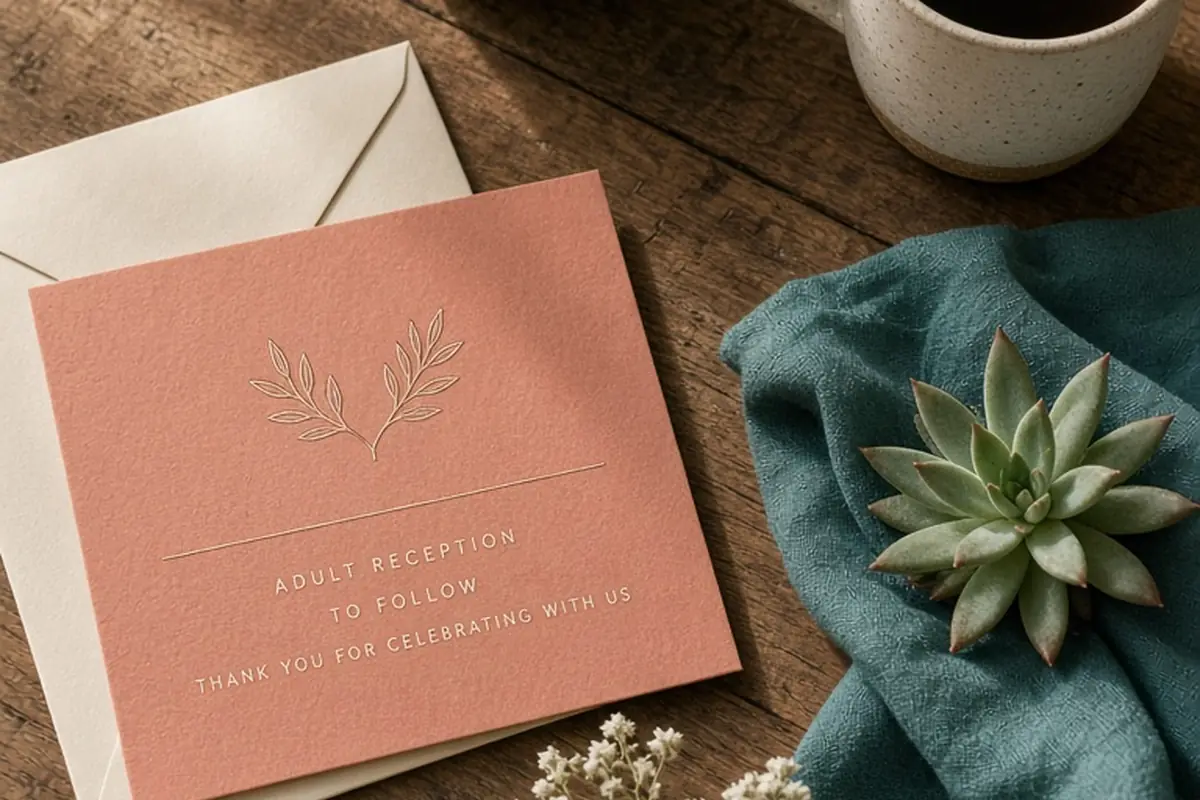
Clear adult only wedding wording alternatives range from strictly formal phrasing on invitation inserts to relaxed notes on wedding websites. Options include explicit statements like 'Adult reception to follow,' gentle explanations such as 'While we love your little ones, our celebration is an adult-only affair,' or setting specific age boundaries like 'Guests aged 18 and older.' Addressing inner envelopes precisely and pre-filling RSVP counts prevents misunderstandings before they occur.
Planning a wedding involves balancing personal vision, venue safety, budget realities, and guest hospitality. Deciding to host an adults-only celebration is a common choice, yet communicating that boundary often causes stress for couples who worry about offending close friends or family members. Using the right phrasing allows you to set clear expectations without compromising warmth or politeness.
Formal and Traditional Phrasing for Invitation Suites
In traditional wedding etiquette, the main invitation card is reserved exclusively for the ceremony details and the names of the hosts and the couple. Explicit restrictions regarding children are generally kept off the primary invitation card itself. Instead, traditional hosts communicate an adults-only event primarily through precise envelope addressing and inclusion cards within the stationery suite.
When using an enclosure card, such as a reception card or details insert, traditional wording remains concise and direct. Phrases like 'Adult Reception to Follow' or 'An adult reception will follow the ceremony' provide clear notice without unnecessary elaboration. These formal lines let guests know what to expect during the evening while maintaining the dignified tone of high-formality stationery.
Another classic method involves inner and outer envelopes. The outer mailing envelope includes the formal title and surname of the primary heads of household, while the inner envelope explicitly lists the first names of every invited individual. If children are not named on the inner envelope, traditional etiquette dictates that they are not invited. However, because modern guests do not always understand inner envelope conventions, pairing this method with an explicit note on the details card prevents assumptions.
- Adult reception to follow immediately at the ballroom.
- Please join us for an adult-only evening of dinner and dancing.
- The ceremony and reception are reserved for adult guests.
Warm and Casual Adult Only Wording Alternatives
For couples planning modern, rustic, or relaxed weddings, traditional formal phrasing can sometimes feel overly rigid. A softer, conversational tone allows you to express affection for your guests' families while reinforcing the adult-focused atmosphere of your event.
Casual phrasing often highlights the celebration as an opportunity for parents to enjoy a night off. Expressions such as 'We adore your children, but we have chosen to keep our wedding day an adults-only celebration' or 'To give all our guests the opportunity to celebrate without worrying about little eyes and ears, we politely request no children' establish boundaries with warmth.
When using softer wording, balance kindness with clarity. Avoid leaving room for interpretation. Phrases that are too vague, such as 'We hope you can take the night off to celebrate with us,' can be misinterpreted as a suggestion rather than a clear boundary. Make sure that the final sentence clearly specifies that the gathering is for adults only.
- Although we love your little ones, our wedding will be an adults-only celebration.
- We want our guests to enjoy a night of relaxation, so we are keeping our wedding an adult affair.
- Sweet dreams to the kids! Our wedding day will be an adults-only party.
Explaining Venue Safety and Space Restrictions Gracefully
Venue limitations and safety considerations are among the most practical and understandable reasons to limit attendance to adults. Historic properties, cliffside venues, working wineries, industrial lofts, and urban rooftops often have strict headcount caps or architectural features that present safety hazards for unsupervised young children.
Framing your decision around venue capacity or physical environment provides an objective reason that guests rarely contest. For example, writing 'Due to strict capacity limits at our historic venue, we are only able to accommodate adults' helps parents understand that the restriction is a logistical necessity rather than a personal slight.
If safety is the primary consideration, be honest and specific. Phrasing such as 'Due to the open water features and architectural layout of our venue, our celebration is restricted to guests aged 18 and older' clarifies that the venue itself is not suited for young children. This helps parents appreciate your concern for their family's safety.
- Due to limited seating capacity at our venue, we are unable to accommodate children under 18.
- Owing to safety constraints at the venue, our ceremony and reception are strictly for adults.
- Because of venue restrictions, we can only invite the specific guests listed on the envelope.
Handling Exceptions for Infants, Immediate Family, and Wedding Party Children
Many couples find that an all-or-nothing policy does not fit their family structure. You may wish to have your own nieces and nephews participate as flower girls or ring bearers, or you may want to welcome nursing infants while keeping the rest of the guest list adult-only.
When making exceptions for immediate family or very young babies, clear communication prevents confusion among other guests who might notice children present. For nursing infants, consider noting on your wedding website: 'We are pleased to welcome nursing infants under 12 months, but we respectfully request an adults-only evening for all other children.'
If you are inviting only nieces, nephews, or young wedding party members, make sure the distinction is transparent if asked. A polite line on your details card or digital FAQ can state: 'While we love all the children in our lives, our wedding is adult-only with the exception of immediate family members.' Setting clear criteria helps other parents understand the reasoning without feeling singled out.
- Adults only, with the exception of the wedding party and immediate family.
- Due to space limits, our wedding is adults-only; nursing infants under one year are welcome.
- We respectfully request an adult reception, with exceptions limited to our nieces and nephews.
Designing RSVP Cards and Wedding Websites to Prevent Ambiguity
Paper invitations and online RSVP portals represent your strongest defense against uninvited additions to the guest list. Ambiguity on the response card is the most common reason parents assume their children are invited, as traditional blank response lines leave room for guests to write in additional names.
To eliminate confusion on physical cards, include pre-printed numbers such as 'We have reserved __ seat(s) in your honor.' Filling in the blank by hand for each household establishes exactly how many guests may attend. You can also include explicit checkboxes that say 'Accepts with pleasure (__ adults)' and 'Declines with regret.'
If you use a wedding website for RSVPs, configure the software to allow responses only for the exact names entered in your guest database. Add a dedicated FAQ section addressing attendance rules. A clear website FAQ entry titled 'Are children invited?' gives parents immediate answers well before the response deadline.
- We have reserved __ seats in your honor. (Please enter names of attending adults).
- Number of adult guests attending: ___
- Our digital RSVP portal is locked to specific invited names to adhere to venue headcounts.
Scripting Conversations for Guests Who Inadvertently Add Children
Even with clear wording on invitations and websites, some guests may still return an RSVP that includes their children. When this happens, a direct, kind, and timely phone call is far more effective than an email or text message, which can easily be misinterpreted.
Approach the conversation with empathy while holding your boundary firmly. A practical script might sound like: 'Hi [Name], we received your RSVP and were thrilled to see you can come! We noticed you added [Child's Name] to the card. We apologize for any confusion, but our venue capacity only allows us to host adult guests. We completely understand if this means you cannot attend, but we hope you can still celebrate with us.'
Resist the urge to apologize excessively or make exceptions on the spot when a guest pushes back. Making an exception for one friend often creates tension with other guests who arranged babysitters or traveled without their children. Sticking consistently to your defined parameters protects your relationships and keeps your plans fair across the board.
Offering Childcare Resources and On-Site Sitter Solutions
If you have many traveling guests with young children, providing helpful childcare information can make an adults-only rule much easier for families to navigate. Parents are far more likely to attend and enjoy the festivities if they have reliable childcare arrangements in place.
Consider listing contact details for reputable, bonded local babysitting agencies on your wedding website's travel page. If budget allows, some couples choose to hire one or two certified childcare professionals to watch children in an adjoining hotel suite or a designated room near the venue during the reception.
If you do provide on-site childcare, clarify the details clearly. Inform parents about the location, the ages accommodated, whether meals are provided, and the hours the sitters will be available. Providing this service turns an adults-only restriction into a convenient, hospitable experience for traveling families.
- List licensed, insured local nanny and babysitting agencies on your website accommodation page.
- Specify the exact hours and location if you are funding a group babysitting room at the hotel.
- Advise parents in advance if they need to bring specific meals or entertainment for their children.
Frequently asked questions
Is it rude to have an adult-only wedding?
No, hosting an adult-only wedding is a standard and respected planning choice. As long as you communicate the boundary clearly, politely, and well in advance, guests will appreciate the transparency.
Where should adult-only wording appear on the wedding invitation?
Adult-only wording belongs on the details or enclosure card, the RSVP card, and your wedding website. Traditional etiquette suggests avoiding restrictive wording directly on the formal invitation card itself.
What age counts as an adult for a wedding?
Most couples define an adult wedding as age 18 and older, or age 21 and older if open-bar service is a primary factor. If you set a specific age cutoff, state the minimum age clearly on your wedding website.
How do we handle a guest who says they cannot come without their kids?
Acknowledge their position with warmth and understanding without bending your rule. Let them know you will miss their presence, respect their decision to stay home with their family, and look forward to celebrating together another time.
Your next step
Review your draft stationery and website text to ensure your adult-only wording is clear, consistent across all cards, and matched by a pre-filled or locked RSVP system.