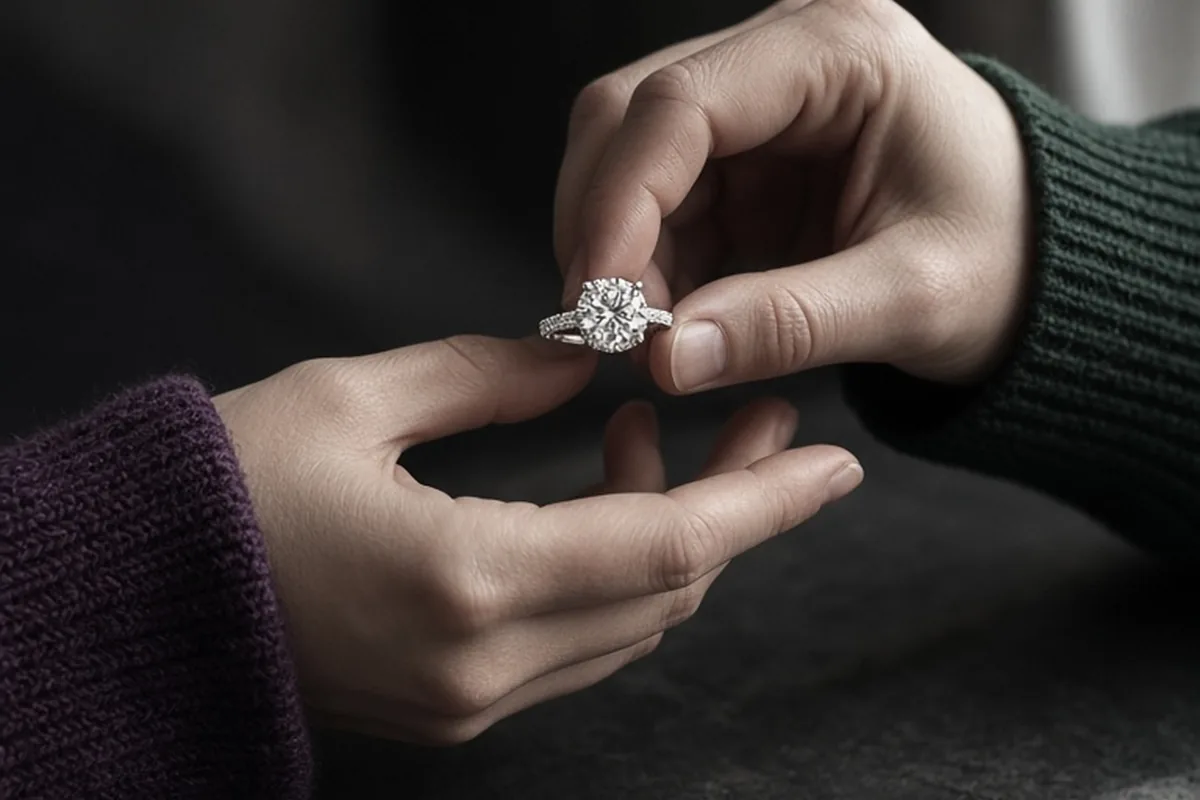
Because moissanite is a laboratory-grown gemstone rather than a mined commodity, its retail cost does not adhere to a single standardized industry price sheet. Instead, the final price of an engagement ring reflects the millimeter dimensions of the center stone, the market price of the selected metal setting, the intricate bench labor required for the design, and individual retailer margins. Buyers determine realistic budgets by separating the center gem expense from the setting architecture and obtaining itemized quotes from reputable jewelers.
Shopping for an engagement ring often involves balancing aesthetic preferences against long-term financial priorities. While moissanite offers exceptional fire, durability, and brilliance, understanding how jewelers price these pieces helps you evaluate quotes accurately and invest your budget where it matters most.
Anatomy of an Engagement Ring Invoice
When you review a quote for a finished engagement ring, the total figure combines several distinct components rather than reflecting the gemstone alone. A typical ring invoice is split between the loose center moissanite, the cast metal mounting, the secondary accent stones, and the bench jeweler labor required to assemble, set, and polish the piece. In many purchases, the precious metal setting and custom labor can represent half or more of the final receipt, especially when selecting complex mountings or premium alloy metals.
Unlike natural diamonds, which trade on established wholesale index sheets based on market speculation and global supply cartels, moissanite is synthesized in controlled laboratory environments from silicon carbide. As an engineered crystal, its raw manufacturing expenses are tied to furnace run times, crystal yield purity, and optical precision during lapidary cutting. Because there is no artificial floor on production volume, retail pricing is driven primarily by competitive manufacturing efficiency, proprietary brand licensing, and standard retail markups rather than commodity exchange indexes.
Moissanite Sizing by Millimeter Dimensions Rather Than Carat Weight
In traditional jewelry retail, gemstones are priced according to physical weight measured in carats. However, silicon carbide has a lower specific gravity than natural diamond, meaning that a moissanite crystal weighs less than a diamond of the exact same physical volume. To avoid confusion, the jewelry trade categorizes moissanite using millimeter dimensions alongside a Diamond Equivalent Weight, which allows shoppers to compare visible surface area and face-up spread directly against traditional diamond profiles.
Pricing for moissanite center stones scales in stepped tiers based on diameter and cut geometry rather than linear weight. Producing larger, optically flawless crystal boules requires substantially longer growing cycles under extreme thermal pressure, which increases the likelihood of internal crystal lattice defects and lowers the usable yield for gemstone cutters. Consequently, moving from a standard six-millimeter round stone to an eight-millimeter or nine-millimeter stone involves an exponential jump in base cost. Fancy shapes such as emerald, pear, marquise, and elongated cushion cuts also command different price points due to higher rough material wastage during precision faceting.
Precious Metal Choices and Their Impact on the Total Price
The choice of metal alloy for your ring band and head plays a substantial role in determining the final cost of the piece. Platinum is renowned for its natural hypoallergenic properties, cool luster, and exceptional density, but its high melting point and resistance during bench work require specialized fabrication equipment and greater artisan labor. Furthermore, because platinum pieces are cast at high purity levels and boast greater physical density than gold alloys, the raw metal mass of a platinum ring contributes significantly to the final estimate.
Gold options present different cost profiles based on purity and color formulation. Fourteen-karat gold blends pure elemental gold with durable alloys such as copper, silver, or zinc, providing superior scratch resistance and everyday durability at an accessible raw material cost. Eighteen-karat gold contains a higher proportion of fine gold, giving it a rich warm hue but also increasing the raw metal charge on your invoice. Buyers choosing white gold must also factor in ongoing maintenance, as white gold rings are plated with rhodium to achieve a bright mirror finish, requiring periodic re-dipping over the lifespan of the ring to preserve their original tone.
Setting Architecture, Accent Stones, and Custom Bench Labor
The physical architecture of your setting dictates the amount of skilled labor a bench jeweler must invest into finishing the ring. A straightforward solitaire design featuring four or six simple prongs requires minimal fabrication time, allowing the majority of your expenditure to focus on the center moissanite and structural metal. In contrast, complex styles featuring intricate halo borders, pavé-set split shanks, hidden halos, or intricate vintage milgrain detailing require hours of delicate handwork under high-magnification microscopes.
Every small accent gemstone incorporated into a multi-stone setting adds to both material and labor costs. Jewelers must carve individual seats, position tiny stones securely, and push tiny metal beads over each gem to hold them in place. Additionally, opting for a fully customized ring design involves computer-aided design modeling, three-dimensional wax resin printing, and lost-wax investment casting. These specialized custom fabrication steps introduce flat design fees that apply regardless of whether you set a modest gemstone or an expansive multi-millimeter center stone.
Color Grades, Crystal Origins, and Brand Markups
Modern moissanite synthesis has advanced significantly since the gemstone was first introduced to commercial jewelry decades ago. Early iterations of silicon carbide crystals frequently displayed subtle yellow, brown, or greenish undertones under natural daylight. Today, advanced high-temperature growing techniques yield crystals graded as colorless, roughly corresponding to the highest color tiers of traditional gemological grading, as well as near-colorless variants that present a faintly warmer, candlelit presence.
Colorless stones require meticulous sorting and tighter laboratory control, placing them at the upper end of the gemstone pricing hierarchy compared to near-colorless stones. Beyond intrinsic color clarity, brand positioning significantly influences retail prices. Well-established brand houses that hold trademarked cutting patents and maintain substantial global marketing campaigns charge a premium for their branded stones. Conversely, unbranded moissanite sourced directly from established lapidary cut houses or independent manufacturers offers identical silicon carbide composition and durability, often at a substantially lower retail price point.
Warranties, Certifications, Appraisals, and Hidden Costs
When purchasing fine jewelry, looking beyond the initial checkout price protects you from unexpected expenses down the road. Independent third-party grading reports verify the chemical identity, dimensions, and optical cut quality of your moissanite. While some vendors include these gemological documentation cards at no extra charge, others charge an ancillary fee for third-party lab documentation. For peace of mind, ensure your certification confirms the stone is genuine synthetic silicon carbide rather than coated cubic zirconia or glass simulant.
Post-purchase maintenance and insurance coverage also influence the true long-term financial commitment of an engagement ring. Many jewelers offer extended warranty plans covering routine inspections, prong tightening, polishing, and free accent stone replacement. If you plan to insure the ring under a personal property insurance policy or homeowners rider, you will need a formal professional appraisal document stating the estimated replacement value. Keep in mind that insurance premiums are calculated on the appraised replacement figure, making accurate documentation essential to avoid overpaying on recurring annual policy premiums.
Requesting Itemized Jeweler Quotes and Comparing Estimates
Navigating the market requires a structured approach to gathering and comparing vendor estimates. When consulting with online retailers or local bespoke bench jewelers, always request a fully itemized quote sheet that breaks down the cost of the loose center stone, the setting mount, custom casting fees, and any optional warranty services. Bundled package pricing often obscures which components carry high profit margins, making it difficult to assess whether you are paying for premium metal craftsmanship or inflated gem branding.
Before finalizing an order or leaving an earnest deposit, review the jeweler policies on resizing, returns, and exchanges. Engagement rings with continuous eternity pavé bands often cannot be resized without remaking the entire shank, which can introduce steep modification fees if the initial finger measurement is off. Confirm the duration of the return window, whether restocking fees apply to custom-ordered mountings, and whether the seller provides complimentary checkups during the first year of ownership to secure your investment.
Illustrative Scenarios
Balancing Setting Complexity Against Center Stone Dimensions
An anonymous couple set out to design a custom engagement ring with an eye on both visual presence and long-term durability. Initially, they considered a very large eight-millimeter center stone paired with an elaborate custom pavé and halo platinum setting, but preliminary itemized estimates showed that intricate bench work and high-density platinum significantly exceeded their intended budget. By shifting to a durable fourteen-karat gold solitaire setting with subtle hidden accents and a well-proportioned seven-millimeter colorless round moissanite, they retained the visual impact they desired while keeping labor and raw metal costs proportionate to their goals.
Key point: Itemizing the ring quote reveals that fine metal alloy and microscopic bench labor can represent a major portion of the total invoice, allowing buyers to adjust setting complexity rather than sacrificing gemstone quality.
Frequently asked questions
Does the shape of a moissanite stone affect its price?
Yes, fancy cut shapes such as oval, emerald, pear, and marquise cuts often cost more than classic round brilliant stones of equivalent visual spread. Cutting these complex geometries results in greater raw crystal waste during the lapidary faceting process, which is reflected in the wholesale and retail price of the loose gem.
Can a local jeweler set a loose moissanite into a separate ring setting?
Most independent bench jewelers can set a loose moissanite into a setting purchased separately or created in their shop. However, jewelers typically charge a dedicated setting labor fee, and some may require you to sign a standard liability waiver before working on customer-supplied gemstones.
How does gold karat selection influence the long-term value of the ring?
Fourteen-karat gold provides greater resistance to daily scuffs and bending due to its higher alloy content, while eighteen-karat gold commands a higher initial price because of its greater pure gold content. Over the lifetime of the ring, higher-karat alloys retain greater scrap precious metal equity, but fourteen-karat settings often incur fewer repair fees from heavy everyday wear.
Why do prices for seemingly identical moissanite rings vary between retailers?
Price discrepancies between vendors stem from differences in setting fabrication quality, precious metal thickness, brand marketing overhead, and gemstone optical grading standards. Mass-produced cast mountings with hollowed under-galleries cost significantly less to produce than solid, hand-finished mountings designed for multi-decade durability.
Your next step
Draft a list of your preferred millimeter dimensions, metal type, and setting style, then request itemized quotes from at least three jewelers that separate the center stone cost from setting labor before placing a deposit.