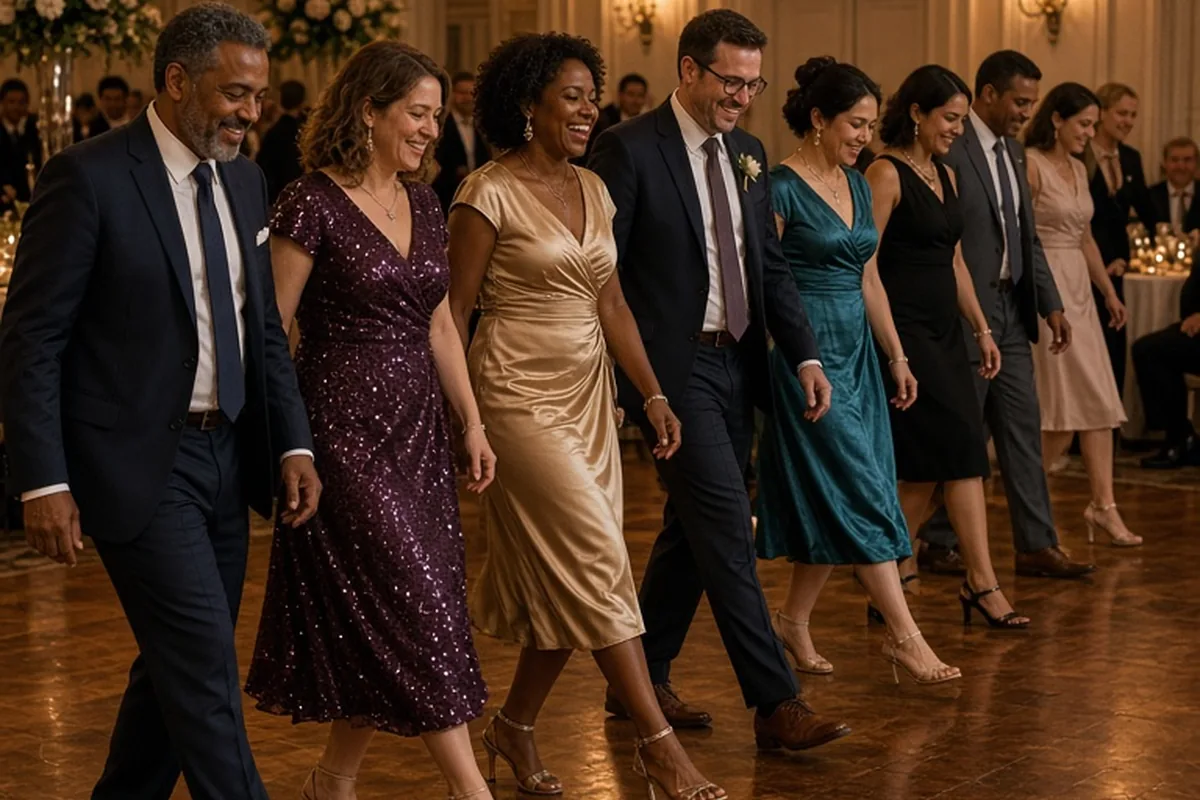
The best line dances to energize a wedding reception combine self-explanatory instructions, recognizable beats, and broad generational appeal. Universal favorites like the Cupid Shuffle, Cha Cha Slide, and Electric Slide reliably draw hesitant guests to the dance floor because the lyrics dictate the choreography. For upbeat transitions, contemporary selections like The Wobble and country staples like Copperhead Road inject immediate momentum when scheduled right after dinner or during a noticeable mid-reception lull.
A wedding dance floor thrives on momentum, but breaking the ice after dinner or cocktail hour often requires an intentional spark. While open freestyle dancing can leave self-conscious guests lingering by the bar, structured group choreography provides a low-pressure environment where nobody feels singled out, turning passive onlookers into an active, cohesive party.
Universal Party Starters Built on Guided Call-and-Response
The most effective way to jumpstart an empty dance floor is by selecting songs that tell dancers exactly what to do in real time. Songs like the Cupid Shuffle by Cupid and the Cha Cha Slide by DJ Casper have become enduring wedding staples specifically because they eliminate performance anxiety. A guest who has never danced in public can easily follow spoken commands to step to the right, step to the left, kick, or turn around. This transparency removes the intimidation factor that often keeps older relatives or introverted friends seated during open freestyle sets.
The Wobble by V.I.C. serves as an exceptional follow-up or alternative when you want a heavier bassline and a more contemporary bounce. While it contains slightly fewer direct verbal instructions than the Cha Cha Slide, the four-count routine is simple enough for guests to absorb within two repetitions. It introduces an urban, rhythmic groove that appeals strongly to younger crowds while remaining repetitive enough for older attendees to mimic without feeling lost. The bounce-and-turn structure encourages playful personal flair, allowing confident dancers to improvise while novices stick closely to the basic steps.
To make the most of these guided routines, consider how you space them across the evening. Deploying a call-and-response track immediately following the formal dances can bridge the awkward gap between seated dinner conversations and full party mode. However, stacking these instructional songs back-to-back can make the reception feel like an organized fitness class rather than an organic celebration. Using one guided track to build the initial crowd, transitioning into open pop or Motown hits, and saving another guided track for later in the night keeps the format feeling fresh and exciting.
Upbeat Country and Southern Line Dances for Fast-Paced Fun
Country and Southern line dances offer a completely different form of energy, prioritizing driving tempos, rhythmic heel taps, and collective stomping. Classics like Copperhead Road by Steve Earle and Boot Scootin' Boogie by Brooks & Dunn deliver a burst of fast-paced momentum that gets guests moving with vigorous footwork. These routines feature grapevines, syncopated hops, and rhythmic claps that create a physical rumble across the wooden dance floor, engaging both the participants and onlookers who enjoy the spectacle.
Another dependable crowd favorite in this category is Kenny Loggins' Footloose, along with Tracy Byrd's Watermelon Crawl. While Footloose leans into theatrical, high-speed kicks that showcase raw energy, Watermelon Crawl brings a playful, mid-tempo swagger that invites lighthearted participation. The primary consideration when incorporating these faster country numbers is footwear and floor space. Guests wearing high heels, fitted dresses, or formal leather dress shoes may struggle with rapid quarter-turns and sudden pivots on slick ballroom surfaces, so these songs work best when the floor is not overly crowded.
If only a portion of your wedding guests are familiar with country music or honky-tonk culture, avoid dropping these selections without visual anchors. Having a few enthusiastic members of the wedding party or family who already know the steps stationed in the front row provides immediate visual cues for everyone else. When the uninitiated see an accessible pattern being executed with confidence, they are much more likely to step in and try the grapevine or boot-heel touches themselves rather than walking off to sit down.
Nostalgic Throwbacks That Unify Older and Younger Generations
Multi-generational participation is the ultimate sign of a successful wedding reception, and nostalgic group dances are uniquely suited to bridge the age gap. Marcia Griffiths' Electric Boogie, widely known as the Electric Slide, remains the benchmark for cross-generational dance floor unity. Its mid-tempo tempo allows grandparents, young children, and college friends to share the same physical rhythm without anyone feeling out of breath. Because it has been played at community gatherings, school dances, and family parties for decades, a substantial portion of your guest list will recognize the steps instinctively.
Other retro favorites include the Village People's Y.M.C.A. and Los Del Rio's Macarena. While these tracks can occasionally be viewed as campy or overplayed by music purists, their undeniable advantage is universal recognition. A guest does not need to consider how cool they look when half the room is forming physical letters with their arms or rotating through hand placements. This shared lightheartedness breaks down social barriers, making self-conscious guests feel entirely comfortable laughing off missteps alongside their tablemates.
For couples seeking a slightly more understated retro aesthetic, traditional soul strolls and Motown line dances provide an elegant middle ground. Routines set to classic soul numbers like The Temptations or Smokey Robinson allow guests to glide forward, step touch, and turn in smooth unison. These dances preserve the communal unity of a structured routine while matching the polished, romantic tone of a black-tie or formal evening reception.
Modern Hip-Hop and Pop Group Routines for Younger Wedding Crowds
If your reception leans heavily toward college friends, coworkers, and younger relatives, modern hip-hop and viral pop line dances can elevate the room's energy to nightclub levels. Tracks from the late 2000s and 2010s, such as Soulja Boy's Crank That, Cali Swag District's Teach Me How to Dougie, and Silento's Watch Me (Whip/Nae Nae), trigger instant collegiate nostalgia for millennial and Gen Z guests. These tracks rely on distinct, recognizable physical gestures that turn the dance floor into an interactive, energetic showcase.
More recent hybrid hits like Blanco Brown's The Git Up blend hip-hop production with country line dance structure, creating a modern, upbeat rhythm that appeals across multiple social groups. Furthermore, social media platforms have introduced synchronized routines to mainstream pop hits, such as Dua Lipa's Levitating or Bruno Mars' 24K Magic. These contemporary selections prevent your music programming from feeling frozen in the past, assuring younger guests that the reception reflects current social dance culture alongside traditional wedding customs.
When planning modern hip-hop group dances, confirm in advance that your entertainment vendor is using clean radio edits. Many early-2000s club hits contain explicit language or references that might feel uncomfortable when danced in front of older relatives or young children. A professional DJ can easily source edited tracks that maintain the driving bassline and signature beat drops while keeping the lyrical content appropriate for a family celebration.
Reception Timeline Tactics: When to Schedule Line Dances
Even the best group dance will fall flat if it is deployed at the wrong point in the reception timeline. The ideal window for an introductory line dance is typically immediately after the formal events wrap up, such as after the couple's first dance and the parent dances. At this juncture, all eyes are already focused on the dance floor, and guests are deciding whether to remain standing or return to their seats. A charismatic DJ playing a universally familiar track like the Cupid Shuffle can invite everyone forward, instantly converting spectator attention into active participation.
The second strategic window occurs during the inevitable mid-reception slump, usually around sixty to ninety minutes into the open dancing portion of the night. This is the period when guests frequently step outside for fresh air, line up at the photo booth, or congregate around the bar, leaving the dance floor looking sparse. Dropping a high-tempo favorite like Copperhead Road or The Wobble during this lull acts as an auditory siren, pulling guests back into the main room and resetting the party's momentum for the final hour.
Avoid using line dances during the final fifteen minutes of the reception, when the crowd is typically primed for massive, emotional sing-alongs, rock anthems, or intimate slow songs. Furthermore, you should strictly limit the total volume of choreographed songs throughout the evening. Scheduling two to four well-placed line dances over a three-hour dance block maintains high enthusiasm, whereas scheduling six or seven will cause fatigue and frustrate guests who prefer freestyle dancing.
Managing Line Dance Skepticism and Reluctant Wedding Guests
Line dances are among the most polarized elements of wedding entertainment. Some couples love the collective joy they create, while others view them as cliché or intrusive. If you or your partner feel hesitant about including them, remember that you have total control over the curation. You do not have to accept an all-or-nothing approach. Many couples choose to add tracks like the Macarena or the Chicken Dance to their strict do-not-play list while permitting one or two modern, high-energy options that their social circle genuinely enjoys.
A common point of friction is the style of DJ announcement used to start these songs. Aggressive microphone demands insisting that everyone get out of their seats often backfire, causing reluctant guests to withdraw or feel uncomfortable. Instead, instruct your DJ to introduce the song smoothly over the music or simply let the opening measures speak for themselves. When the wedding party and immediate friends walk out naturally and begin the steps, other guests will join organically based on social proof rather than artificial pressure.
It is equally important to provide gracious space for guests who prefer to remain spectators. Structured line dances can be intensely entertaining to watch from the perimeter, provided the spectators are not pressured to participate. Designing your reception layout with high-top cocktail tables or perimeter lounge seating near the dance floor allows hesitant guests to stay close to the music, enjoy a beverage, and laugh along with the choreography without feeling forced into the formation.
Frequently asked questions
How many line dances should be played at a wedding reception?
Most professional wedding DJs recommend playing two to four line dances during a typical three-hour open dancing set. This volume provides enough structure to gather hesitant guests without disrupting the natural flow of open freestyle music or exhausting the crowd.
How can we get guests to join a line dance without awkward DJ announcements?
Ask your wedding party and a few confident friends in advance to move directly to the center of the floor as soon as the track begins. Guests respond far more naturally to seeing a group of friends having fun together than they do to repeated verbal demands over the microphone.
What should we do if one partner dislikes line dances but the guests expect them?
A sensible compromise is selecting exactly one universally known, low-pressure track like the Cupid Shuffle or Electric Slide to play early in the evening. This satisfies family expectations and packs the floor while leaving the rest of the night open for your preferred genres.
Which line dance is the easiest for guests with zero dancing experience?
The Cupid Shuffle and the Cha Cha Slide are the easiest options because the vocal tracks explicitly call out each move in real time. Guests do not need to memorize any steps ahead of time; they simply listen to the instructions and step to the side, kick, or slide on cue.
Your next step
Review your reception music preferences with your partner, select no more than three group routines that reflect your crowd's taste, and communicate clean radio edit requirements to your DJ during your final timeline consultation.