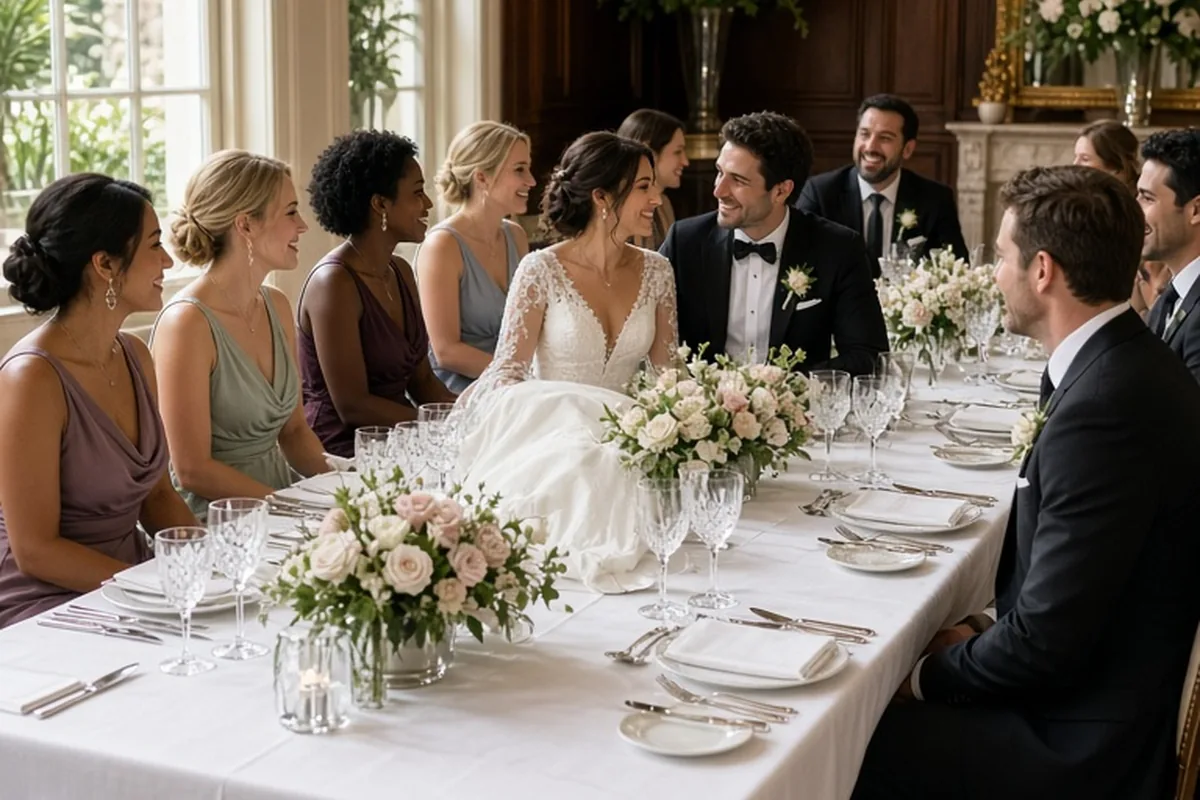
To create the right wedding party table arrangement, select a layout that balances room dimensions with social comfort: a traditional long head table for formal visibility, a sweetheart table paired with nearby party seating to allow dates to sit together, or a double-sided king's table for natural conversation. Confirm the room's sightlines and clearance paths with your venue coordinator before finalizing seats, place personal belongings away from guest views, and seat wedding party partners together whenever space allows.
Planning reception seating requires balancing visual focal points, venue architecture, and the comfort of the people standing beside you. Choosing how to seat your wedding party sets the tone for the entire evening, directly influencing how easily your guests mingle, how smoothly catering staff navigate the dining room, and how relaxed your closest friends feel throughout the meal.
Choosing Between Traditional Head, Sweetheart, and King's Tables
The three primary formats for seating the central wedding group each resolve distinct priorities regarding social interaction and visual presentation. A traditional head table is a long, single-sided rectangular setup that faces the rest of the reception room. This format places the newlyweds in the center, flanked by the maid of honor, best man, and remaining attendants in alternating or gender-grouped patterns. While it creates an unambiguous focal point for speeches and photography, it inherently limits conversation to the people sitting directly to the left and right. It also typically isolates wedding party members from their spouses, dates, or children who are seated out in the general reception area.
A sweetheart table bypasses social separation by seating only the newlyweds at a dedicated small round or rectangular table, while wedding attendants sit at standard round or banquet tables nearby alongside their significant others. This approach provides the couple with brief moments of private conversation during dinner while relieving attendants of stage-like exposure. Alternatively, a king's table utilizes wide banquet tables with double-sided seating, placing the couple, their attendants, and their attendants' partners around a shared perimeter. King's tables foster lively dinner-party conversation and eliminate the awkwardness of separated couples, though they require significant square footage and can create visual blind spots if placed poorly within narrow reception halls.
Arranging Seating When Wedding Party Members Have Dates
Deciding where to seat the significant others of your attendants is one of the most common points of friction during reception planning. When attendants are expected to sit at an elevated or single-sided head table without their partners, their dates are frequently placed at a separate table of acquaintances or strangers. For many guests, attending a multi-hour dinner without their partner can feel isolating, especially if they do not know other attendees well. If you prefer a traditional single-sided head table, consider seating attendant dates together at an adjacent, high-priority table near the front of the room rather than dispersing them across outer tables.
If keeping couples together is a top priority, transitioning from a single-sided head table to a king's table or cluster layout is often the cleanest solution. A king's table places attendants directly across from or beside their spouses and dates, treating the wedding party as a unified dinner party. Another functional alternative is the split-table format, where the couple hosts their immediate families or maid of honor and best man, while the remaining attendants host individual tables of mutual friends. Evaluating your party's social dynamics in advance helps you choose a layout that feels welcoming rather than rigid.
Mapping Sightlines, Traffic Flow, and Venue Clearance
Even an attractive table configuration fails if it disrupts room service or blocks key moments from guest view. Before locking in your design, examine the architectural relationship between your chosen table location, the catering entry doors, the dance floor, and primary guest pathways. Venue service standards typically require at least 60 inches of clearance between table edges to allow servers carrying loaded trays and guests using mobility aids to move freely. Placing an elongated head table flush against a back wall might save floor space, but it can trap attendants in their seats and force catering staff to reach across diners to clear plates.
Sightlines require equal consideration during dinner toasts and first dances. A long rectangular head table set parallel to the dance floor provides an unobstructed view for guests seated directly across, but guests seated along the outer flanks may have their views blocked by venue pillars or tall floral installations. When setting up a king's table in the center of the room, remember that attendants seated with their backs to the room will need to swivel their chairs during formal toasts and presentations. Confirm that surrounding guest tables have enough setback so turned chairs do not collide with neighboring place settings or service corridors.
Coordinating Floral Heights, Place Settings, and Table Linens
Tablescapes for the wedding party require a careful balance between elevated decor and practical dining mechanics. Because this table is frequently photographed throughout the meal and formal toasts, centerpieces should never obstruct direct eye contact between diners or block photographers capturing candid reactions. Elevated floral arrangements should be set on narrow risers starting at least 14 inches above table height, while low centerpieces, compotes, and runner greenery should stay below 10 inches. Testing these heights seated in standard banquet chairs prevents arrangements from acting as physical barriers across the table.
Table depth often dictates what can realistically fit alongside glassware, chargers, flatware, and menus. Standard rental banquet tables measure 30 inches wide, which leaves minimal room for lush centerpiece garlands when place settings are positioned on both sides. If you select a double-sided king's table, request 42-inch or 48-inch wide tables (often called queen or wide banquet tables) to prevent glassware from crowding centerpieces. For long single-sided tables, remember that the exposed front skirt of the linen will be visible in numerous photos; ensure full floor-length linen drops and organize concealed under-table storage for bridal party bags, wraps, and flat footwear.
Managing Uneven Party Sizes and Blended Wedding Groups
Modern wedding parties rarely conform to matching, symmetrical numbers on each side, and seating layouts must adapt gracefully to asymmetrical groups. Attempting to force an uneven group into a strictly symmetrical layout often results in awkward gaps or unbalanced photographs. If one side has four attendants and the other has seven, consider alternating attendants along the length of a king's table rather than separating them strictly by side. Blending attendants across both sides creates a cohesive gathering that celebrates collective friendship rather than drawing attention to mismatched numbers.
For couples with mixed-gender attendants, junior attendants, or adult children, practical adjustments make the evening smoother for everyone. Junior bridesmaids and groomsmen often prefer sitting with their parents at a family table rather than navigating an adult head table throughout multi-course dinner service. Similarly, attendants who share complex personal histories can be spaced comfortably across a large king's table or assigned to separate hosting tables without making the separation obvious. Designing the layout around personal relationships rather than rigid protocol ensures the dining experience remains relaxed and comfortable.
Planning Speeches, Microphone Access, and Plate Service Transitions
The physical logistics of speeches, toasts, and plate clearing influence how smoothly your dinner service progresses. During toasts, the person speaking should have a clear path to the microphone without stepping over floor floral installations, purse straps, or electrical cables. Position the designated speaking area slightly off-center from the head table so the speaker can look at the couple naturally without turning their back on the broader room. Inform your banquet captain and DJ or audio technician of your table arrangement early so they know where to position wireless microphones and cue lighting adjustments.
Catering service flow also changes based on table geometry. At a traditional head table, servers typically serve the newlyweds first, moving outward along the row, which can create a visible delay between when the center and outer ends receive hot food. For a sweetheart table, the couple is served quickly, freeing them to eat early and circulate between courses if desired. When confirming details with your caterer, clarify how drinks will be refilled during toasts and confirm that dirty dinner plates will be cleared before formal photography resumes, avoiding cluttered foregrounds in toast photos.
Frequently asked questions
Can we seat the wedding party at standard guest tables instead of one large group table?
Yes. Seating attendants as hosts at standard round tables alongside their partners and mutual friend groups is increasingly common. This approach simplifies room layouts, keeps couples together, and allows the newlyweds to opt for a small sweetheart table or dine directly with immediate family.
How much table width should we allocate per person at the head table?
Plan for 24 to 30 inches of linear table width per person for comfortable dining. If attendants are wearing formal attire with fuller skirts, allocating closer to 30 inches ensures adequate elbow room and prevents place settings from feeling cramped.
Where should the wedding party stash their personal bags and bouquets during dinner?
Designate an adjacent prep suite or install discrete low hooks or storage boxes beneath floor-length table skirting. Many couples place water vases along the center of the head table so attendants can safely display bouquets as functional decor during dinner.
Should parents of the couple sit at the head table or their own table?
Parents are traditionally seated at dedicated family tables positioned close to the head or sweetheart table rather than directly with the wedding party. This allows parents to sit comfortably with grandparents, siblings, and extended family members without crowding the attendant table.
Your next step
Request a scaled floor plan from your venue coordinator, mark the exact dimensions of your preferred table format, and confirm clearance paths before ordering linens and floral installations.