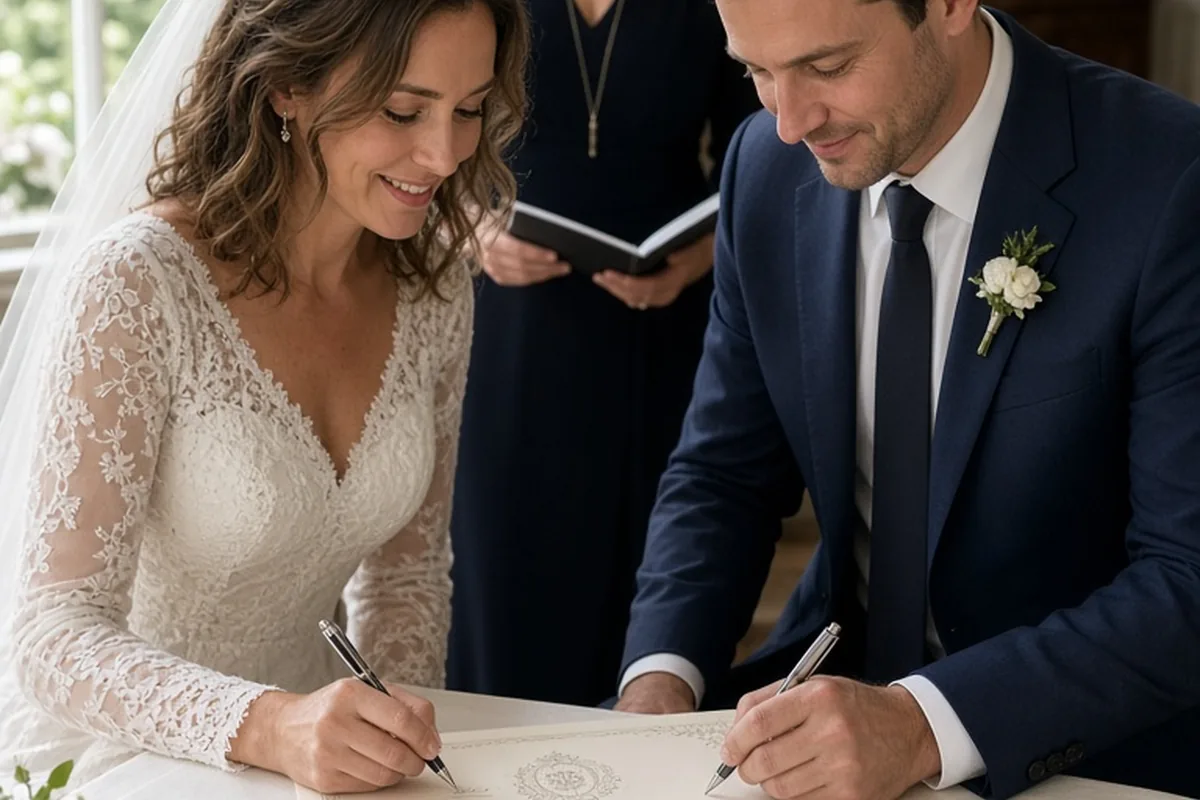
Creative printable certificates provide a personalized, commemorative keepsake to celebrate your wedding ceremony, distinct from your official government-issued marriage license. Couples use printable certificate designs to feature their custom vows, gather signatures from wedding guests or the bridal party, honor traditions like Quaker marriage contracts, or celebrate blended families. You can customize digital templates with your chosen typography and wording, printing them on archival cardstock or cotton paper for framing and long-term display in your home.
While standard civil marriage documentation registers your union with local government records, it rarely reflects the visual aesthetic or emotional depth of the vows you share during your wedding ceremony. Printable commemorative certificates fill this gap by turning the act of solemnization into a personalized piece of art that captures the personal promises, witnesses, and aesthetic of your wedding day.
Distinguishing Commemorative Certificates from Legal Marriage Licenses
Before selecting or designing a printable wedding certificate, it is essential to understand the difference between a legal marriage license and a commemorative document. A legal marriage license is an official government record issued by your local county clerk, court, or civil registry. That document must meet strict jurisdictional requirements, adhere to official state or municipal formatting, and be signed by an authorized officiant and legally required witnesses before being returned to the issuing office for recording. A commemorative wedding certificate carries no civil or legal authority; it is an artistic keepsake created entirely for your personal celebration.
Because decorative certificates are free from government formatting rules, they allow complete freedom regarding layout, imagery, and text. Couples frequently sign the official legal paperwork privately before or after the main ceremony, while reserving the presentation and signing of the decorative printable certificate for the public gathering. This keeps official paperwork safe from accidental spills, smudges, or aesthetic compromises, while providing an attractive focal piece for photographs and ceremonial signing moments in front of family and friends.
Creative Printable Wedding Certificate Styles and Ceremonial Formats
Printable wedding certificates can be adapted to many ceremony styles, decorative themes, and cultural practices. One of the most enduring formats is the Quaker-inspired marriage certificate. In historical Quaker traditions, couples marry each other without an intermediary officiant, and every guest in attendance signs the document as a community witness. Modern couples often adopt this layout by surrounding their personal vows with an organized grid or border of signature lines, transforming the certificate into a collaborative guestbook that represents the support of their community.
Another popular design style is the modern minimalist certificate, which emphasizes clean typography, generous white space, and subtle geometric or line-art borders. These designs work particularly well for contemporary loft, urban, or modern outdoor weddings and pair effortlessly with sleek, modern home interiors. For botanical and garden weddings, certificates featuring hand-painted watercolor greenery, eucalyptus garlands, or floral wreaths provide an organic frame around the ceremony text.
Blended family certificates offer a meaningful variation by including specific signature spaces for children, step-parents, or guardians alongside the couple. This structure honors the joining of households and allows children to participate directly in the ceremonial commitments. Similarly, vow renewal certificates celebrate milestone anniversaries by documenting renewed promises, listing original marriage dates alongside the renewal date, and offering signature lines for lifelong friends and growing families.
Drafting Meaningful Text, Custom Vows, and Signature Blocks
The phrasing you choose for a printable certificate establishes its tone and emotional resonance. Traditional formats often follow historical declaration language: 'Whereas [Partner A] and [Partner B], having declared their intention of marriage, did on this day solemnly promise before these witnesses to live together in mutual love and fidelity...' This phrasing provides a formal, timeless rhythm that suits historic venues, traditional aesthetics, and archival presentation.
If you prefer secular or contemporary wording, you can replace formal declarations with direct, heartfelt commitments. For example, your certificate might read: 'On this day, [Partner A] and [Partner B] united their lives in the presence of family and friends, promising patience, mutual support, laughter, and lifelong partnership.' You can also choose to print your exact spoken vows directly in the center of the certificate, preserving the precise words you spoke to one another during the ceremony.
Signature blocks require thoughtful planning based on who will be signing during the ceremony or reception. If you want only the couple and the officiant to sign, three balanced lines across the bottom create a clean, elegant layout. If you intend to have two formal witnesses or your entire wedding party sign, designate dedicated lines with printed names beneath each line. For communal guest certificates where dozens or hundreds of attendees will sign, calculate signature box dimensions carefully—allocating roughly two to three inches of horizontal space and half an inch of vertical height per signature—to ensure the layout accommodates your full guest count comfortably.
Selecting Cardstock, Archival Inks, and Printing Methods
The physical quality of your printed certificate determines both how it looks on your wedding day and how well it resists yellowing, fading, or moisture damage over decades. Standard lightweight printer paper is unsuitable for a keepsake certificate; it tends to warp when inked and wrinkles easily under the pressure of multiple signatures. Instead, select a heavyweight cardstock with a basis weight between 80-pound and 110-pound cover (approximately 216 to 300 gsm).
Paper texture also plays an important role in the finished aesthetic and writing experience. Smooth matte cardstock provides crisp edges for fine-line modern typography and minimalist designs. Textured cotton rag, linen-finish paper, or heavy cold-press watercolor paper lends an organic, artisanal feel that complements botanical and vintage calligraphy layouts. If choosing cotton rag with deckled (hand-torn) edges, ensure the paper surface is sized sufficiently so ink does not feather or bleed when guests write on it.
When choosing between home printing and commercial print shops, consider ink permanence. Home inkjet printers using dye-based inks can produce vibrant colors, but these prints are susceptible to water damage and UV fading. Local professional print shops or fine-art giclée printing services use pigment-based archival inks that resist degradation over decades. If printing at home, test your design on sample sheets first to verify margin alignment, color fidelity, and paper feeding without roller marks.
Choosing the Right Pens to Prevent Smudges and Bleeding
The choice of writing instrument is one of the most frequently overlooked logistics of certificate signing. Standard ballpoint pens require heavy downward pressure that can indent thick cardstock and often produce inconsistent, patchy ink lines. Conversely, liquid fountain pens and standard rollerballs release wet, dye-based ink that takes a long time to dry on dense paper, creating a high risk of accidental hand smudges as people sign.
The most reliable option for signing commemorative certificates is a dedicated archival pigment pen with a fine or medium felt tip, such as a technical drawing pen or museum-grade illustration marker. These pens dispense lightfast, waterproof, acid-free pigment ink that dries almost instantly on contact with paper. Archival gel pens with medium points are also a solid choice for smooth paper surfaces. Always place a scrap sheet of your chosen paper stock at the signing table for your officiant, wedding party, or guests to test the pen before signing the actual certificate.
Organizing Certificate Signing into Your Ceremony Logistics
Deciding exactly when and where the certificate will be signed prevents awkward pauses and maintains the emotional rhythm of your celebration. If the signing is incorporated directly into the ceremony, coordinate the moment with your officiant so it feels intentional. A natural placement is immediately after the exchange of rings and vows, accompanied by an instrumental musical interlude while the couple and witnesses step to a small side table to sign.
Ensure the signing station is fully prepared before the ceremony begins. The table should have a hard, completely flat surface; signing on an uneven rustic wood table or over a soft linen tablecloth can puncture the paper or cause distorted writing. Secure the certificate flat against a rigid, acid-free backing board using gentle drafting tape or corner mounts so the page does not shift while being signed.
If you are using a community-style certificate where all guests will sign, do not attempt to have dozens of people sign during the ceremony itself, as this can derail the pacing. Instead, have the couple and primary witnesses sign during the ceremony, and then move the certificate to a well-lit signing station near the entrance of your reception or cocktail hour. Appoint a wedding coordinator or trusted attendant to oversee the table, assist guests, and ensure signatures stay within designated boundaries.
Displaying, Framing, and Preserving Your Completed Certificate
Once your wedding day concludes, preserving the completed certificate requires proper framing materials that shield the paper from environmental stressors like ultraviolet radiation, humidity, and atmospheric pollutants. When framing the certificate, use conservation-grade framing materials, including an acid-free, lignin-free mat board and backing. Direct contact between the paper and regular glass can trap moisture and cause the ink or paper to adhere to the pane over time, so always use a mat or frame spacers to create a protective air gap.
Select framing glass with high UV-filtering capability (often labeled as museum glass or conservation clear glass). Standard picture frame glass blocks only a small portion of UV light, which can cause colored inks, dark watercolor illustrations, and handwritten signatures to fade significantly when exposed to ambient daylight. Avoid hanging your framed certificate directly opposite sunny windows, above working fireplaces, or in areas subject to significant humidity swings like bathrooms or uninsulated exterior walls.
Frequently asked questions
Can a printable wedding certificate replace my official marriage license?
No. A printable wedding certificate is strictly a decorative keepsake and holds no legal standing. You must obtain and file an official marriage license from your municipal or county government to make your marriage legally recognized.
What paper weight is best for printing a keepsake wedding certificate?
A heavyweight cover stock between 80 lb and 110 lb (approximately 216 to 300 gsm) is ideal. This thickness prevents buckling, supports clean ink absorption without bleeding, and provides durability for framing.
Which pens should be used so guest signatures do not smear on the certificate?
Use archival, pigment-based fine-tip pens or acid-free gel pens with waterproof ink. These dry almost instantly on heavy cardstock and prevent the smearing common with standard rollerball or fountain pens.
How do you calculate space for all wedding guests to sign a community certificate?
Allocate a rectangular space roughly 2.5 inches wide by 0.5 inches tall per guest or couple. For larger guest lists of 100 or more, consider choosing a poster-sized format (such as 16x20 or 18x24 inches) to comfortably fit all names.
Your next step
Download your preferred certificate template early, finalize your ceremony wording, and test your chosen paper stock with an archival pigment pen before your wedding day.