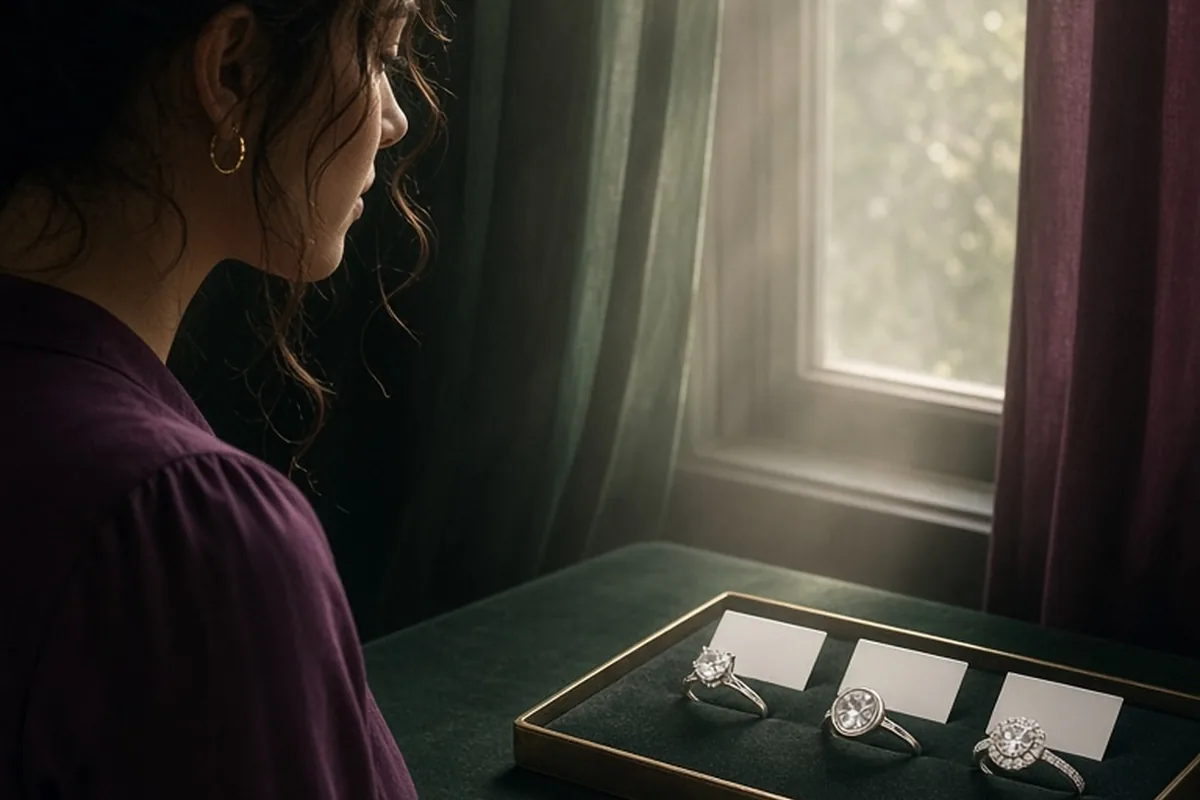
Engagement ring settings on a budget focus on smart metal choices, simple structural designs, and mounts that protect the center stone without inflated manufacturing labor. Classic four-prong solitaires, clean bezel cups, and dainty pavé accents offer timeless visual appeal at lower baseline prices. Opting for fourteen-karat or ten-karat gold over platinum reduces structural metal costs while maintaining everyday strength, leaving more flexibility for your preferred center gemstone.
Choosing an engagement ring setting involves balancing everyday wearability, personal aesthetic taste, and real-world financial constraints. The mounting serves as the physical foundation for the centerpiece, dictating how secure the gem sits and how much ongoing maintenance the piece will require over decades.
Classic Solitaire Prongs for Minimal Labor and Maximum Light
A traditional solitaire setting remains one of the most reliable ways to secure a gemstone while keeping setting fees manageable. Because solitaire designs rely on a single central mounting head attached to a plain shank, bench jewelers spend fewer production hours casting, cleaning, and setting accent stones. This straightforward production workflow directly lowers the retail markup compared to complex multi-stone mountings. Solitaires also showcase the center stone cleanly, allowing light to enter from multiple angles to optimize natural sparkle without requiring additional side stones.
When evaluating budget solitaire mountings, the choice between four-prong and six-prong configurations represents a balance between stone security and visual coverage. A four-prong basket uses less raw metal, exposes more of the gem's perimeter, and creates a clean rectangular or square orientation for round and fancy cuts alike. A six-prong head provides a tighter safety net against snagging, holding the gemstone in place even if a single prong bends during manual tasks. Choosing standard round wire prongs rather than custom claw or petal prongs keeps labor rates low while ensuring that future retipping remains affordable at any standard jewelry bench.
Bezel and Half-Bezel Mountings for Durability and Low Maintenance
Bezel settings wrap a continuous rim of metal around the perimeter of the center stone, offering structural protection that active wearers benefit from every day. While a full custom bezel can occasionally carry higher fabrication costs, standard catalog bezel mountings eliminate the fragile micro-prongs that frequently catch on knitwear, gloves, and furniture. By preventing corner chipping on fancy cuts like pears, marquises, and princess cuts, a bezel mount protects your financial investment against accidental impact damage that would otherwise require costly stone recutting or total replacement.
A half-bezel or semi-bezel offers a practical alternative for shoppers who want the protective benefits of framed metal alongside open sides that welcome ambient light. Half-bezels secure the stone on two opposing edges, reducing the total amount of precious metal used in the head while creating a sleek, modern silhouette. Because there are no raised prongs to snag, bend, or thin out over time, bezel-style mountings significantly reduce the frequency of routine bench repairs, lowering the long-term cost of ownership over the lifetime of the ring.
Halo and Cluster Settings to Maximize Center Stone Presence
A halo setting surrounds the central gem with a ring of smaller accent stones, creating the optical illusion of a much larger center diameter. For buyers working with a fixed overall budget, choosing a modest center stone paired with a petite halo setting often delivers a prominent visual footprint at a fraction of the cost of a single large solitaire. The perimeter of small accents reflects light outward, bridging the gap between the center gem and the outer rim to present an expansive surface area on the finger.
Cluster and multi-stone illusion settings take this principle even further by grouping multiple smaller, lower-cost stones closely together to form the appearance of a single larger shape. When considering these detailed styles on a budget, look for shared-prong or bead-set arrangements rather than intricate micro-pave configurations with individual bezels. Shared prongs reduce the total metal framework and manufacturing assembly time while providing adequate security for the accent gems, keeping the initial setting price within reach.
Strategic Metal Selection Between Gold Karats, Platinum, and Alternatives
The metal alloy chosen for an engagement ring setting heavily influences both the upfront price tag and the ring's long-term durability. Platinum offers extreme density and natural hypoallergenic properties, but its raw material expense and high melting temperature make it the most expensive mounting choice. Fourteen-karat gold represents the industry standard for balancing cost, durability, and color richness, blending pure gold with durable alloys like copper, silver, and zinc to resist daily scratching better than softer eighteen-karat gold.
For shoppers seeking even greater savings on metal weight, ten-karat gold provides a resilient option with higher scratch resistance due to its greater alloy proportion. White gold requires occasional rhodium replating to maintain its bright silver mirror finish, representing a modest recurring maintenance cost that should be factored into your decision. Yellow gold and rose gold do not require plating, making them maintenance-friendly choices that retain their warm tones naturally over years of continuous wear.
Pre-Set Rings and Semi-Mounts Versus Custom Bench Fabrication
How a jeweler sources and assembles your ring setting plays a major role in the final invoice. Custom bespoke jewelry design involves initial computer-aided design modeling, three-dimensional wax printing, custom mold casting, and individualized stone setting, all of which carry separate design and labor fees. In contrast, semi-mounts are pre-fabricated factory settings designed to accept calibrated center stones of standard millimeter dimensions, eliminating custom design surcharges.
Choosing a standard semi-mount from a jeweler's catalog allows you to select your preferred center stone independently while taking advantage of mass-production economies of scale for the setting itself. If you already possess an heirloom gemstone, selecting a stock mounting with matching millimeter measurements avoids custom fabrication costs entirely. Always request that the bench jeweler verify the exact depth, girdle thickness, and diameter of your loose stone before ordering a stock setting to ensure a seamless fit without forcing metal adjustments.
Structural Longevity Checks to Avoid Hidden Repair Expenses
An inexpensive setting is only economical if it can withstand years of daily use without dropping stones or warping out of round. Thin shanks measuring under 1.5 millimeters at the base may save a small amount on raw metal weight, but they are prone to bending under normal gripping pressure, which can loosen the prong basket above. Prioritize a band thickness of at least 1.8 to 2.0 millimeters at the base of the shank to ensure structural integrity and allow for future ring resizing without compromising the band.
Examine the junction where the head attaches to the shank to verify whether it is a peg head or an integrated cathedral setting. Cathedral shoulders extend upward from the band to brace the central basket on both sides, providing valuable leverage protection against side impacts. While peg heads soldered onto a flat band are slightly cheaper to manufacture, an accidental bump against a hard surface can snap the peg off entirely. Choosing a setting with integrated side supports prevents sudden catastrophic loss and avoids costly emergency repair bills.
Frequently asked questions
Which engagement ring setting style is typically the most affordable?
A classic four-prong solitaire mounting crafted in fourteen-karat gold is generally the most affordable setting option. It requires minimal precious metal weight and fewer bench labor hours to assemble than multi-stone, halo, or custom-carved designs.
Does choosing a bezel setting cost more than a traditional prong setting?
A standard pre-cast bezel setting is comparable in upfront price to a quality prong setting, though custom hand-rubbed bezels may carry higher labor fees. However, bezels often save money over time because they lack delicate prongs that require regular inspection and retipping.
How can I tell if a low-cost ring setting is sturdy enough for daily wear?
Check that the band thickness is at least 1.8 millimeters wide at the base and inspect the head attachment points for solid metal joins rather than thin surface solder. Ensure that prongs have adequate thickness over the gem's crown facets so the stone remains firmly seated without rattling.
Your next step
Measure your center stone's exact millimeter dimensions and compare stock semi-mount catalog designs with a minimum 1.8-millimeter band width to secure an affordable, structurally sound setting.