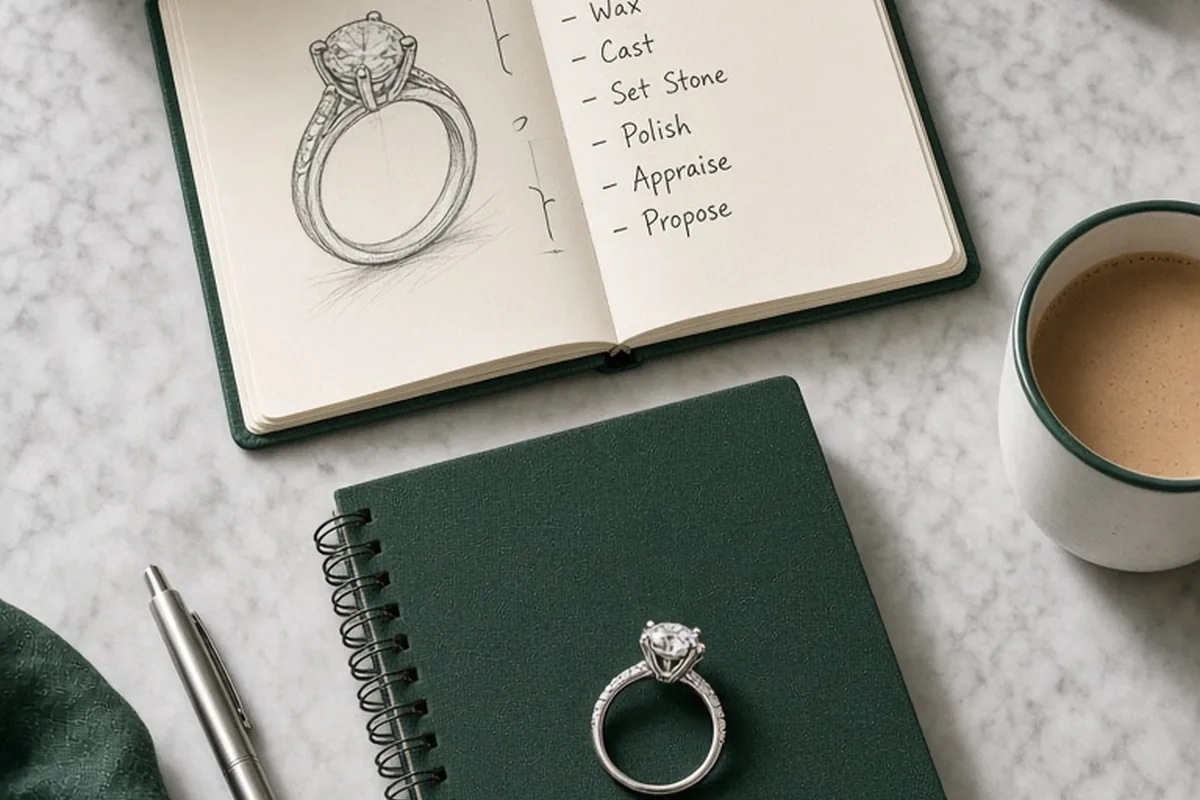
A realistic engagement ring settings planning timeline ranges from two to eight weeks, depending on whether you choose a prefabricated catalog mounting or a fully bespoke custom design. Simple catalog settings with in-stock diamonds typically require two to three weeks for assembly, sizing, and polishing. Custom CAD designs, hand-carved wax models, non-standard gemstone seat modifications, and casting from raw precious metal require four to eight weeks, plus an extra two-week safety buffer for appraisal, insurance, and unexpected revisions.
Purchasing an engagement ring involves more than picking a center stone; the setting anchors the design, dictates daily wearability, and controls the actual manufacturing schedule. Understanding the jeweler bench calendar prevents rushed craftsmanship, missed proposal deadlines, and costly rush fees.
Mapping the Lead Times for Stock Mountings Versus Custom Ring Settings
The first major timeline fork occurs when deciding between an existing commercial mounting and a custom-fabricated setting. Commercial stock mountings are pre-cast rings produced in standardized calibrations, such as round, oval, or princess cuts in standard millimeter spreads. When you select a stock setting, the jeweler orders the semi-mount or pulls it from existing distributor inventory, adjusts the finger size, cuts the seats into pre-cast prongs, and sets your stone. This path generally takes between ten business days and three weeks from deposit to final hand-off.
Custom settings, by contrast, begin from a raw concept, sketch, or digital reference and require a multi-stage production queue. A bench jeweler or jewelry designer must translate your aesthetic ideas into three-dimensional specifications that support structural integrity, metal thickness, and precise stone tolerances. Because custom work requires dedicated computer-aided design time, iterative approvals, physical prototype generation, and one-off metal casting, the process routinely requires four to eight weeks. If your design incorporates rare accent gems, complex filigree, or unconventional metal combinations, sourcing and bench time can extend the production window further.
Coordinating Center Stone Dimensions With Setting Fabrication Milestones
A common scheduling mistake is attempting to finalize a ring setting before securing the exact center gemstone. While standardized round diamonds have relatively predictable depth and girdle proportions, fancy shapes like pear, marquise, emerald, and elongated cushion cuts possess unique length-to-width ratios, corner angles, and pavilion depths. A jeweler cannot cast a precision custom head, bezel, or basket without taking direct micrometer measurements or high-resolution 3D optical scans of the actual loose stone.
To keep your production calendar synchronized, finalize and purchase the center diamond or gemstone before the jeweler begins metal casting or structural CAD drafting. If you are sourcing the stone from an independent dealer or inheriting an heirloom family diamond, factor in the transit time required to get that gem physically into your setting jeweler's hands. Rushing this sequence by asking a bench jeweler to cast a setting based on approximate millimeter estimates often results in poorly seated stones, exposed girdles, or costly re-casting delays when the physical gem does not seat cleanly into the cast basket.
Managing the Multi-Phase Custom CAD, Wax Model, and Casting Schedule
Custom ring settings follow a strict sequence of review and fabrication gates, with each phase requiring explicit client sign-off before raw metalwork begins. The design stage opens with 3D CAD modeling, which typically consumes one to two weeks depending on the designer's backlog. During this window, the CAD artist renders multi-angle digital images displaying exact metal thicknesses, prong positions, and gallery details. Requesting major structural adjustments at the digital rendering stage adds several business days per iteration, making clear upfront communication essential.
Once you approve the digital CAD rendering, the jeweler outputs a physical prototype—usually via high-precision 3D wax printing or resin milling—which takes three to five business days. Viewing this wax model in person or through video verification ensures the ring's scale, finger coverage, and side profile match expectations before precious metals are committed. After wax approval, the physical casting occurs through the lost-wax method: investing the model in plaster, burning out the wax in a high-temperature kiln, and centrifugally injecting molten platinum or gold. This metallurgy and cleaning stage requires three to seven business days before the rough casting reaches the jeweler's bench for assembly.
Factoring in Prong Setting, Pavé Detailing, and Final Metal Finishing
Transforming a raw cast mounting into a finished engagement ring represents the most skill-intensive and time-sensitive portion of the workshop schedule. A rough casting emerges with an oxidized, granular surface that requires filing, preliminary abrasive lapping, and precision magnetic tumbling to smooth the internal structure. If the ring features multiple components, such as a two-tone gold shank with a platinum head or a multi-part vintage filigree under-gallery, the master bench jeweler must solder and assemble these individual castings prior to setting any gems.
Stone setting introduces its own distinct labor requirements based on your chosen mounting style. A classic four-prong solitaire requires meticulous seat cutting, level testing, prong clipping, and rounded bead shaping, which takes an experienced setter several hours. Conversely, micro-pavé halos, hidden accents, channel-set shoulders, or flush-set bezels demand microscopic bench work to raise minute beads of metal over dozens of small accent stones. This intensive detailing stage generally requires five to ten business days on the workshop calendar, followed by multi-step polishing, ultrasonic cleaning, and rhodium electroplating for white gold alloys.
Scheduling Essential Buffers for Ring Sizing, Independent Appraisals, and Insured Delivery
A practical planning timeline must never end on the projected fabrication completion date; post-production administration and quality assurance require built-in buffer time. Even with careful finger measurement, minor sizing adjustments are common. Simple plain bands can be adjusted within one to two days, but intricate settings with continuous side stones or eternity-style bands may require micro-adjustments or a complete remake if the initial sizing was inaccurate. Building a dedicated one-week cushion accommodates unexpected bench corrections without threatening your proposal date.
Furthermore, protecting your investment requires formal documentation before the ring leaves the premises. A qualified gemologist must inspect the completed piece, verify that the mounted center stone matches its grading certificate via laser inscription inspection, and generate an itemized insurance appraisal report. If you are ordering through a remote jeweler, insured overnight courier transit requires adult signature confirmation and can occasionally experience carrier holds or weather delays. Allocate three to five business days strictly for appraisal paperwork, final quality control review, and transit logistics.
Creating Your Reverse-Engineered Calendar to Meet the Proposal Date
To establish your purchase schedule, set your target proposal date and work backward through the required milestones. If your goal is a specific proposal weekend, set your target delivery date at least two full weeks before that day. This cushion provides peace of mind, permits at-home physical inspection, allows you to practice opening and concealing the ring box, and leaves ample room to secure an active personal property insurance policy before the ring is ever worn outside.
Using this reverse calendar, a custom ring with a twelve-week horizon breaks down into manageable decision checkpoints: Stone sourcing and initial design consultations during weeks one and two; CAD modeling and design revisions during weeks three and four; physical wax inspection in week five; metal casting, soldering, and bench setting during weeks six through eight; sizing checks, polishing, appraisal documentation, and shipping during weeks nine and ten; leaving weeks eleven and twelve completely clear as contingency. Starting early transforms a stressful countdown into an organized, creative collaboration.
Frequently asked questions
Can I rush an engagement ring setting if I need it in two weeks?
Yes, but your design choices will be constrained to in-stock commercial mountings or ready-to-ship inventory rather than bespoke CAD designs. Jewelers can often expedite stone setting, sizing, and polishing for a dedicated rush fee, though complex multi-stone pavé or custom-cast mountings cannot be compressed safely without risking structural quality.
Why does a custom engagement ring setting take longer than a standard catalog setting?
Custom settings require unique engineering, digital CAD generation, 3D wax model printing, physical mold investment, and raw metal casting before any jeweler can begin setting stones. Catalog settings are already manufactured or held as standard molds, skipping the design drafting and wax verification cycles entirely.
What happens to the timeline if I need to change my ring design during the CAD phase?
Minor modifications, such as adjusting prong claw shapes or band widths, typically add two to four business days for digital re-rendering. Substantial changes, such as altering the setting profile, switching center stone shapes, or changing metal architectures, require rebuilding the digital model and can delay production by one to two weeks.
How far in advance of the proposal should I start looking at ring settings?
You should begin researching setting styles and consulting jewelers approximately three to four months before your desired proposal date. This provides ample time to select your center stone, navigate design approvals without pressure, and receive the completed ring several weeks ahead of the proposal.
Your next step
Determine your ideal proposal date, subtract ten weeks to establish your start deadline, and schedule an initial jeweler consultation with your target stone shape and setting style in hand.