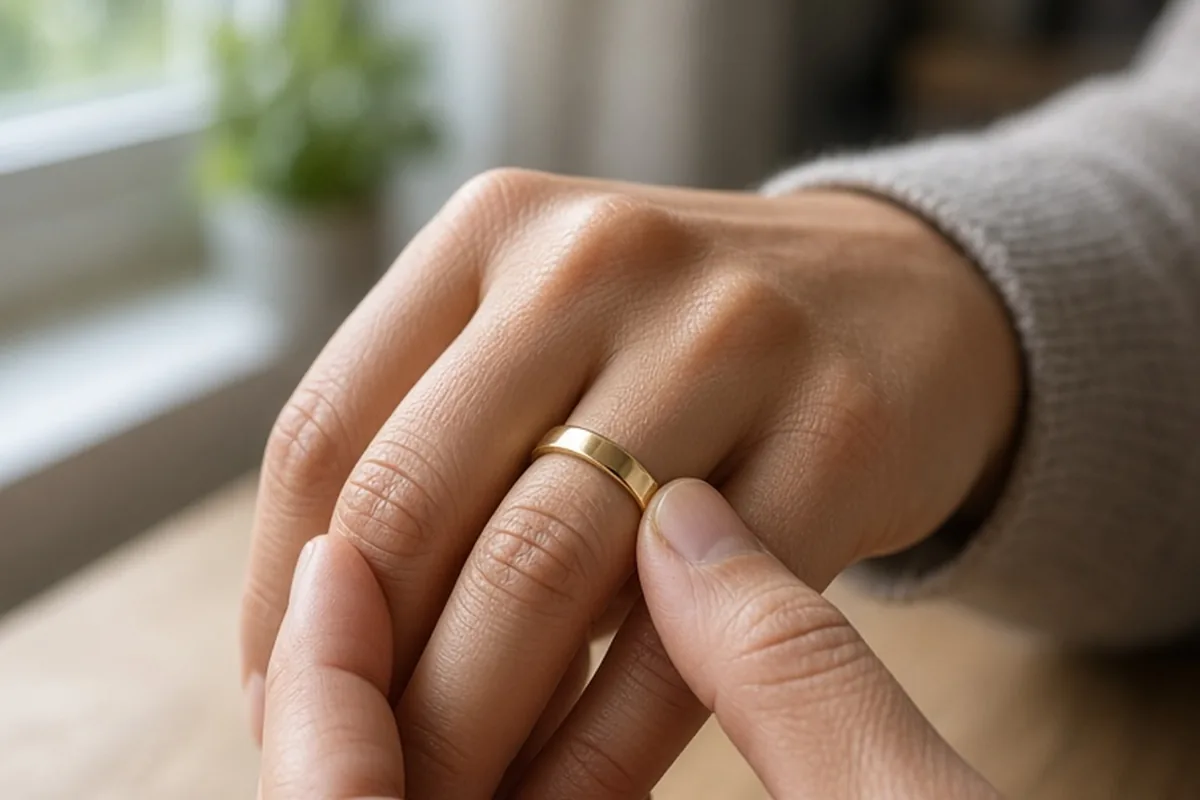
Ensuring the perfect fit for your wedding ring requires measuring your finger at room temperature when your hands are relaxed, accounting for band width, and choosing the right interior profile. A properly fitted band should glide over your knuckle with light friction and rest securely at the base of your finger without pinching skin, sliding off when your hand shakes downward, or causing throbbing pressure during normal daily movement.
A wedding ring is intended for daily, long-term wear, which means small sizing discrepancies that might go unnoticed on occasional jewelry can quickly cause discomfort or risk loss. Because your hands naturally fluctuate throughout the year, getting the fit right involves more than matching a simple number on a standard sizing stick.
Daily Fluctuations: How Temperature and Routine Impact Ring Size
Fingers are dynamic structures composed of bone, soft tissue, blood vessels, and fluid, meaning their circumference changes throughout any given day. Cold temperatures cause blood vessels near the skin surface to constrict, which reduces finger volume and makes rings feel noticeably looser. Conversely, warm environments, humidity, hot showers, and cardiovascular exercise cause blood vessels to dilate and soft tissue to retain slight fluid, making bands feel significantly tighter. Dietary factors, particularly elevated sodium consumption or alcohol intake, can also produce temporary fluid retention that noticeably affects ring tolerance.
To find a reliable baseline measurement, schedule sizing sessions when your body is at a neutral, rested baseline rather than immediately after a strenuous workout, a long walk in freezing air, or a direct flight. Late afternoon is generally considered the most dependable time of day for sizing because your hands have adapted to normal circulation and daily activity. If you notice substantial swelling during specific seasons, testing your fit across different days or temperatures provides a much safer estimate than relying on a single, five-minute measurement in a heavily air-conditioned retail space.
Standard Fit Versus Comfort Fit: Choosing the Interior Band Profile
The interior geometry of a wedding ring significantly influences how it slides across the knuckle and rests on the finger pad. A standard fit ring features a completely flat inner surface that sits flush against the skin across the entire width of the band. Standard fit designs provide maximum surface friction, which keeps the ring stationary, but the flat interior edge can create noticeable drag when crossing the joint of a prominent knuckle, sometimes pinching soft tissue when the hand makes a tight fist.
A comfort fit ring incorporates a domed, convex interior curvature, which means only the center point of the inner profile makes continuous, direct contact with the finger while the outer edges curve gently away from the skin. Because there is less surface contact and reduced drag over the knuckle, a comfort fit band generally glides on and off much more smoothly. Many wearers find that a comfort fit design requires a half-size smaller than their standard fit size to prevent the band from spinning loosely. When selecting your ring, always confirm whether the sizing rings used for measurement share the exact interior profile of your intended finished band.
Band Width and Thickness: Calculating Needed Size Offsets
The width of your wedding band directly alters how much surface area of your finger is covered, which fundamentally changes how tight the ring feels. A narrow band, such as one measuring two millimeters wide, displaces very little skin and encounters minimal friction, making it slide easily over the knuckle. In contrast, a wider band measuring six, eight, or ten millimeters covers a substantial portion of the lower phalanx, compressing more soft tissue and trapping more natural moisture beneath the metal.
Because wider bands cover more surface area, they almost always require an increase in ring size compared to a delicate, narrow band. A band that measures six millimeters or wider often requires moving up by a quarter size to a half size to achieve the exact same level of comfort as a two-millimeter ring. When trying on sample rings, ensure you test sizing gauges that match the specific millimeter width of your chosen design, as using a thin metal gauge to order an eight-millimeter band frequently results in a finished piece that feels uncomfortably tight.
Wedding Ring Metals and Their Resizing Constraints
Selecting your ring metal involves balancing aesthetic preference and durability with future adjustability. Traditional precious metals such as yellow gold, white gold, rose gold, and platinum are ductile and malleable, allowing experienced bench jewelers to resize them relatively easily throughout your lifetime. A jeweler can stretch, compress, or cut and solder additional metal into a gold or platinum band to accommodate life events, weight fluctuations, or joint changes. However, extensive resizing on rings with continuous channel-set diamonds or intricate hand-engraved patterns can distort the stone settings or disrupt the decorative motif.
In contrast, contemporary alternative metals present severe resizing constraints that require careful consideration before purchase. Tungsten carbide, titanium, ceramic, and cobalt chrome are exceptionally hard and resistant to scratching, but they cannot be altered through traditional cutting and soldering techniques. If your finger size changes in the future, an alternative metal band generally cannot be resized and must be exchanged or replaced entirely. If you opt for an alternative metal, verify the manufacturer warranty or retailer exchange policy regarding lifetime size replacements before finalizing your order.
Stacking Your Wedding Band with an Engagement Ring
Wearing a wedding band alongside an engagement ring changes the mechanics of how both pieces sit on the hand. When two or three rings are stacked together on a single finger, they behave like one wide band, covering more vertical space on the finger pad. This cumulative width displaces additional tissue and pushes the upper ring closer to the knuckle joint, which can make both rings feel noticeably tighter than when either piece is worn independently.
To ensure long-term comfort when creating a bridal stack, always test the fit of both rings together rather than evaluating the wedding band in isolation. Pay close attention to how the profile shapes interact; a straight wedding band placed next to a low-set engagement ring basket may create an awkward gap or force the band outward at an angle, increasing pressure against adjacent fingers. In some instances, selecting a contoured, notched, or curved wedding band allows the two rings to sit flush, distributing pressure evenly and maintaining a secure, comfortable fit without requiring an unnecessary size increase.
Evaluating Knuckle Prominence Versus Finger Base Diameter
Finger anatomy varies considerably from person to person, falling broadly into two distinct anatomical patterns: tapered fingers and prominent knuckles. Individuals with tapered fingers have knuckles that are narrower than or equal in width to the base of the finger, meaning rings slide on effortlessly but can slip off just as easily if the band is even slightly loose. For tapered fingers, a snug fit at the base is essential to prevent the ring from sliding off when washing hands or shaking hands downward.
For individuals with prominent knuckles, the joint is significantly wider than the fleshy base where the ring ultimately rests. Sizing a ring for a prominent knuckle requires finding a precise balance: the band must be large enough to clear the joint with reasonable effort, yet not so loose that it spins continuously or tilts uncomfortably once seated at the base. In cases where the difference between the knuckle and the finger base is substantial, jewelers can install discreet internal sizing beads, a spring insert, or a horseshoe-shaped bridge inside the band. These mechanisms allow the ring to clear the wider knuckle while gently gripping the narrower base to prevent rotation.
Accurate Sizing Methods Versus Common At-Home Measurement Errors
The most reliable way to determine ring size is through an in-person fitting with a professional jeweler using calibrated metal sizing bands that match your intended width and profile. Jewelers use standardized, machined metal rings that accurately replicate the weight, edge profile, and friction of a finished piece of jewelry. A professional can also assess your knuckle structure, note local weather conditions, and provide immediate feedback on whether a specific resistance level represents a secure fit.
Conversely, common at-home measurement techniques—such as wrapping string, thread, or printable paper strips around the finger—carry significant margins of error. String and paper bend easily, stretch under light tension, and fail to simulate how a rigid, three-dimensional metal band traverses the knuckle joint. Flexible plastic zip-tie sizers offer slightly better accuracy than paper, but they still lack the structural rigidity, weight, and edge thickness of precious metal. If visiting a brick-and-mortar jeweler is not possible, request a set of rigid plastic or metal sizing gauges directly from your jeweler rather than relying on printable templates.
Recognizing When Your Ring Fits Properly Versus Needing an Adjustment
A properly fitted wedding ring should feel virtually unnoticeable during routine activities while remaining completely secure under normal physical movement. When putting the ring on, it should glide over the knuckle with modest resistance; when removing the ring, you should need to apply deliberate, gentle pressure to work it back over the joint, taking roughly one to two seconds. The band should not cause a visible indentation that turns skin pale, nor should it create a sensation of throbbing pressure when your hand is at rest.
Clear signs that a ring is too tight include constant redness, irritation beneath the band, difficulty curling your fingers into a fist, or skin noticeably bulging over the metal edges. Warning signs that a ring is too loose include the band spinning continuously under its own weight, the ring sliding past the knuckle when you shake your relaxed hand downward over a soft surface, or the ring pulling off effortlessly without any manual manipulation at the joint. If you experience these signs consistently across several days of normal wear, consult your jeweler to explore a minor size adjustment or internal sizing aid.
Frequently asked questions
How should a wedding ring feel when taking it off?
A wedding ring should come off with deliberate, gentle effort rather than sliding off instantly. You should feel slight friction as the metal passes back over the knuckle joint, requiring you to wiggle or pull the band intentionally for one to two seconds without causing pain.
Can all wedding rings be resized if my finger size changes?
Traditional precious metals like gold and platinum can usually be resized up or down by a bench jeweler. Contemporary alternative metals such as tungsten, titanium, and ceramic cannot be cut or soldered, meaning they must be replaced entirely if your size changes.
Why does my wedding ring feel tighter in the summer than in the winter?
Warm weather, humidity, and increased physical activity cause blood vessels to dilate and soft tissue to retain slight fluid, which increases finger volume. Cold winter air constricts blood vessels and reduces finger circumference, making the exact same ring feel looser.
Should I order a different size for a wide wedding band?
Yes, bands measuring six millimeters or wider cover more surface area on the finger, creating greater friction and tissue compression. Most individuals need to increase their standard ring size by a quarter to a half size when purchasing a wide band.
Your next step
Schedule an in-person fitting with a professional jeweler late in the afternoon to test calibrated metal sizing rings that match the exact width and comfort profile of your chosen wedding band design.