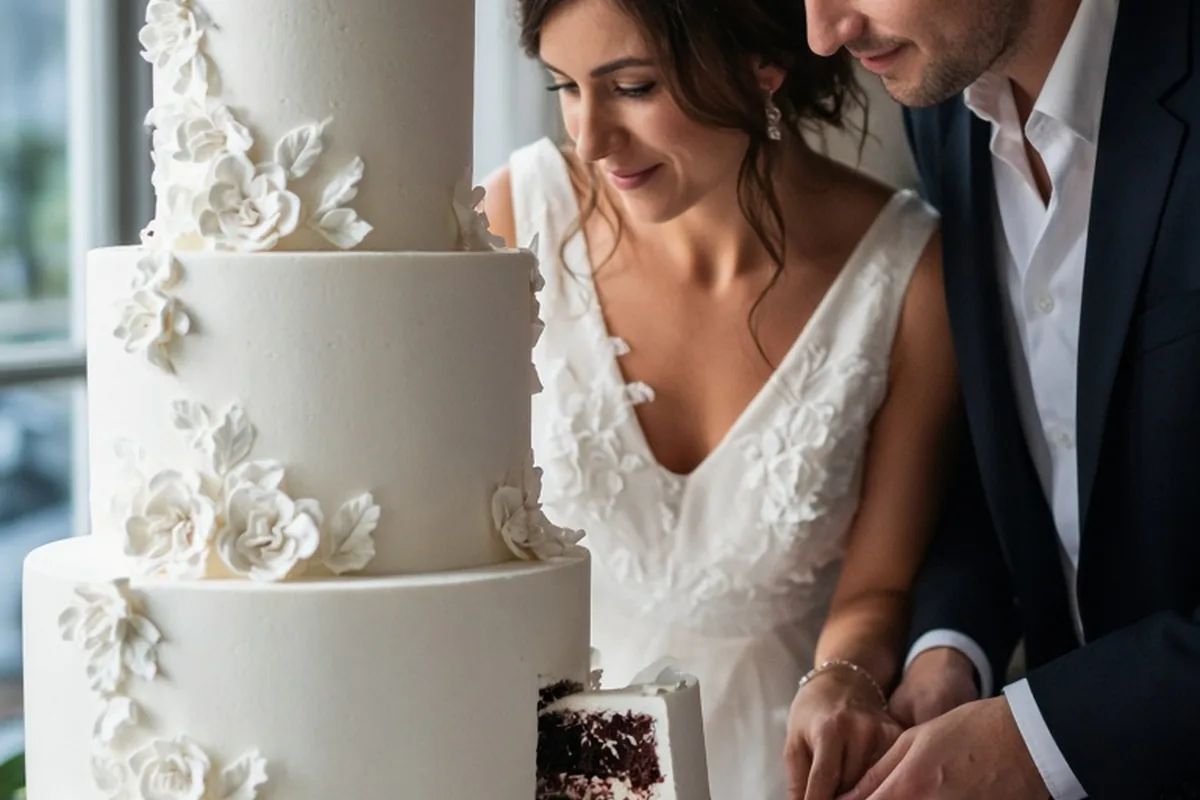
A fake wedding cake for 200 guests uses decorated polystyrene foam tiers to create the visual centerpiece, while a small, hidden edible wedge allows the couple to perform the traditional cake cutting. The remaining 200 servings come from unadorned kitchen sheet cakes sliced and plated behind the scenes. This setup delivers the aesthetic presence of a towering multi-tier cake while lowering decorating labor, simplifying banquet service, and eliminating the structural collapse risks of large tiered sponge cakes.
Planning dessert for a 200-guest reception requires balancing visual presentation, banquet logistics, and budget allocations. A faux display cake combined with behind-the-scenes sheet cakes offers a practical alternative to a fully edible multi-tiered centerpiece without sacrificing the symbolic cutting moment.
Engineering the Hidden Edible Slice Slot
The core mechanism of a faux cutting cake is an engineered hollow section built into one of the lower foam tiers. To create this, the cake artist carves out a clean wedge from the back of an expanded polystyrene (EPS) dummy tier. This cavity is lined with food-grade plastic wrap, wax paper, or a custom food-safe insert to ensure raw styrofoam particles never touch the edible cake. A fresh, fully frosted wedge of real cake matching the exterior frosting color and style is then inserted into this cavity just prior to reception delivery or during on-site venue setup.
The secret slice must be carefully positioned and marked so the couple and the banquet coordinator know exactly where to make the ceremonial cut. Professional decorators often use a discreet visual marker, such as an edible pearl, a small decorative piping dot, a discrete sugar petal, or a hidden ribbon tag at the base of the designated tier. The cake is oriented on the display table so that this marked section faces directly away from the guests and the photographer's primary camera angle. When the couple steps up to cut the cake, they slice into the marked edible insert, lift out a clean piece, and feed each other without disturbing the exterior structural stability of the surrounding faux tiers.
Sizing Display Tiers for 200-Person Reception Ballrooms
A reception space accommodating 200 guests is typically a large ballroom, barn, or outdoor marquee with expansive square footage and elevated ceilings. In a room of this scale, a modest two-tier edible cake can easily look diminutive and get lost in wide-angle photos. A faux display cake allows you to scale the height and presence of the dessert table to fit the venue architecture without the high structural engineering costs or food waste of a massive edible tower.
For a 200-guest setting, a 4-tier or 5-tier dummy cake setup creates an imposing, elegant silhouette. Common tier diameters include a 14-inch base, followed by 12-inch, 10-inch, 8-inch, and 6-inch foam rounds. Because dummy tiers carry negligible weight compared to dense sponge, buttercream, and filling, they can be stacked higher with standard internal center dowels and displayed on ornate pedestals without fear of sagging, leaning, or tilting under venue lighting. Adding a 4-inch to 6-inch decorative cake riser or floral base elevates the cake further into the natural sightline of the ballroom entrance.
Coordinating Sheet Cake Ratios and Kitchen Timing for 200 Servings
While the dummy cake sits in the spotlight on the dance floor, the actual dessert distributed to your 200 guests is pre-baked, frosted, and stored in the venue kitchen. Standard commercial sheet cakes are baked in half-sheet and full-sheet aluminum pans. A standard commercial half-sheet cake (typically 12 by 18 inches) yields roughly 36 to 54 standard banquet portions, depending on whether slices are cut to 1x2-inch or 2x2-inch event standards. A commercial full-sheet cake (typically 18 by 24 inches) comfortably yields 72 to 108 banquet servings. For a 200-guest headcount, banquet managers generally order two full sheet cakes or four half-sheet cakes to ensure a minimum of 200 to 220 total portions, allowing a slight margin for vendor meals and seconds.
The primary service advantage of sheet cakes is kitchen efficiency. With a conventional 5-tier edible cake, the banquet staff must wait until the couple finishes their ceremonial cut, carefully carry the heavy tiers back into the prep kitchen, deconstruct the internal support dowels, scrape away structural cardboard separators, and portion the round tiers slice by slice. This process can cause significant delays during dessert service. With kitchen sheet cakes, catering staff can pre-score, portion, and plate the sheet cakes onto dessert dishes twenty minutes before the ceremonial cake cutting. The moment the couple finishes their photo opportunity, banquet staff can immediately roll out pre-plated trays to guest tables, completing dessert distribution across all 200 guests in minutes.
Decorating Mediums, Materials, and Rental Options
Dummy wedding cakes can be decorated using either fondant or non-perishable royal icing. Rolled fondant provides an ultra-smooth, porcelain-like exterior that adheres well to pre-misted foam dummies. Fondant-covered dummy cakes can be crafted weeks or months in advance, making them resilient to last-minute bakery production schedules. If you prefer the textured look of buttercream, decorators often use an artificial decorating paste or an ultra-stable mock icing that cures hard to the touch, ensuring the finish will not melt under banquet spotlights or outdoor summer humidity.
Couples have two main acquisition avenues for faux display cakes: purchasing a custom-designed keepsake dummy or renting a pre-fabricated stock display. Specialized event rental companies and independent bakeries maintain inventories of elaborate, pre-decorated dummy cakes in classic styles, such as white textured stenciling, faux marbling, or cascade floral mounts. Renting a pre-made display tier set significantly lowers your initial investment, but you must ensure the rental contract permits cutting into the designated slice insert or verify whether the rental company supplies a removable insert tray. If purchasing a custom dummy cake from your pastry chef, you can match your wedding color palette, monogramming, and sugar floral design precisely to your vision, with the added benefit of keeping the top tier or floral elements as a memento.
Navigating Venue Cutting Fees and Total Cost Variables
A common misconception is that serving sheet cakes alongside a dummy cake completely eliminates wedding cake service fees. In reality, total dessert expenses consist of three distinct categories: the display cake design or rental, the price per serving for the kitchen sheet cakes, and the venue or caterer's mandatory cake-cutting and plating fee. Even though catering staff do not have to carve down a complex tiered structure, they still supply dessert plates, flatware, napkins, and labor to plate, garnish, and clear dessert items from 200 place settings.
When gathering quotes, ask both your bakery and your venue coordinator for a transparent itemized breakdown. Ask the pastry chef for the flat construction fee of the faux display cake, the price per slice of the sheet cakes, and whether delivery and setup of the display are billed separately. Simultaneously, review your catering agreement for per-person cake-cutting charges. Some venues charge the exact same per-plate fee regardless of whether the cake is a tier-stacked structure or a kitchen sheet, while others offer a reduced plating fee for pre-sheeted pastries. Clarifying these terms before signing guarantees accurate budget forecasting for your 200-person event.
Baker and Banquet Staff Logistics on the Wedding Day
Flawless execution of a faux cake cutting depends on clear operational alignment between your bakery delivery team and the venue's banquet captain. Because the display cake contains an edible segment, it cannot sit unrefrigerated in direct sunlight or extreme ambient heat for prolonged hours if the edible slice contains perishable dairy-based fillings such as mascarpone, fresh mousse, or fruit curds. If the venue lacks walk-in refrigeration space tall enough for a 4-tier display, the baker will typically insert the real slice on-site shortly before guest arrival, or deliver the edible slice in a separate chilled container for the catering captain to insert during room turnover.
Establish an explicit division of responsibilities on your vendor timeline. The timeline should note who is responsible for placing the cutting knife and server at the display table, who verifies the orientation of the secret slice marker, and at what exact minute the kitchen staff should begin plating the 200 sheet cake slices. Providing your banquet lead and wedding planner with a physical diagram showing the location of the hidden edible wedge prevents embarrassing moments where the couple accidentally attempts to cut into solid polystyrene foam during live photography.
Taste Variety and Dietary Accommodations for Large Guest Lists
One significant advantage of decoupling your visual display from your edible servings is the freedom to offer multiple cake flavors and satisfy dietary restrictions. When ordering a standard tiered cake, bakeries often restrict flavor selections to one or two options due to internal structural balance and baking complexity. With sheet cakes, you can easily order two or three different flavor combinations—such as classic vanilla bean with raspberry compote, rich dark chocolate fudge, and spiced carrot cake—allowing your catering staff to offer guests a choice during table service.
Furthermore, managing allergy protocols is far simpler when using kitchen sheet cakes. Bakeries can prepare separate, sealed 8-inch gluten-free, dairy-free, or vegan cakes or individual boxed portions prepared in an allergen-controlled environment. These specialty portions remain safely in the kitchen away from cross-contamination at the main dessert station and can be delivered directly to specific table numbers corresponding to guests with severe dietary needs. This ensures your entire 200-person gathering enjoys a fresh, safe dessert experience while maintaining a cohesive presentation in the ballroom.
Illustrative Scenarios
Coordinating Faux Tier Logistics in a Large Ballroom
A couple planning a 200-guest ballroom reception wanted the visual grandeur of a five-tier piped design but faced a strict venue timeline that allotted only twenty minutes for dessert service. They commissioned a 5-tier faux display cake with a pre-cut back cavity for the ceremonial cut, paired with four half-sheet cakes in alternating lemon curd and chocolate hazelnut flavors held in the banquet kitchen. The pastry chef delivered the faux display during morning setup and marked the rear slice compartment with a tiny sugar dot. During the reception, the couple completed their photo cut immediately following dinner speeches; simultaneously, the banquet team emerged from the prep kitchen with 200 pre-plated sheet slices garnished with fresh berries.
Key point: Pre-cutting and plating kitchen sheet cakes while using a marked display cake allows large receptions to achieve formal multi-tier aesthetics without causing dessert service bottlenecks.
Frequently asked questions
How do we make sure we do not cut into the foam during our photos?
Your baker will line the edible cavity and mark its exact location with a subtle decorative indicator, such as a colored pearl, piped bead, or ribbon pin at the back base. The cake table should be set up so this marker faces away from the audience, allowing the couple and photographer to see the target clearly before the knife touches the cake.
Can guests tell the difference between sheet cake and tiered cake?
No. When sheet cakes are prepared by the same professional bakery using identical recipes, sponges, fillings, and buttercreams, the plated dessert looks and tastes identical to a slice taken from an edible tiered cake. Guests receive neat, professionally cut rectangular banquet portions on formal china.
What happens to the fake wedding cake after the reception ends?
If you rented the display cake, the rental company or venue coordinator will box it up at the end of the evening for return. If you purchased a custom dummy cake, you can dispose of the foam base, save sugar flowers as keepsakes, or retain the entire decorated display for future anniversary celebrations since dummy cakes do not spoil if kept dry and clean.
Your next step
Request itemized quotes from your baker for both a 4-to-5 tier dummy cake with a cutting slot and 200 servings of kitchen sheet cakes, then check your venue catering contract for sheet cake plating fees.