Planning wedding food and drinks involves selecting a service style that matches your budget and timeline, calculating appropriate beverage quantities, and managing dietary requirements. Start by deciding between plated dinners, buffets, food stations, or family-style service. Pair your food selections with an open bar, limited beer-and-wine package, or curated signature drinks. Finalize headcount estimates before your caterer's cutoff date, coordinate serving schedules with your venue, and confirm all staffing, corkage, and service charges in writing.
Reception dining is both a central hospitality gesture and one of the largest line items in a wedding budget. Balancing guest comfort, personal tastes, and kitchen logistics requires evaluating how food and beverage decisions influence the flow of the entire celebration.
Choosing the Right Wedding Catering Service Style
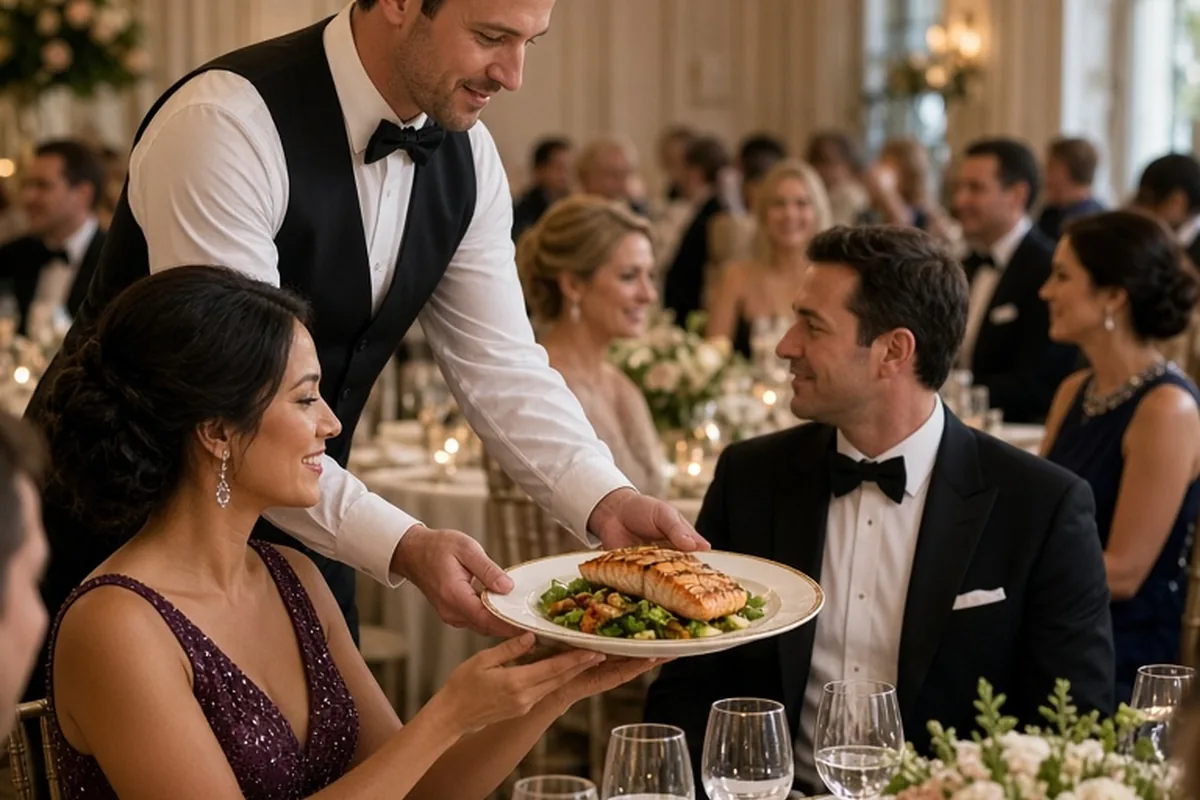
The catering format you select establishes the tone, schedule, and staffing requirements for your reception. A plated dinner is the most formal option, where servers deliver individual courses directly to seated guests. This format guarantees uniform portion control and ensures all tables eat at roughly the same time, making it easier to stick to an exact evening timeline. However, plated service demands higher staff-to-guest ratios and requires you to collect detailed meal selections from guests weeks before the event.
Buffets and food stations create a more casual, social environment and allow attendees to customize their portions. Buffets typically require fewer dedicated service staff than plated meals, though they require adequate floor space to prevent bottlenecking. Setting up dual-sided buffet lines or releasing tables sequentially helps keep lines moving smoothly. Interactive food stations, such as carving tables, pasta bars, or street taco displays, disperse foot traffic around the room and offer variety, though they can increase rental needs for specialized serving equipment.
Family-style service offers a middle ground by placing shared platters on each table for guests to pass among themselves. This encourages conversation and lets diners sample every dish without leaving their seats. The primary logistical challenge with family-style dining is tabletop real estate. Platters and serving utensils require significant surface area, meaning floral centerpieces, water goblets, wine glasses, and bread plates must be scaled down to keep the table functional.
Structuring the Bar: Open Bar, Limited Bar, and Signature Drinks
Bar service dictates a significant portion of both reception cost and guest experience. A full open bar offers an unrestricted selection of standard spirits, wine, and beer throughout the evening, billed either as a flat hourly rate per guest or based on actual bottles consumed. Flat-rate open bars provide budget predictability, whereas consumption-based bars can be economical if your guest list drinks moderately, though they carry the risk of an unexpected bill if consumption exceeds projections.
A limited bar, serving only beer, wine, and non-alcoholic options, substantially reduces beverage expenses while still providing ample hospitality. Couples often augment a limited bar by introducing one or two signature cocktails during cocktail hour. Signature drinks allow you to personalize the beverage menu while controlling liquor varieties and speeding up drink preparation through pre-batched recipes.
To avoid long queues at the bar, plan for at least one bartender per 75 to 100 guests for full bars, or one per 100 to 125 guests for simple beer-and-wine setups. Always ensure self-serve water stations are readily accessible from the moment guests arrive at the venue, and include appealing non-alcoholic beverages such as flavored sparklers, craft sodas, or mocktails for non-drinking guests, designated drivers, and children.
Accommodating Allergies, Dietary Needs, and Children's Meals
Managing dietary requirements is an essential component of modern event catering. Use your RSVP response cards or digital wedding website to capture specific allergies, dietary restrictions, and lifestyle preferences such as vegetarian, vegan, gluten-free, dairy-free, kosher, or halal diets. Provide this compiled list to your caterer at least three to four weeks before the event so the culinary team can prepare dedicated alternative dishes without last-minute scrambling on the day.
Cross-contact prevention is critical for guests with severe food allergies. Confirm that your caterer has a designated protocol for preparing allergy-safe plates separately from the main production line. For buffet and station formats, ensure each dish features clear descriptive signage listing common allergens like nuts, shellfish, soy, and dairy, and ask the caterer to provide dedicated serving tongs for every platter.
Children and on-site vendors require tailored meal arrangements. Many caterers offer discounted children's meals featuring familiar, simple items. Professional vendors who work throughout the event, including the photographer, videographer, DJ or band members, and wedding coordinator, should receive hot meals served at the same time as the couple so they can eat without missing key reception events.
Designing the Timeline from Cocktail Hour to Dessert
A cohesive reception timeline coordinates the kitchen's preparation schedule with your planned speeches, dances, and formalities. Cocktail hour typically lasts 60 to 75 minutes, bridging the gap between the ceremony and the seated reception. During this window, serve a combination of passed bite-sized appetizers and stationary grazing boards to keep guests satisfied while photography takes place, aiming for three to five distinct appetizer bites per person.
Once guests are seated, pacing determines the energy in the room. In a three-course plated meal, allow approximately 45 to 60 minutes for salad and entrée service. Scheduling welcome remarks or toasts between courses keeps guests entertained while the kitchen clears and plates subsequent courses. Avoid placing extensive speeches after the entrée when guests are ready to stand, mingle, or hit the dance floor.
Dessert timing usually marks the transition to open dancing. If you choose a traditional tiered cake cutting, schedule it shortly after dinner service concludes so the kitchen can slice and distribute the cake while other activities begin. Offering alternative dessert tables, such as mini pastries, donut walls, or an espresso cart, allows guests to grab dessert on their own schedule without disrupting dancing.
Estimating Quantities, Portion Sizes, and Late-Night Snacks
Accurate quantity forecasting prevents food shortages while curbing unnecessary catering waste. Caterers generally prepare a standard five to ten percent buffer over your final submitted headcount to account for unforeseen plate drops or minor guest additions. When selecting menu items, balance rich, heavy proteins with crisp, fresh vegetables and balanced starch sides to keep guests from feeling overly sluggish after dining.
Alcohol volume calculations typically assume each adult guest will consume roughly two drinks during the first hour and one drink per hour thereafter. For an average five-hour reception with 100 drinking adults, that totals approximately 600 drinks. A common purchasing distribution is 50 percent wine, 30 percent beer, and 20 percent spirits, though this should be adjusted based on the season, geographic location, and specific preferences of your crowd.
Late-night snacks have become a popular addition, served approximately 90 minutes to two hours before the reception ends. After hours of dancing and beverage consumption, guests appreciate hot, handheld, carb-forward items such as gourmet sliders, flatbread pizzas, street tacos, soft pretzels, or french fry cones. Keep late-night portions compact and easy to consume while standing or socializing.
Evaluating Catering Contracts, Gratuities, and Service Charges
Catering estimates often include multiple line items beyond the base per-person food and drink cost. When reviewing proposals, distinguish between the mandatory service charge, administrative fees, state sales tax, and staff gratuity. A service charge is commonly an operational fee retained by the catering company to cover logistics and overhead, whereas a gratuity is distributed directly to the kitchen and floor staff. Always verify in writing whether tips are included in the quoted service fee.
Equipment rentals can significantly alter the total catering quote if your venue does not supply standard kitchenware. Clarify whether your caterer provides basic flatware, china, glassware, cloth napkins, serving chafers, and kitchen prep tables, or if those must be sourced through an external rental company. Ask if cleanup, trash removal, and breakdown services are included in the hourly staffing quote.
Venues that allow outside alcohol often charge a corkage fee per bottle opened by their bartending staff, and caterers may charge a cake-cutting fee if you bring in a cake from an outside bakery. Review these specialty fees early during vendor comparisons so you can accurately assess the true bottom-line cost between all-inclusive venues and bring-your-own catering arrangements.
Frequently asked questions
When should we finalize the wedding menu and guest count with our caterer?
Menu tastings and selections usually occur four to six months before the wedding. Final headcounts and specific dietary requirements are typically due to the caterer 14 to 30 days before the event, depending on the contract terms.
How many appetizers should we plan for during cocktail hour?
For a standard one-hour cocktail hour preceding a full dinner, plan for four to six appetizer bites per guest across three to five varied recipes. If there is no dinner immediately following, increase this to 10 to 12 bites per person.
What is the recommended bartender-to-guest ratio for a wedding reception?
A reliable guideline is one bartender per 75 to 100 guests for a full liquor bar to prevent long waiting times. For simpler beer-and-wine bars, one bartender per 100 to 125 guests is generally sufficient.
How do vendor meals work for wedding photographers, planners, and musicians?
Vendors working through the reception should be included in your catering headcount. Ask your caterer for discounted vendor meals, which are often the same hot entrée served to guests, timed alongside the main dinner service.
Your next step
Schedule an initial menu tasting once your estimated guest range is established, and request an itemized proposal detailing all staffing ratios, rentals, corkage policies, and service charges before signing.