Heartfelt wedding vows that embrace children blend romantic devotion with supportive family promises, reassuring children of their security without replacing biological parents or demanding emotional reciprocity. Couples can speak vows directly to their stepchildren, make joint family commitments, or read a personal letter privately. The strongest vows focus on steady guidance, unconditional acceptance, and building a welcoming home together, using concrete, age-appropriate language tailored to the child's comfort level.
A wedding that brings together a blended family represents more than the union of two individuals; it establishes a new emotional foundation for an entire household. When planning a ceremony that involves sons or daughters, tailoring your promises to honor their presence creates a shared moment of stability and warmth that they will remember for years to come.
Deciding Between Public Promises and Private Moments for Stepchildren
Before drafting a single line of your vows, talk directly with the children involved about how visible they want to be on the wedding day. While adults often view a public vow at the altar as a moving tribute, a child or teenager may perceive standing in front of dozens or hundreds of onlookers as intensely stressful. Inviting their input gives them autonomy during a transition where they may otherwise feel like passive observers.
Offer clear, low-pressure choices based on their temperament. An extroverted nine-year-old might love standing next to you to receive a special family medallion, while a reserved thirteen-year-old might feel exposed having personal sentiments read aloud in front of peers and extended family. If a child expresses hesitation, honor that boundary immediately. A heartfelt, handwritten letter tucked into their pocket before the ceremony or an intimate conversation during morning preparations carries just as much emotional weight as an altar reading, while safeguarding their peace of mind.
Speaking Directly to Stepchildren: Sample Vow Wording and Commitments
Addressing a stepchild directly requires language grounded in companionship, reliability, and respect. It is vital to avoid promises that sound like a claim of ownership or an attempt to replace an existing parent. Instead, emphasize consistency, active listening, and a commitment to creating an encouraging home environment where they can always be themselves.
Consider this vow written from a stepparent to an elementary-age stepchild: 'From the moment I met your parent, my world expanded, but getting to know you has been one of the greatest joys of my life. I do not stand here to take the place of your mom or dad, but to promise you my own steadfast support. I promise to cheer you on at your games, to listen whenever you want to talk, and to stand by you whenever you need a hand. I promise to love you, respect you, and always keep our home a place where you feel safe, heard, and valued.'
For an older child or teenager, the tone should reflect maturity and partnership rather than parental authority: 'I know that blending our lives is an ongoing journey that requires patience, honesty, and mutual respect. I promise to always honor your boundaries, give you space to grow into the person you want to be, and offer you steady guidance whenever you ask for it. You will never have to earn my care or my loyalty; they are yours freely, every single day.'
Joint Family Vows Spoken by the Couple Together
In many blended households, both partners want to speak with one united voice to the children. Joint family vows demonstrate that the marriage provides a stable foundation from which both adults will nurture the household together. This approach shifts the dynamic away from an individual audition for affection and centers the ceremony on a shared family standard.
To perform joint vows, the couple can alternate lines or recite sentences in unison, addressing the children by name as they stand together. A practical example: 'Together, we promise to build a home filled with laughter, patience, and understanding. We promise to listen to your ideas, support your dreams, and navigate challenges as a team. We promise to love one another in ways that make you feel secure, and to always remind you that this family is stronger, brighter, and more complete because you are part of it.'
Adapting Vow Language for Toddlers, Tweens, and Older Adolescents
A child's developmental stage shapes how they process emotional pledges. Vows intended for a four-year-old should be short, sensory, and rooted in their daily reality. Abstract concepts like lifelong fidelity or emotional security mean little to a toddler, but promises about bedtime routines, outdoor games, and unconditional care make immediate sense. For example: 'I promise to read you bedtime stories, build tall block towers with you, and give you a warm hug whenever you are feeling tired or sad.'
Tweens, typically aged nine to twelve, are beginning to form distinct social identities and often look for validation of their unique interests. Promises directed at this age group benefit from mentioning specific passions or quirks: 'I promise to support your art projects, learn the rules of your favorite video games, and always take your opinions seriously when we make plans as a family.'
Adolescents and young adults often experience blended family dynamics with complex loyalty considerations. They need reassurance that their independence is valued and that your presence in their home does not mean unexpected policing or forced intimacy. A meaningful vow for an older adolescent prioritizes reliable mentorship: 'I promise to be an adult in your life you can always call on without judgment, to celebrate your independence as you step into the world, and to remain a reliable source of support wherever your life takes you.'
Navigating Co-Parenting Boundaries and Sensitive Family Dynamics
Blended family ceremonies do not occur in an emotional vacuum. Children often experience split loyalties, fearing that showing warmth toward a stepparent betrays their biological mother or father who is not standing at the altar. Thoughtful vow wording consciously alleviates this burden rather than intensifying it.
Steer clear of phrases like 'now we are finally a complete family' or 'I will love you just as if you were my own child,' which can unintentionally dismiss the child's other parent or minimize their pre-existing family identity. Instead, frame your role as an addition of care, not a replacement of biological ties. Explicitly clarifying that your role is a new, unique relationship allows the child to embrace your support without feeling like they are compromising their devotion to their other parent.
Symbolic Rituals and Low-Pressure Ceremony Alternatives
Words are not the only way to embrace children during a ceremony, and for many young people, participating in a visual action feels far less intimidating than standing under the spotlight for spoken vows. Including a tactile ritual gives the child a tangible reminder of the day without requiring them to speak or respond emotionally on cue.
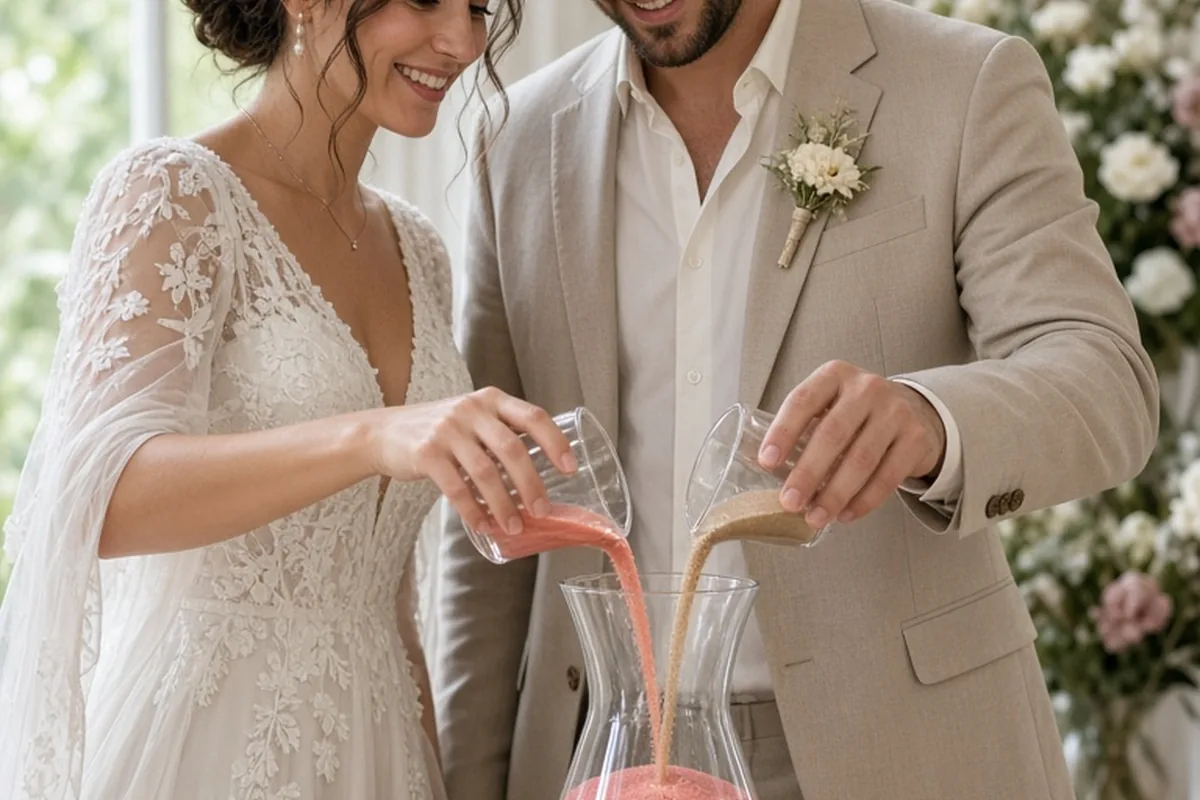
One common option is the family sand-blending ceremony, where each family member pours a distinct color of sand into a central glass vessel, illustrating that while each person retains their individual identity, they are united in a common life. Another option is presenting the child with an engraved necklace, ring, or pocket watch immediately following the exchange of rings between spouses. If the child prefers to stay seated in the front row, the couple can briefly step down together to hand them the token and say a quick, unamplified 'thank you for sharing this day with us,' keeping the moment gentle and private.
Structuring the Ceremony Flow to Keep the Romantic Union Central
A successful blended ceremony thoughtfully balances the romantic commitment between spouses with the collective commitment to the family. If the vows to the children overwhelm the ceremony, the central purpose of the wedding—the marriage between the two partners—can feel overshadowed. Conversely, ignoring the children can leave them feeling disconnected from the milestone.
The most effective structure usually follows a three-part progression. Begin with the traditional vows and ring exchange between the couple, formalizing their partnership first. Next, transition into the family vows or ritual as a natural extension of that new marriage, demonstrating how their spousal commitment overflows into their parenting. Finally, conclude with the pronouncement and the celebratory exit. This sequence clarifies that the adult union is the sturdy foundation upon which the family will thrive.
Frequently asked questions
Should children be asked to recite vows back to the adults during the ceremony?
It is generally best not to ask children to make spoken vows of their own at the altar. Asking a child to make formal commitments in front of an audience can create unnecessary pressure, anxiety, or guilt. Keeping the promises one-directional—from the adults to the children—demonstrates that providing love, safety, and stability is entirely the responsibility of the parents.
What if a child gets emotional or refuses to participate on the wedding day?
Have a calm backup plan ready with the officiant and wedding coordinator before the ceremony begins. If a child becomes overwhelmed, allow them to sit quietly in the front row with a supportive relative without making a scene or forcing them to the altar. Never scold or cajole a hesitant child into public participation; respecting their emotions in that moment will build far more trust than forcing a photo opportunity.
Can I include stepchildren in my vows if their other parent is attending the wedding?
Yes, but keeping the wording respectful of the existing co-parenting relationship is especially crucial in this setting. Focus on your unique role as an additional supporter, guide, and friend rather than using terminology that suggests parenting rights or replacement. A warm, collaborative tone honors everyone present and keeps the focus where it belongs: on the child's well-being.
Your next step
Sit down with your partner and each child individually this week to ask how they would prefer to be recognized on the wedding day, giving them full permission to choose between a public vow, a physical token, or a quiet private letter.