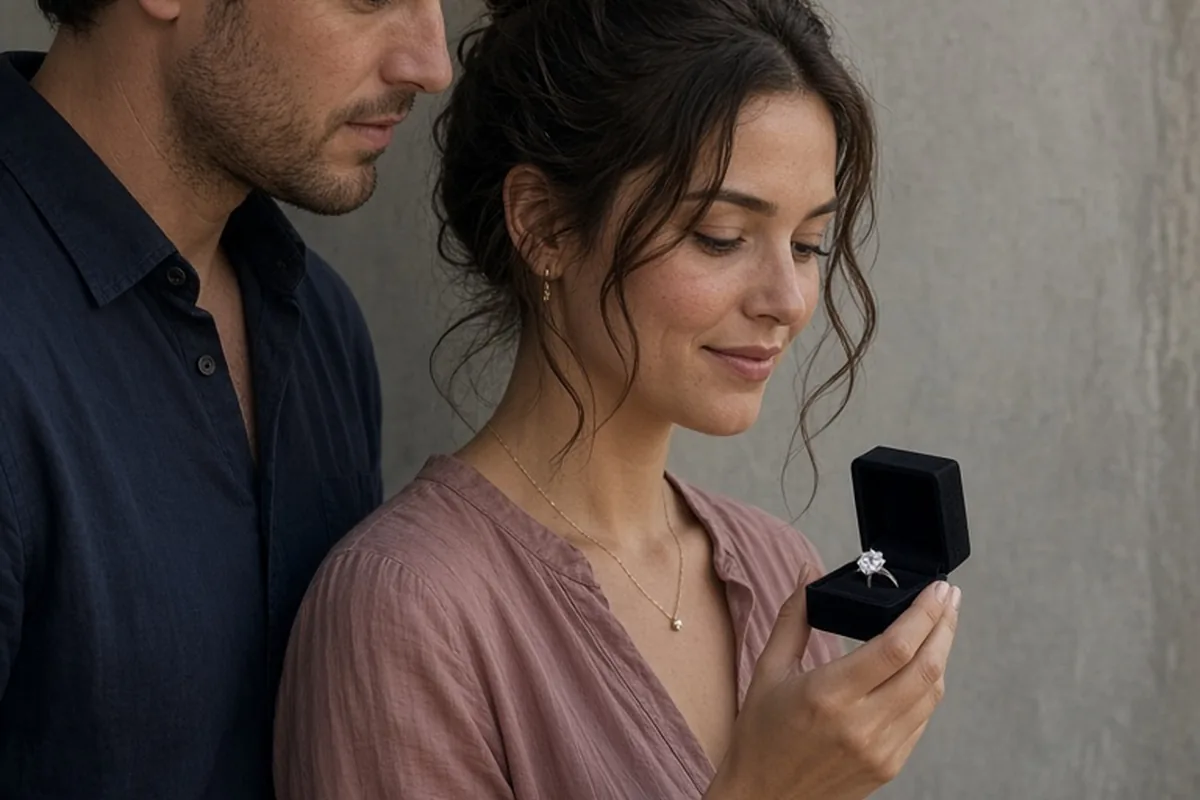
Moissanite engagement ring costs depend on the diamond equivalent size of the center stone, the optical color grade, the chosen setting metal, and whether the crystal comes from a branded gemstone manufacturer. Because silicon carbide crystals are grown in controlled laboratories rather than extracted from mines, final retail prices reflect precision cutting labor and metal fabrication rather than natural geological scarcity. Buyers must request itemized quotes comparing millimeter dimensions, metal purities, and setting complexity to establish an accurate final price.
Choosing an engagement ring involves weighing aesthetic preferences, physical durability, and household financial priorities, which leads many shoppers to evaluate modern lab-created gemstones alongside traditional mined options.
How Millimeter Measurements and Diamond Equivalent Weight Determine Gemstone Pricing
Evaluating the cost of a moissanite center stone requires looking beyond conventional carat weight measurements. Carat is strictly a unit of mass rather than physical dimension, and silicon carbide has a lower specific gravity than natural diamond. A moissanite stone cut to the exact physical dimensions of a standard one-carat diamond weighs measurably less on a jeweler scale, even though the two gems occupy the exact same visual footprint in a ring mount. Reputable jewelers address this discrepancy by pricing and labeling moissanite using either millimeter dimensions or diamond equivalent weight, often abbreviated as DEW. Pricing steps do not follow a linear path; as millimeter dimensions increase, the raw crystal yield required from the laboratory crystal boule expands, demanding longer synthesis cycles and higher cutting precision that increase the stone cost progressively.
When browsing loose stones or complete rings, selecting by millimeter dimensions ensures that you pay for visible face-up size rather than an arbitrary mass measurement. Common cuts like round brilliant, oval, emerald, cushion, and pear all carry distinct surface area proportions that alter pricing brackets. A round shape generally requires standardized cutting angles that maximize light dispersion, while elongated shapes such as marquise or pear cuts require specialized rough crystal material and customized faceting to prevent dark centers or excessive light extinction. The overall cost jump between modest millimeter increments can be substantial, meaning buyers who choose slightly smaller face-up dimensions often free up considerable room in their total ring budget for upgraded metal bands or handcrafted prongs.
The Impact of Color Grading and Optical Clarity on Moissanite Rings
Optical grading standards significantly shift the baseline price of a moissanite gem. While moissanite does not develop the dark carbon or mineral inclusions common in mined diamonds, the synthesis of silicon carbide can occasionally produce faint structural graining or microscopic needle-like formations during crystal lattice development. Top-tier stones are visually clean under high magnification, falling into clarity brackets comparable to flawless or near-flawless grades. Crystals that exhibit visible internal graining or surface irregularities are discarded or discounted heavily, making eye-clean clarity a standard expectation for premium center stones.
Color grading creates the most noticeable price differentiation among otherwise identical moissanite stones. Manufacturers categorize stones into colorless and near-colorless classifications, mirroring conventional jewelry scales. Colorless gems show no detectable tint under varied natural and artificial lighting conditions, commanding the highest market tier because synthesizing pure silicon carbide crystals without faint yellow, gray, or greenish undertones requires tightly calibrated environmental controls. Near-colorless tiers exhibit subtle warm or silvery undertones, especially in larger millimeter sizes or under overcast natural lighting. Choosing a near-colorless grade provides a practical way to lower the overall center stone cost, particularly when mounting the stone into warmer precious metals like yellow gold or rose gold where faint tinting blends harmoniously.
Setting Architecture and Precious Metal Selection as Core Cost Drivers
In many finished moissanite engagement rings, the metal mount accounts for a larger share of the total retail bill than the center gem itself. The choice of alloy directly dictates both base raw material charges and bench jeweler labor rates. Platinum sits at the top of the price ladder due to its density, natural hypoallergenic composition, and the demanding bench temperatures required to cast and polish it. Gold settings offer varied price points based on purity: eighteen-karat gold contains a higher proportion of pure precious metal by weight than fourteen-karat gold, resulting in a higher baseline material price. Ten-karat gold offers an even more economical alternative, though some wearers experience skin sensitivities due to its higher base-metal alloy content.
The physical complexity of the setting architecture also changes the final quote. A minimalist four-prong or six-prong solitaire requires relatively little raw metal and straightforward assembly labor, representing the most economical mounting approach. Conversely, complex settings that feature micro-pavé halos, hidden accent collars, hand-carved filigree, or split-shank bands require substantial additional workbench hours. Setting dozens of tiny accent gems demands precision labor, and buyers must decide whether those side stones are moissanite or lab-grown diamonds. Choosing accent stones that match the color grade and light refraction of the center stone ensures visual continuity, but each individual prong, bezel, and micro-seat cut into the metal adds directly to the jeweler fabrication fee.
Proprietary Brand Marques Versus Unbranded Silicon Carbide Crystals
The commercial landscape for moissanite includes established, heavily marketed brands alongside emerging independent crystal growers, and this distinction accounts for wide variations in retail prices. Historically, a single corporate patent holder dominated the production of gem-quality synthetic silicon carbide, maintaining premium brand pricing and proprietary certification programs. Following the expiration of initial production patents, manufacturing expanded across global specialized crystal laboratories. Today, prospective buyers encounter both branded stones carrying proprietary trademarks, laser-inscribed girdles, and manufacturer warranties, as well as unbranded raw gems sourced directly from international crystal producers.
Paying a premium for an established brand name often buys quality assurance standards, verified cut symmetry, and comprehensive corporate replacement guarantees against optical clouding or accidental chipping. However, unbranded moissanite cut by experienced independent lapidaries can achieve equivalent visual performance, fire, and durability at a notably lower baseline price. The core trade-off centers on verification and risk tolerance. When purchasing unbranded stones, buyers must rely on the independent jeweler inspection, detailed high-definition video evaluation, or third-party gemological reports rather than relying on a widely recognized commercial brand badge.
Custom CAD Design, Casting, and Bench Jeweler Labor Charges
Off-the-shelf production settings produced through mass-market molds cost significantly less than bespoke jewelry created from scratch. When commissioning a custom moissanite ring, the billing structure introduces separate professional service fees that do not apply to ready-to-wear inventory. The design phase typically begins with computer-aided design (CAD) modeling, where a jewelry designer drafts the three-dimensional geometry of the ring to accommodate the exact millimeter dimensions of the chosen center stone. This process requires technical expertise to ensure proper structural integrity, prong thickness, and balanced proportions, translating to an initial design and rendering fee.
Once digital designs are approved, the production shifts to high-resolution three-dimensional wax printing, investment casting, metal cleanup, stone setting, and final hand polishing. Each bench hour spent filing casting sprues, hand-aligning prongs, and checking stone security contributes directly to the total cost. If you request intricate detailing—such as milgrain borders, hand engraving on the band interior, or non-standard prong configurations like claw or compass orientations—the artisan labor increases accordingly. Understanding whether a jeweler handles casting and setting in-house or outsources fabrication to external trade shops helps clarify why labor fees fluctuate widely across different retail studios.
Post-Purchase Realities: Insurance Appraisals, Resizing, and Care Policies
Calculating the true investment in an engagement ring requires accounting for post-purchase expenses that arise throughout the ring's lifespan. Insurance coverage represents an ongoing consideration; insurers typically calculate annual premiums based on the full appraised replacement value of the finished ring. Independent jewelry appraisals detail the metal weight, alloy purity, and gemstone specifications, serving as the baseline documentation should the ring ever require replacement after theft or loss. Because moissanite carries a lower replacement value than rare natural minerals, annual insurance premiums are generally modest, but obtaining the initial certified appraisal still incurs an upfront professional fee.
Maintenance and sizing constraints can also impact lifetime expenses. Moissanite is an exceptionally hard mineral, ranking just below diamond on the Mohs hardness scale, which provides excellent resistance to daily abrasion and surface scratching. However, moissanite exhibits sensitive thermal properties under high direct heat. If a ring requires sizing up or down in the future, bench jewelers must either unseat the center stone entirely or employ precision laser welders rather than open blowtorches to prevent damaging the crystal lattice. Not all neighborhood repair shops possess laser welding equipment or willingness to work on synthetic silicon carbide, which can lead to higher specialized bench fees for routine ring adjustments or claw re-tipping.
How to Secure an Itemized Quote and Evaluate Merchant Return Terms
Navigating the retail market effectively requires asking potential vendors for fully transparent, itemized quotes rather than accepting a single consolidated lump-sum figure. Request a written breakdown that isolates the raw gemstone price, the mount metal cost based on purity and weight, individual accent stone charges, and bench labor fees. Separating these line items allows you to compare competing retailers accurately and assess whether a higher price reflects better metal casting quality or merely an elevated retail markup on the stone.
Carefully review merchant return policies, trial periods, and long-term service agreements before making a financial commitment. Reputable online and physical jewelers usually offer return windows that allow you to inspect the stone under different lighting environments, such as direct sunlight, warm incandescent bulbs, and diffused office lighting, where moissanite's high refractive index and double refraction are most evident. Verify whether the merchant covers return shipping insurance, charges restocking fees on custom-set items, or provides complimentary prong retightening and rhodium replating as part of a recurring care program.
Frequently asked questions
Does moissanite lose its sparkle or change color over time?
High-quality silicon carbide crystals do not fade, turn cloudy, or alter their internal crystal structure through regular daily wear. While surface oils, hand lotions, and soaps can leave an exterior film that temporarily dulls surface light entry, routine cleaning with mild dish soap and a soft brush restores original brilliance.
Why is moissanite priced by millimeters instead of carat weight?
Silicon carbide is naturally less dense than diamond, meaning an identical physical volume weighs less on a gem scale. Jewelers use millimeter measurements or diamond equivalent weight so buyers can select stone dimensions that visually correspond to traditional ring proportions.
Can any local jeweler resize a moissanite engagement ring?
Most professional jewelers can resize standard precious metal bands, but extreme torch heat can alter moissanite's optical clarity. Jewelers must either unset the stone before soldering or use modern water-cooled laser welding tools, making it important to confirm the shop's equipment in advance.
Are moissanite accent stones more cost-effective than lab diamond accents?
In micro-pavé settings and tiny accent positions, the price difference between lab-grown diamond melee and moissanite melee is minimal. Many jewelers prefer lab diamond accents for tiny side stones because diamond single refraction offers a crisp look that complements the fiery double refraction of the center moissanite.
Your next step
Request itemized written estimates from three jewelers specifying millimeter size, metal alloy purity, and setting labor before placing a deposit on a finished ring.