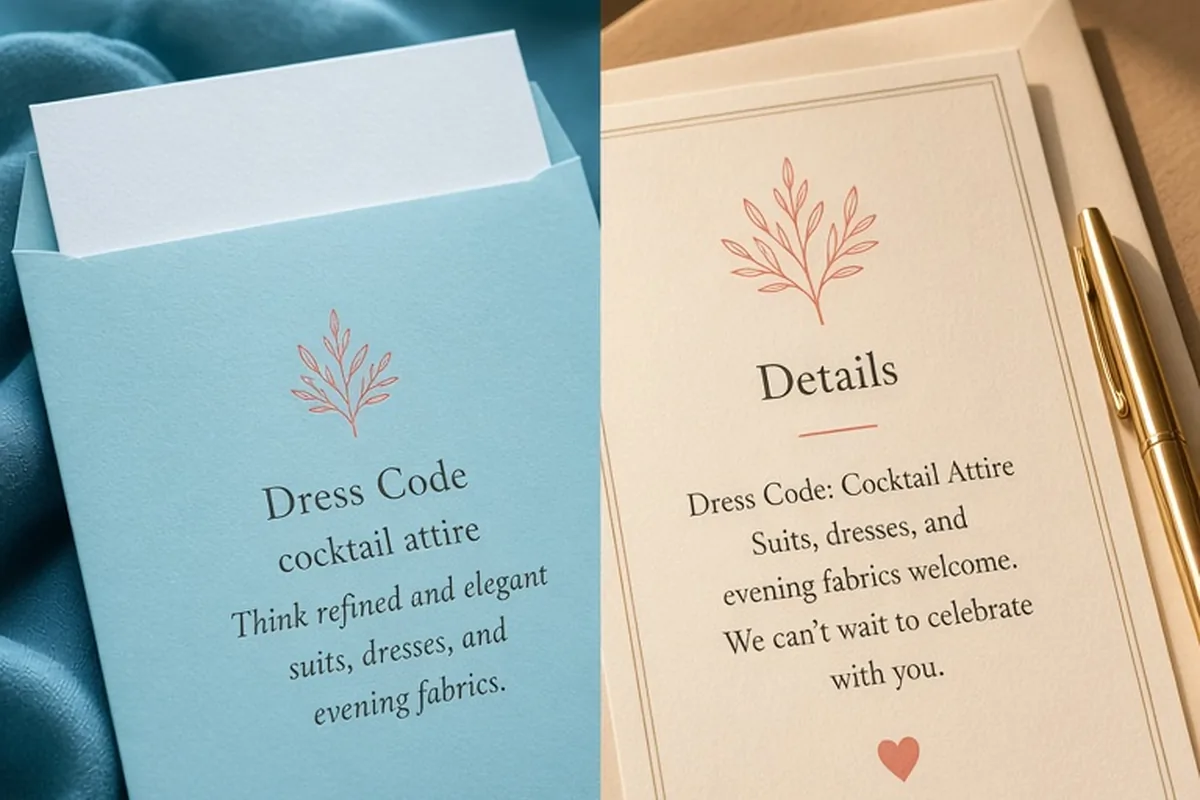
Wedding dress code wording itself carries no cost if written independently, but including it in your wedding stationery suite involves physical production, calligraphy, or professional copywriting fees. Costs depend on whether you print a dedicated details enclosure card, add custom calligraphy lines, pay for stationer typesetting proofs, or host the wording digitally on a wedding website.
Establishing the dress code for a wedding is an essential step in setting event expectations, but translating that guidance into print or digital correspondence often introduces unexpected line items to a wedding stationery budget.
Stationery Line Items and Print Methods for Dress Code Inserts
When calculating the financial impact of sharing your dress code in print, the primary expense comes from the physical paper goods used to deliver the message. Traditional wedding invitation etiquette discourages printing the dress code directly on the main formal invitation card unless the event is strictly White Tie or Black Tie. Consequently, most couples print their attire guidance on a secondary insert, typically called an enclosure card, details card, or reception card. Adding an extra physical card to an invitation suite requires budgeting for several discrete components: the paper stock, the printing plate or digital setup, ink passes, and physical cutting.
The printing method you choose significantly shapes the overall bill. Flat digital printing is generally the most economical production route because it does not require custom metal plates or individual manual press runs. In contrast, specialized print techniques such as letterpress, blind debossing, foil stamping, and thermography require specialized machinery, custom copper or magnesium dies, and skilled press operators. When you add a dress code line to a letterpress details card, you are paying for the physical plate space and the dedicated press run required to impress that ink into heavy cotton paper stock.
Paper selection also drives production variance. Standard smooth cardstock costs noticeably less than handmade deckle-edge cotton papers, thick double-ply stocks, or translucent vellum overlays. Furthermore, adding physical weight and bulk to your invitation suite can push the total envelope weight over the threshold for standard single-piece postal rates. If a heavy enclosure card causes the invitation suite to exceed standard weight or rigidity limits, you will face additional non-machinable surcharges or higher postage fees across your entire mailing list.
Professional Copywriting and Calligraphy Rates for Wedding Enclosures
Beyond the mechanical costs of printing paper, couples sometimes hire professionals to craft the exact phrasing or render the lettering by hand. Professional wedding copywriters and full-service event stationers often charge consultation or copywriting fees if you require custom wording guidance. While standard phrases like Cocktail Attire or Black Tie require no creative formulation, unique multi-event weekends, intercultural celebrations, or complex venue requirements often require tailored explanations. Copywriters typically bill either a flat fee per stationery insert or an hourly rate for creative editorial development.
If you work with an independent calligrapher to create custom titles, spot calligraphy, or entire hand-lettered cards, the fee structure differs from commercial print shops. Calligraphers charge based on the time and manual skill required to draft bespoke lettering. Spot calligraphy—where only the heading, such as Attire or Dress Code, is drawn by hand and then digitally digitized for printing—is billed as a one-time design asset fee. If you commission an artist to hand-letter each individual details card with custom metallic gouache or specialized inks, the cost scales directly with guest count, charged at a per-piece rate.
Design proofing revisions represent another potential cost variable. Most stationery designers include a baseline number of digital proofing rounds in their standard contract. If you repeatedly alter the dress code terminology, change venue notes, or adjust font pairings after the design phase has officially closed, stationers typically levy change-order fees or revision charges per additional proof cycle.
Where Dress Code Guidance Appears and How Placement Dictates Expense
The specific medium and location you select for your dress code wording determine whether your expenses are minimal or substantial. Couples generally choose between three distinct placement models: adding the dress code to the main invitation card, printing a dedicated details card, or routing guests to an online wedding website. Each pathway carries distinct cost implications, practical trade-offs, and etiquette considerations.
Placing the dress code at the bottom right or bottom center corner of the main invitation card is the most cost-effective print method because it uses existing paper stock without adding a separate printed piece. However, formal stationery etiquette strictly limits this placement to White Tie, Black Tie, and Black Tie Optional events. If your event calls for Casual, Festive, Cocktail, or Semi-Formal attire, placing those labels directly on a formal wedding invitation can conflict with traditional formatting rules, leading many couples to choose a dedicated enclosure card instead.
Using a dedicated enclosure card creates an additional production cost, but it provides ample visual space to explain attire expectations, footwear recommendations for outdoor terrain, climate details, and shuttle schedules. Alternatively, couples seeking to eliminate extra stationery costs often print a compact website enclosure card directing guests to an online landing page. On a digital platform, dress code wording can be expanded indefinitely with visual mood boards, color palettes, and seasonal advice at zero incremental printing cost.
Physical Details Cards Versus Digital Wording Alternatives
Evaluating physical stationery against digital dress code hosting requires balancing production budgets, guest convenience, and aesthetic preference. Physical cards provide a tactile, unified presentation that older guests or traditional attendees can easily reference without accessing an internet browser. However, physical paper is static; once printed, any unexpected change in venue conditions, weather contingencies, or timeline adjustments cannot be amended without funding an emergency reprint.
Digital wording hosted on a wedding website platform provides complete operational flexibility with negligible ongoing costs. Most website hosting providers and wedding planning platforms offer template pages where couples can publish comprehensive dress code definitions, visual lookbooks, and frequently asked questions. Digital platforms also permit real-time updates if an unexpected cold snap or venue policy shift requires guests to adjust their planned footwear or outerwear choices.
The practical trade-off between print and digital solutions often comes down to demographics and the formality of the event. For highly formal celebrations, relying exclusively on a website can feel informal to some guests, whereas casual or modern celebrations frequently bypass physical enclosure cards entirely. A balanced approach involves printing a single general details card with a clear URL or QR code, keeping physical print charges low while retaining the freedom to provide detailed digital attire guidance online.
Clear Dress Code Terminology to Prevent Costly Guest Confusion
Precision in dress code wording prevents misunderstandings that can disrupt your wedding day atmosphere or prompt a flood of individual inquiries that consume your planning time. Choosing established, universally recognized attire terms minimizes guest confusion and avoids the need to distribute follow-up communications or supplemental notes.
Standard categories include White Tie, Black Tie, Black Tie Optional, Cocktail Attire, Semi-Formal, and Casual. White Tie demands full evening dress, including a tailcoat and floor-length ballgown. Black Tie establishes that guests should wear traditional tuxedos and formal floor-length gowns. Black Tie Optional signals that formal tuxedos and evening gowns are preferred, but dark suits and formal midi dresses are completely acceptable. Cocktail Attire requests polished suits with ties alongside sophisticated knee-length or midi dresses.
Inventing hybrid or ambiguous categories—such as Rustic Chic, Beach Formal, Sunset Glam, or Festive Casual—frequently generates confusion. When guests cannot decipher what an ambiguous phrase means, they inevitably message the couple or wedding party for clarification, increasing stress and prompting secondary informational updates. If you have unique venue logistics, such as uneven gravel paths or grassy lawns that compromise stiletto heels, state the formal category first and add a short, functional note regarding footwear or outdoor temperatures rather than creating an unstandardized label.
How to Solicit Stationer Quotes and Avoid Hidden Reprint Expenses
To determine the exact cost of your dress code wording and enclosure printing, solicit comprehensive itemized estimates from prospective stationers or commercial printers. Requesting line-item pricing ensures you understand how much you are paying for the baseline design, paper inventory, specialized printing processes, and proof revisions before committing your budget.
Begin by asking vendors how they bill for enclosure cards of varying dimensions. Stationers frequently offer standard sizes, such as A2 or business-card-style inserts, which carry lower manufacturing costs than custom die-cut or oversized cards. Clarify whether typesetting the text of your dress code is included in the base design package or billed as a separate formatting line item. You should also confirm the exact number of digital design proofs included in your package to avoid unexpected revision fees during the drafting process.
Carefully review final digital proofs before approving the production run. Verify spelling, punctuation, capitalization, and venue details alongside your partner or wedding coordinator. Authorizing a print run with a misspelled attire category or an incorrect website address leads to expensive reprint charges, rush shipping fees, and potential postal delays. Having multiple reviewers inspect physical or high-resolution PDF proofs is the most effective safeguard against avoidable stationery expenses.
Frequently asked questions
Does adding a dress code to a wedding website cost extra money?
Adding dress code explanations to a wedding website is typically free on most standard wedding platforms. If you choose to purchase a custom domain name or hire a professional web designer to build a bespoke site, minor annual registration or design fees will apply.
Where should the dress code wording go if I do not want to buy an extra card?
If you want to avoid purchasing a dedicated enclosure card, you can place a simple Black Tie or White Tie notation in the bottom corner of the main invitation. For other dress codes, printing a short wedding website link on your reply card or main suite allows guests to read the attire guidance online without adding extra paper pieces.
Why do stationers charge revision fees for simple wording changes?
Stationers allocate dedicated design time to format typography, adjust line spacing, and prepare print-ready press files for each revision. Once proof files are generated or physical printing plates are ordered, any subsequent text change requires redesigning files and remaking manufacturing tools, which incurs real labor and material costs.
Your next step
Draft your preferred dress code phrasing alongside your venue logistics notes, then request an itemized quote from your stationer comparing the cost of a dedicated enclosure card against a compact website card.